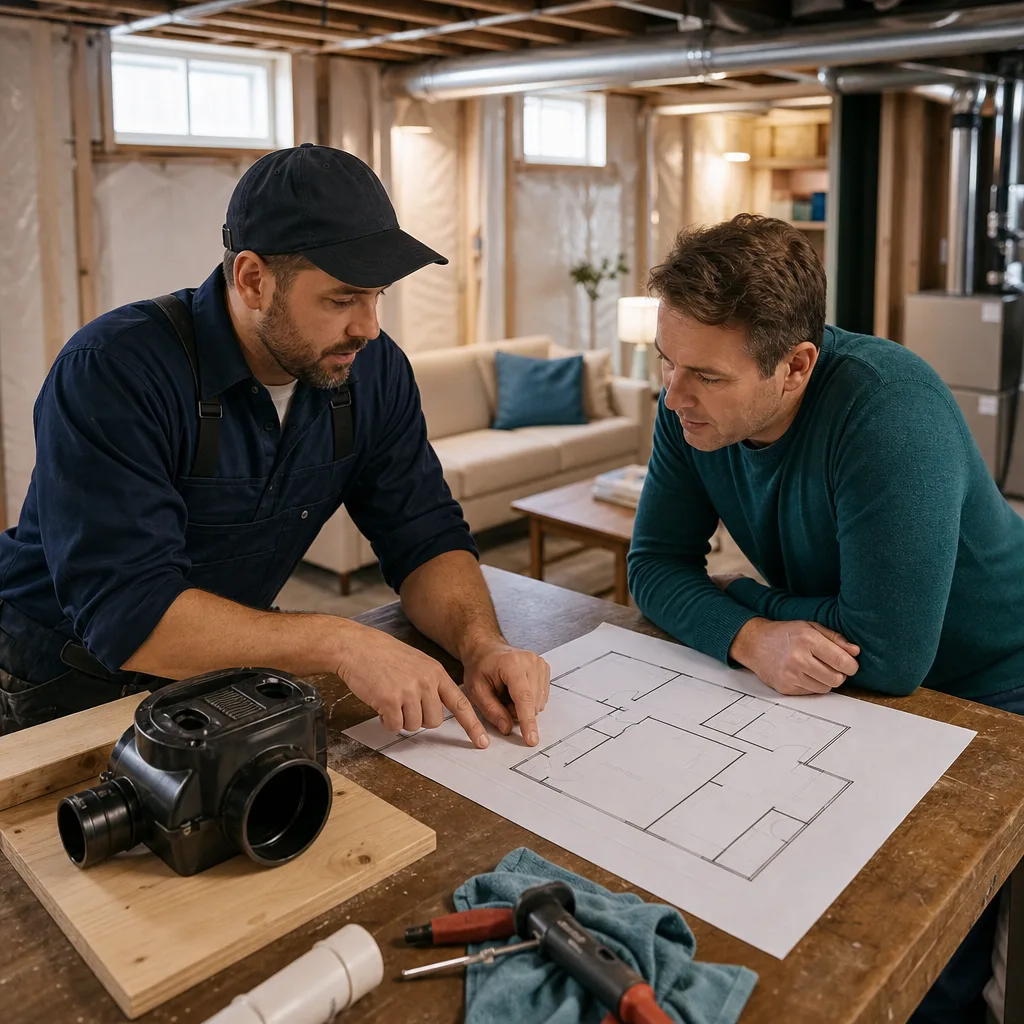
Hintonburg’s compact blocks, older building stock, converted dwellings, infill and busy Wellington Street West setting make documentation and access central to backwater-valve planning. An address may have passed through additions, basement lowering, unit conversion or service work that is not obvious from the façade. The only responsible starting point is the building’s actual drainage and ownership record.
A sanitary backwater valve permits normal outward flow and closes against reverse flow. Correctly designed, it may reduce one route by which sewage reaches low fixtures. It does not prevent foundation seepage, surface entry, a plumbing leak, roof-water problems, sump failure or an obstruction on the private line. This guide focuses on investigation and decisions, not do-it-yourself installation, and makes no claim that any local property has a particular sewer arrangement.
Reconstruct the drainage history of the Hintonburg house
Start with permits, renovation plans, old invoices and a list of basement fixtures. Identify additions, secondary units and previous floor lowering. A pipe that once served one household may have branches added later; conversely, an apparent floor drain may not reveal the route expected from the original plan. House age is context, not a diagram.
Record prior incidents carefully: which opening was first affected, whether water contained waste, what fixtures were slow and whether clear water also entered at walls or windows. Safe photographs and dates can support diagnosis. Do not enter contaminated or electrically unsafe spaces to collect evidence.
Resolve ownership and multi-unit questions first
Hintonburg includes detached homes, semis, converted buildings, rentals and condominiums. Before invasive work, determine who owns the slab and building drain, whether multiple units discharge through it, and who has authority to obtain permits. Tenants should report concerns to the owner; condominium owners should seek written corporation direction.
A valve selected for one unit must not create an unexamined consequence for another. Shared drainage may require broader design review. Ask for available building plans and have a qualified professional explain which fixtures and units are upstream of a proposed location. Resolve ambiguity before asking a contractor to price concrete cutting.
Use camera locating to minimize disruptive exploration
Where a finished basement, party wall or narrow lot limits options, camera and locating work can reduce guesswork. The plumber can document accessible pipe interiors, direction, branches and some defects, then relate the route to the floor. Request footage and a clear explanation of the proposed protection zone.
A camera cannot see through deposits or standing water and does not certify hidden joints or the public sewer. If roots, displacement, heavy buildup or other concerns appear, ask whether cleaning, repair or additional investigation comes first. A valve is not a substitute for correcting an obstructed private drain.
Plan urban access, dust and restoration before excavation
A compact property may offer limited parking, material staging and routes to a basement. The quote should identify how equipment enters, where debris goes, how common halls and neighbours’ property are protected, and whether municipal street or parking permissions are relevant. Do not assume a plumbing permit authorizes occupation of public space.
Inside, clarify flooring removal, dust isolation, protection of contents, working hours and final cleaning. Ask whether older finishes need hazardous-material assessment before disturbance. Plumbing completion, concrete patching and decorative restoration may be separate scopes; record their boundaries instead of relying on a verbal promise.
Make the City permit a design checkpoint
Ottawa’s protective-plumbing FAQ states that a building permit is required. Confirm current submission and inspection requirements with the Building Code Client Service Centre or 3-1-1. The agreement should assign application, review-response and inspection-booking duties and state what remains exposed.
A qualified professional should choose an approved device and installation that protects intended fixtures, avoids inappropriate bypasses and preserves service access. Do not cut drains or excavate below a slab yourself: sewage exposure, buried services, structural conditions and incorrect orientation create serious risks. Keep the installation visible until City inspection permits closure.
Related reading
Separate heritage of place from rebate eligibility
An older-looking Hintonburg property is not automatically eligible for Ottawa’s Residential Protective Plumbing Program. The City publishes construction-date and other conditions, eligible measures, application requirements and maximum amounts. It currently pays the lesser of eligible cost or the stated maximum, subject to its decision.
Confirm the municipal address, legal property type, construction evidence, prior protective plumbing and approval sequence directly with the City. Conversions and multi-unit situations warrant explicit clarification. Save estimates, correspondence, permits, inspection records, paid itemized invoices, model details and photos. No installer can guarantee approval or funding.
Related reading
Compare quotes by protected fixtures and complete scope
A proposal should name the device, exact location, investigation, protected fixtures, permit, inspection, concrete work, testing, cleanup, access cover and restoration boundary. Request a sketch. Ask what conditions could trigger a change order after opening an older floor and require written authorization for additional work.
The cheapest apparent valve price may exclude the work most important in a finished urban basement. Compare equivalent scopes, access and serviceability. Ask what occupants must do during drain shutdown and where they can safely remain. Reject claims that a valve makes the property floodproof.
- Confirm branch layout and any fixtures outside protection.
- Identify party-wall, common-area or tenancy approvals.
- Separate plumbing, concrete and finish warranties.
- Preserve a readily removable service cover.
Related reading
Keep roof, yard and foundation water in the assessment
On a compact lot, downspout routing, paving and grading can change over time. Observe where roof and surface water travel without redirecting it onto a neighbour or public sidewalk. Clear water at a wall or window requires a different investigation from wastewater at a drain.
If the building has a sump, evaluate pump reliability, discharge and backup power separately. A sanitary valve and sump pump perform different jobs. The correct plan may include several measures, but every recommendation should identify the specific pathway it addresses.
Related reading
Teach every occupant how closure changes plumbing use
When a sanitary valve closes against reverse flow, wastewater generated inside cannot pass normally. Stop flushing, bathing, laundry, dishwashing and other discharge until the condition clears. In a multi-unit building, instructions must reach every affected occupant or one unit can cause an upstream overflow.
Keep access clear and follow the manufacturer’s and plumber’s maintenance directions. Inspection checks model-specific movement, seating and debris; schedule also depends on conditions. Arrange service after a backup or abnormal drainage. Never reach into contaminated equipment without appropriate professional controls.
Related reading
Create a durable record for insurance and resale
Ask the insurer before work about sewer-backup coverage, unit or rental implications, deductibles, exclusions and maintenance evidence. A City permit or rebate does not guarantee coverage, premium treatment or payment after a loss.
Retain the approved scope, permit, inspection result, invoice, photographs, device manual and maintenance log. Provide required information to co-owners, the corporation or future buyers. Describe the protection accurately and never imply that all basement water pathways are controlled.
Use older-home checkpoints without generalizing the block
An older urban floor can conceal multiple repair eras. Before work, ask how the contractor will respond to unidentified pipe material, abandoned branches, a thin or irregular slab, or a condition outside the plumbing scope. These are possibilities to manage, not claims about a Hintonburg house. A pre-construction walk-through should identify visible cracks, finishes and contents so later responsibility is clear.
Confirm that the proposed access remains useful after restoration. A beautifully matched floor that requires destructive removal for every inspection defeats long-term serviceability. Review cover dimensions, clearance, furniture layout and any sound or fire separation that applies to a multi-unit building. Where specialized finish work is needed, coordinate that trade before plumbing starts.
Plan information flow in a converted or rented building. Name the person who can authorize changes, receive City inspection updates and tell all occupants when plumbing is unavailable. Provide notices in a durable, understandable form. A valve may serve piping used by people who never see the basement access, so operating instructions cannot remain with one owner.
At completion, reconcile the original sketch with what was found. Record changed branch assumptions, protected fixtures and known exclusions. Keep photographs taken before concealment, if allowed, with the permit and invoice. This as-built record will be more useful to a future technician than a generic statement that a valve exists.
Schedule the first maintenance discussion at handover rather than choosing an arbitrary interval online. The installer should point to the manufacturer’s instructions and conditions that warrant earlier service. Add reminders to the property calendar, and treat abnormal drainage or a backup as a reason for prompt inspection.
Keep street work and private work clearly separated
A dense urban setting can make an underground route appear inseparable from the street, but authority and responsibility still need to be established. Ask the City and plumber where the observed concern lies and what evidence locates it. Do not assume that a symptom at a basement drain proves a defect in municipal infrastructure, or that a problem near the frontage is automatically private.
If equipment, bins or vehicles may affect a sidewalk, roadway or parking space, identify required permissions separately from the plumbing permit. A building permit does not necessarily grant use of public space. Plan lawful staging before the crew arrives so access pressure does not drive an improvised arrangement.
Coordinate with neighbours where shared access, a party wall or common drainage is genuinely involved, while protecting personal information. Neighbour accounts can help establish timing but cannot diagnose the pipe. Professional evidence and official records should drive design.
Where an investigation expands beyond the original valve scope, pause and issue a revised written plan. State the new objective, responsible party, approvals, cost and restoration. Separating private repair, public inquiry and protective plumbing prevents one unresolved issue from being hidden inside another contract.
Preserve all correspondence with dates and contact names. In an older property with several past alterations, a clear contemporary record is an asset even if the final decision is monitoring rather than immediate construction. Include the evidence supporting that decision and a practical, documented trigger for timely reassessment.
Hintonburg backwater valve FAQ
Does an older Hintonburg house automatically need a valve?
No. Age makes records and pipe condition worth investigating, but it does not establish reverse flow or a suitable installation. A qualified plumber should map the actual drain and evidence.
Can one valve protect both units in a converted dwelling?
Possibly, but never assume it. A professional must map shared and separate branches, fixture elevations and ownership, and the authorized owner must obtain required approvals.
Will installation solve roots or a collapsed service?
No. A valve does not repair an obstruction or damaged pipe. Camera findings may indicate cleaning, repair or further investigation before protective plumbing is considered.
Does Hintonburg work require an Ottawa permit?
The City FAQ says protective-plumbing installation requires a building permit. Verify current requirements and keep work exposed for the required inspection.
Is the rebate guaranteed because the building is old?
No. The City decides using all current eligibility and documentation rules. Building appearance is not proof of construction date, and listed maximums are not guaranteed payments.
Can fixtures be used while a valve is closed?
No. Wastewater can accumulate on the house side and overflow. All affected occupants should stop plumbing use until safe normal drainage is confirmed.
What access should remain after new flooring?
A durable, removable cover with the clearance needed for inspection and cleaning. Do not conceal it under fixed cabinetry, appliances or permanent flooring.
Sources and official references
- City of Ottawa — Wellington Street West Secondary Plan
- City of Ottawa — Residential Protective Plumbing Program
- City of Ottawa — protective-plumbing FAQ
- City of Ottawa — sewer connection by-law
Programs, permits and bylaws change. Confirm current requirements with the City of Ottawa before acting.
Questions about your Hintonburg home?
Ask a local plumber, without pressure.
Requests are sent to Lister Plumbing, who serve homes across all Ottawa areas listed here. A request is not a commitment, and no price is promised before someone looks at your plumbing.