
In this guide10 sections
- 01Protection and restriction happen together
- 02Reduce water use while drainage may be blocked
- 03Recognize the limits of a valve
- 04Understand why timing and behaviour vary
- 05Do not force the flap or remove the cover
- 06Respond safely to wastewater or a suspected backup
- 07Call the right professional and explain the symptoms
- 08Plan for normal use to resume only when appropriate
- 09Review installation and permit information after the event
- 10Treat the valve as one part of household preparedness
- ↗Official references
Before you begin
The practical consequence of a closed valve: reverse flow may be limited, while wastewater from the home may temporarily have nowhere to go.
Protection and restriction happen together
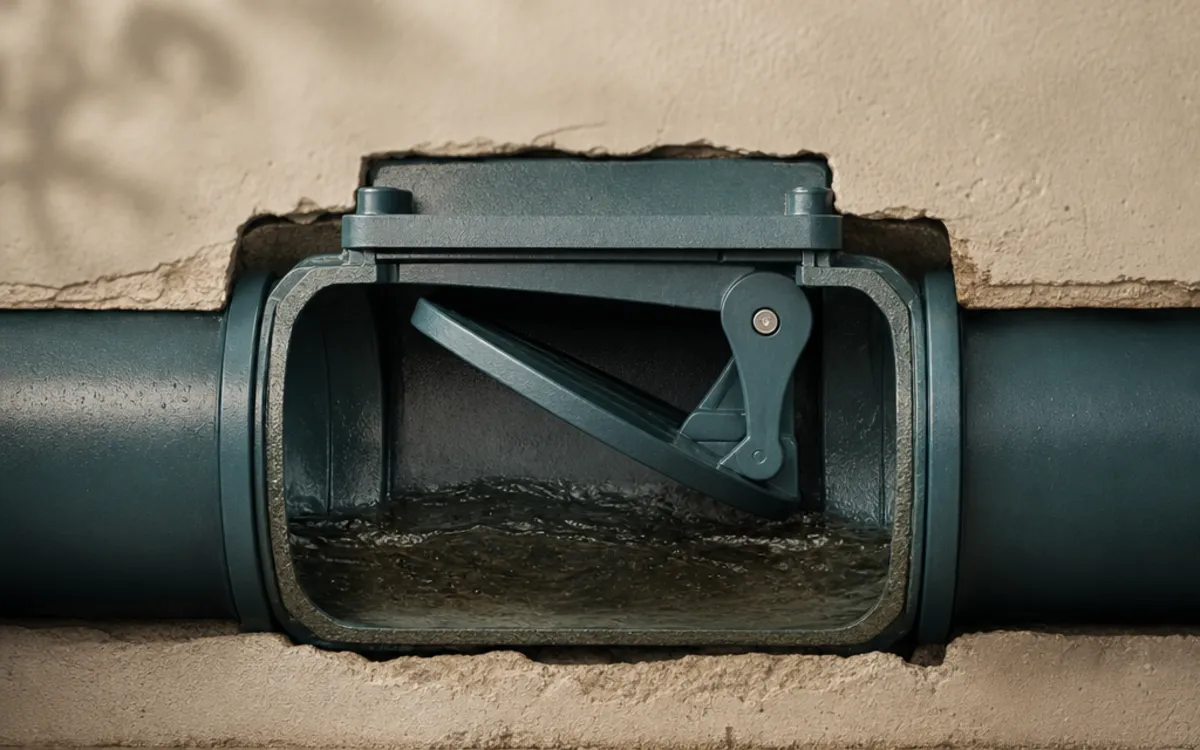
A backwater valve is designed to allow normal drainage in the intended direction and to limit reverse flow when water or pressure moves back toward the building. In a typical arrangement, a moving closure component responds to that reverse condition. When it closes, it may reduce a pathway for sewer water to enter through the connected drain. The precise behaviour depends on the actual device, its installation, the connected piping, and the conditions in the sewer; no online description can confirm what a particular valve is doing.
The same closure can restrict wastewater leaving the home through the protected line. Toilets, sinks, showers, laundry, and other connected fixtures may not be able to discharge normally until the reverse pressure subsides and the valve can reopen. This is why a closing valve is not simply a one-way shield with no household consequences. Do not interpret closure as proof that the system is safe to use normally or as proof that the valve has failed.
Points to carry forward
- Closing may limit reverse entry and also block outward discharge.
- The actual response depends on the installed equipment and conditions.
- Do not assume a closed valve has failed or is safe to override.
Reduce water use while drainage may be blocked
If you suspect the valve has closed during a sewer backup, stop adding water to plumbing fixtures served by the affected line. A toilet flush or running tap can send more wastewater into piping that may have nowhere to drain. The effect can vary by the home’s layout and which fixtures connect through the valve, so avoid assuming that an upstairs fixture is unaffected. Explain the situation to a qualified professional and ask which household uses should pause until the condition is assessed.
Do not test the valve by repeatedly flushing, running a washing machine, or filling a tub. Such experiments add volume and can create an overflow if the drain is restricted. If you are unsure whether the symptoms are related to the valve, a cautious reduction in water discharge while seeking advice is safer than trying to prove the mechanism’s state. Tell household members what to avoid, and do not use drains as a way to dispose of standing water or cleaning products during the suspected event.
Points to carry forward
- Pause water use on affected fixtures while a restriction is suspected.
- Do not flush or run appliances to test whether the valve has reopened.
- Ask a professional which fixtures share the protected piping.
Recognize the limits of a valve
A valve protects only the drainage path and area for which it was installed; it does not control every route by which water can enter a basement. The device may limit reverse flow through a connected sanitary drain, while water could still enter through a storm connection, floor or foundation opening, surface runoff, or a failed sump system. If water is present, the location and sequence matter, but appearance alone may not identify its source. A valve’s presence is not evidence that every flood risk has been addressed.
Sanitary wastewater backflow, storm-water surcharge, foundation seepage, and sump-pump discharge or failure are distinct concerns. A qualified assessment should identify the system involved before recommending a fix. Keep children and pets away from contaminated water, avoid direct contact, and follow appropriate health and municipal guidance. Do not assume that a closed sanitary valve caused unrelated water at a wall or that opening it will make that water drain safely.
Points to carry forward
- Protection is limited to the connected piping and intended flow path.
- Distinguish sanitary backflow from storm, seepage, runoff, and sump issues.
- Treat unknown or contaminated water as a safety concern, not a test opportunity.
Understand why timing and behaviour vary
A valve may close in response to reverse-flow conditions, but homeowners should not expect a specific duration, sound, or visible signal. Sewer conditions can change, and the assembly may not be exposed or observable during an event. Different models and installations can behave differently. A valve might reopen when conditions permit, but only a professional familiar with the system can evaluate whether it is moving and draining as intended. A brief symptom or the absence of an obvious sound does not establish the device’s condition.
Record when fixtures slowed or stopped, which drains were involved, whether there was an odour or visible water, and when conditions changed. Also note relevant household water use and external conditions, without drawing a firm causal conclusion. This timeline is useful to a service provider or municipal contact. Avoid stating that the valve definitely closed unless it was reliably observed. A symptom can also reflect a blockage, a different plumbing issue, or a problem farther along the sewer route.
Points to carry forward
- Do not expect a standard duration, sound, or visible indication of closure.
- Record a careful symptom timeline without claiming an unverified mechanism.
- Consider other drain and sewer causes during professional assessment.
Do not force the flap or remove the cover
Forcing a flap open during reverse flow can defeat the protection it is intended to provide and may expose a person to wastewater. Forcing it shut can damage the mechanism or prevent normal drainage after conditions change. Removing a cover during a suspected backup can also expose occupants to contaminated water, odour, or moving parts. Do not wedge the assembly, insert tools, or reach into the opening to find out whether a component has moved.
If access is stuck, damaged, or unsafe, leave it alone and call a qualified plumbing professional. Give a clear description of the symptoms and state that a backup may be active so the person can plan appropriate precautions. A picture taken from a safe distance may help describe the surrounding area, but never place yourself at risk to obtain it. Follow emergency and public-health advice when there is active contaminated water or danger to people, and keep vulnerable occupants away from the affected area.
Points to carry forward
- Never force, wedge, or manually restrain the moving component.
- Do not open an unsafe access point during suspected active backup.
- Describe the possible backup when requesting professional service.
Respond safely to wastewater or a suspected backup
If wastewater is present, prioritize people over troubleshooting. Keep occupants and pets away from the affected area and avoid touching water or contaminated materials. Do not operate electrical equipment while standing in water or enter a space where electrical hazards may exist. If there is an immediate threat to life or property, use appropriate emergency services; for municipal sewer concerns, follow the City’s current reporting guidance. A plumber can assess private plumbing, but not every incident is solely a private-valve problem.
Avoid flushing, sweeping, or pumping contaminated water without appropriate direction and protective measures. Do not mix cleaners or use chemicals in the valve. If the water source is uncertain, state that clearly when asking for help and explain where it first appeared. The City’s wastewater information provides general context, not incident-specific instructions. Follow relevant local health guidance for cleanup and contact qualified remediation support if the affected area cannot be handled safely.
Points to carry forward
- Keep people and pets away from suspected contaminated water.
- Avoid electrical hazards and do not enter an unsafe flooded space.
- Use appropriate emergency, municipal, plumbing, and health guidance as needed.
Call the right professional and explain the symptoms
When asking for service, describe which fixtures are affected, what changed, when it began, whether water or odour is present, and whether the condition is continuing. Tell the professional that a backwater valve is installed if you know that, and identify whether it serves sanitary or storm piping if records establish this. Share the permit, model, and previous service information when available. Avoid directing the person to a conclusion such as “the flap is stuck” unless that has been verified.
Ask what the inspection will cover, what access is needed, whether the work may expose wastewater, and what the professional will do if the problem is beyond the valve. Ask whether any permit or follow-up testing applies to proposed repairs. A qualified plumber can assess the building’s plumbing and valve; a municipal contact may be relevant if a public sewer condition is suspected. Keep the roles distinct and retain a written account of findings, work performed, and recommended next steps.
Points to carry forward
- Share a timeline, affected fixtures, visible conditions, and known equipment details.
- Ask what will be inspected and how a different cause will be considered.
- Keep service findings and recommendations in the home record.
Plan for normal use to resume only when appropriate
Do not assume the valve has reopened merely because a fixture briefly drains, an odour fades, or standing water stops rising. Conditions in the sewer and the device can change, and the installation may not offer a direct indicator. Ask a qualified professional whether the restriction has cleared and whether the affected plumbing can be used normally. If the professional advises that some fixtures remain out of use, follow that advice until the reason is resolved.
Once service is restored, resume water use sensibly and avoid sending unnecessary solids, grease, wipes, or other inappropriate material into drains. Follow the product’s operating instructions and the professional’s recommendations for inspection. Record the event, including the symptoms and response, without turning one incident into a prediction about future risk. If recurrence occurs, a history of dates and conditions can help determine whether the valve, private sewer, public sewer, or another source deserves further investigation.
Points to carry forward
- Get qualified guidance before assuming unrestricted drainage has returned.
- Follow any temporary limits on fixture use or follow-up inspections.
- Document the event and report recurrence rather than guessing at its cause.
Review installation and permit information after the event
A repeated or confusing event may be a reason to review the installation records and confirm that the valve’s intended role is understood. Locate the product details, permit records, drawings, and prior service reports. Ask a professional to explain which fixtures discharge through the valve, what the assembly is designed to protect, and whether access is adequate for safe service. If the device’s purpose or connected piping cannot be established from records, have it traced instead of inferring its layout from the visible cover.
The City’s backwater-valve permit page provides municipal information about permits, while the City wastewater education page explains general sewer concepts. Neither page is a substitute for assessing a specific property or confirming a valve’s operation. Check with the City about current permit requirements before changing the assembly or connected piping. An event alone does not prove that installation was faulty or that a particular upgrade is necessary; base any proposed alteration on documented findings and applicable requirements.
Points to carry forward
- Gather valve model, permit, layout, and service information for review.
- Ask which fixtures and piping the actual assembly protects.
- Verify current permit requirements before alterations or replacement.
Treat the valve as one part of household preparedness
A backwater valve is one protective measure, not a substitute for a household plan or comprehensive drainage assessment. Know where its access point is, keep records available, and ensure household members understand that fixture use may need to pause if a suspected backup closes the route. Keep important contact details accessible. Ask a qualified professional what warning signs apply to the installed equipment and what actions are safe, rather than adopting a generic emergency procedure that may conflict with the specific assembly.
If the property has recurring water, have the pathway assessed broadly. Discuss sanitary and storm connections, foundation conditions, surface grading, and sump equipment as relevant, rather than presuming one device addresses all concerns. The City’s current protective plumbing and wastewater information can help explain municipal programs and concepts, but individual eligibility and plumbing behaviour require specific review. A calm, documented response protects people and gives service providers better information without implying certainty that the valve or sewer will behave in a particular way.
Points to carry forward
- Keep access, records, and appropriate contacts known to household members.
- Ask for model-specific safe steps rather than relying on a generic emergency script.
- Include other water pathways in assessment when symptoms warrant it.
Further reading
Official references
Rules and program details can change. Check the current source before making a decision about work on your home.
Continue reading
The next useful question.
When the question is about your home
An on-site conversation can clarify what a general guide cannot.