
In this guide10 sections
- 01Sanitary versus groundwater
- 02What a backwater valve is intended to do
- 03What a sump pump is intended to do
- 04Diagnose the pathway before selecting equipment
- 05Assess the two systems independently
- 06Compare maintenance without conflating it
- 07Plan for power, capacity and limitations
- 08Review installation, records and municipal questions
- 09Questions to ask when comparing recommendations
- 10Use a layered, evidence-based plan
- ↗Official references
Before you begin
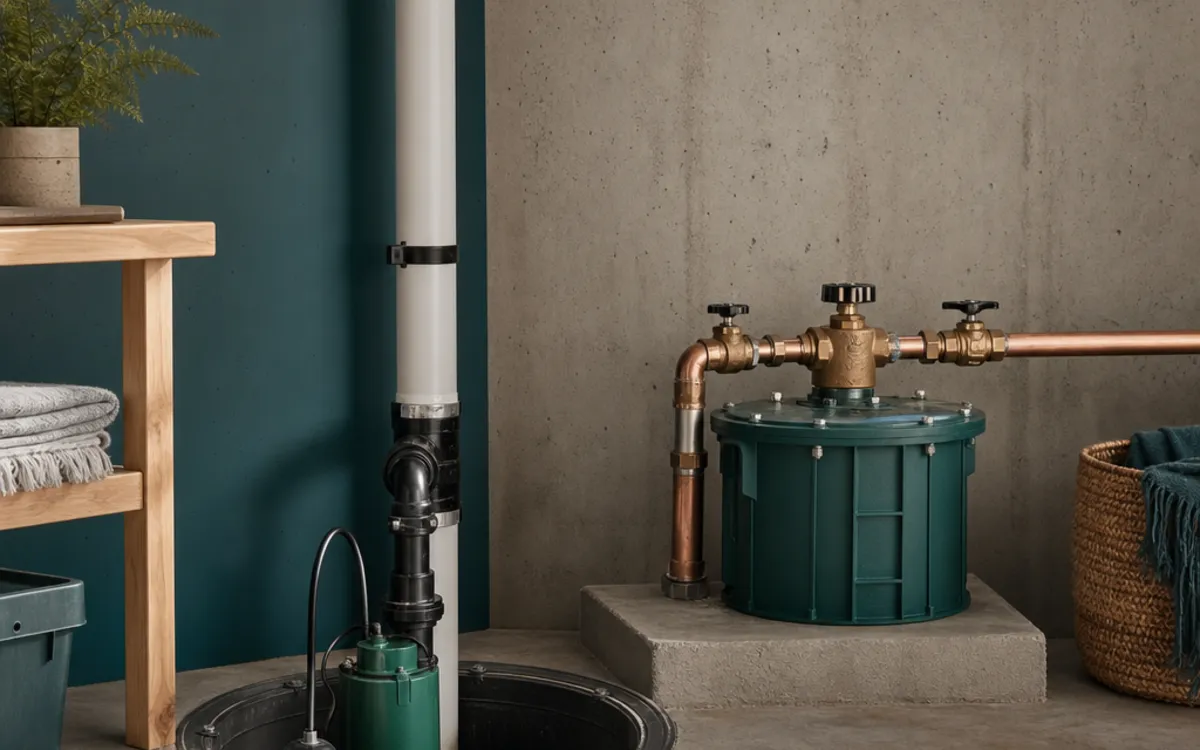
A side-by-side explanation of two systems that address different water pathways in a home.
Sanitary versus groundwater
A backwater valve belongs to the sanitary drainage conversation. Installed in an appropriate sanitary drainage path, it is intended to limit reverse flow under certain conditions. A sump pump moves water that has collected in a sump basin, commonly in connection with foundation drainage. The two devices serve different pathways and respond to different conditions, even though both may be discussed after someone finds water in a basement.
A basement-water report is not enough to choose between them. Water may enter through a sanitary fixture or floor drain, seep through a foundation, arrive as surface runoff, result from a plumbing leak, or involve more than one source. Stormwater and foundation drainage should not be assumed to be sanitary wastewater. Start by asking which pathway is suspected and what observations support that view. Only a qualified assessment of the home can connect observations to a specific repair or device.
Points to carry forward
- Ask which water pathway is being investigated before comparing devices.
- A sump pump does not substitute for a sanitary backflow solution.
- A backwater valve does not pump groundwater out of a foundation.
What a backwater valve is intended to do
In normal conditions, wastewater leaves the home through the sanitary building drain. A backwater valve is placed in a suitable part of that path so a moving component can restrict reverse flow toward the building when conditions cause backpressure. The exact design, location and protected branches matter. The name alone does not tell a homeowner which fixtures are connected, what the assembly looks like, or whether it is appropriate for a particular property.
When the valve closes, it may also prevent wastewater from the home from draining normally until the condition changes. That operational limitation is important: household water use during a closure can create a problem inside the building. A valve is not a pump, a check of the whole sewer system, or a guarantee against all sewer-related events. Have a qualified plumber explain the actual installation, affected fixtures, access requirements and response if the valve closes or appears obstructed.
Points to carry forward
- Ask which fixtures and branches are protected by the actual valve.
- Understand that a closed valve can restrict the home's own drainage.
- Do not treat the device as protection against every water event.
What a sump pump is intended to do
A sump system collects water in a basin and uses a pump to move it to a discharge location. Depending on the home's design, it may be associated with groundwater or foundation drainage. The basin, float or control, power supply, pump, discharge piping and permitted discharge destination all matter. A pump that runs does not automatically prove the water source has been identified, and the visible basin alone does not establish how the foundation drainage is connected.
A sump pump does not stop a reverse flow of sanitary wastewater through a toilet or floor drain. Conversely, a sanitary backwater valve does not remove water from a sump basin or correct a foundation seepage problem. Ask a knowledgeable professional to identify the installed system and explain where its water goes. Never assume a discharge hose can be routed anywhere convenient; local requirements and the system design govern. Keep the basin accessible and follow equipment-specific service instructions rather than improvising repairs.
Points to carry forward
- Identify the pump, basin, controls and discharge route as a system.
- Ask where water is directed and whether that route is appropriate.
- Do not use a sump pump as a sanitary sewer backup remedy.
Diagnose the pathway before selecting equipment
A useful first assessment records the location and pattern of water without overstating what it proves. Note whether water appeared at a plumbing fixture, floor drain, foundation joint, wall, sump basin or another location. Record timing, weather, household plumbing use and whether the sump pump was operating, if known. These details can help a professional ask better follow-up questions; they are not a do-it-yourself diagnosis and do not establish whether water was sanitary, storm-related or groundwater.
Keep people away from potentially contaminated water, and do not touch electrical equipment in a wet area. If a safety hazard or active sewage release is present, prioritize appropriate emergency and professional help. After immediate safety concerns, arrange an assessment that considers the sanitary piping and foundation drainage separately. Avoid buying a device because a symptom sounds familiar. A wrong-pathway fix may leave the actual cause unchanged while creating a false sense that the basement is protected.
Points to carry forward
- Write down where water appeared, when and under what conditions.
- Treat observations as clues for a professional, not a diagnosis.
- Keep clear of contaminated water and wet electrical equipment.
Assess the two systems independently
A home may have both systems, one, or neither, and their access points can be in different parts of the basement. For the sanitary side, ask where the building drain and cleanouts are, whether a valve is present, which branches it affects, and how its cover can be serviced. For the sump side, identify the basin, pump controls, discharge route and any backup equipment. Do not open a cover or operate unknown components just to confirm what they are.
Separate assessments make it easier to identify missing information. A plumber may be appropriate for sanitary piping questions, while foundation drainage or water-entry concerns may need a professional with relevant expertise. Ask each person to explain the limits of their review and what other assessment may be needed. A map with confirmed facts and clearly marked unknowns is more useful than a single label such as “flood system,” which can blur unrelated plumbing and water-management functions.
Points to carry forward
- Document valve access and sump equipment as separate systems.
- Ask what the inspection did and did not establish.
- Mark unverified pipe connections as unknown on the home map.
Compare maintenance without conflating it
The maintenance tasks differ because the components and failure modes differ. A sanitary valve needs accessible inspection and attention to its moving parts under appropriate professional or manufacturer guidance. A sump system may require attention to the basin, pump operation, controls and discharge piping. The correct interval and procedure depend on the installed model, local conditions and professional advice; a broad online schedule cannot substitute for the equipment instructions.
Keep records of servicing and changes for both systems, but do not combine them into one vague annual “flood check.” A pump test does not test a backwater valve, and a valve inspection does not confirm that a sump discharge is clear. Ask what household checks are safe, which work requires a professional and what symptoms should prompt service. Never force a valve open, bypass a pump control or disconnect piping based on an illustration. If an unusual noise, recurring alarm or visible damage appears, describe it to a qualified service provider.
Points to carry forward
- Use model-specific instructions for each system's maintenance.
- Record valve service and pump checks separately.
- Do not force, bypass or dismantle unfamiliar equipment.
Plan for power, capacity and limitations
A sump pump depends on its power source and on water reaching the basin; it cannot address water that follows another route. A household considering backup power or a secondary pump should ask a qualified provider to assess compatibility, capacity, alarms and safe discharge arrangements. Backup devices have their own limitations and need suitable maintenance. No general guide can confirm that a particular pump setup will handle a site's conditions or a specific storm event.
A backwater valve has a different limitation: when it closes against reverse flow, the home's own sanitary drainage may also be restricted. Household use of plumbing fixtures while the valve is closed could cause wastewater to back up within the home. Ask the installer to explain how occupants would know there is a concern and what safe next steps apply to the installed system. Neither a battery-powered pump nor a sanitary valve should be presented as complete flood protection. Planning should describe the separate risks each measure may reduce and the conditions it cannot control.
Points to carry forward
- Ask what happens to each system during a power interruption.
- Confirm any backup equipment is compatible and maintained.
- Discuss safe household response if sanitary drainage is restricted.
Review installation, records and municipal questions
Whether a backwater valve can be installed, where it belongs and what work is required depend on the home's plumbing layout and current requirements. The City of Ottawa's official information is the starting point for permit questions, but it is not a substitute for confirming how municipal rules apply to a particular scope. Ask the contractor to describe the proposed work and who will determine permit and inspection responsibilities. Keep approvals and inspection records when applicable.
Sump systems also need a suitable design and discharge path; do not assume the discharge can be connected to a sanitary line or routed outdoors without checking requirements. Ask the professional to identify the intended destination and any relevant restrictions. Store plans, equipment details, invoices and service records for both systems. If the home changes hands, clear records can help a future owner understand what exists without assuming that a device is functional just because it appears on a plan.
Points to carry forward
- Check current City permit information for proposed valve work.
- Ask how sump discharge is routed and what rules apply.
- Keep equipment information and service records for each system.
Questions to ask when comparing recommendations
When two recommendations sound similar, ask each provider to state the water pathway they are addressing and the evidence behind that assessment. Ask what the proposed device will do, what it cannot do, which parts of the home it affects and how it will be maintained. Request an explanation of access needs, likely disruption, permit responsibilities and records. A useful answer should distinguish sanitary drainage from foundation water rather than treating all basement moisture as one plumbing problem.
Be cautious if a recommendation promises that one device will prevent basement flooding, or if it does not explain how the home-specific layout was reviewed. Ask whether another professional or a separate inspection is appropriate. The purpose is not to reject a recommendation automatically, but to understand its assumptions before authorizing work. A written scope with limitations and follow-up steps is easier to compare than a product name or a broad assurance.
Points to carry forward
- Which water pathway does this recommendation address?
- What evidence and home-specific layout support the proposal?
- What remains unprotected, and how is the equipment serviced?
Use a layered, evidence-based plan
The right plan may involve plumbing work, foundation or surface-water measures, maintenance, household preparation, or simply better records. It should follow the assessed pathway rather than begin with an assumption that every basement needs the same equipment. Separate the tasks into sanitary drainage, sump and foundation drainage, roof runoff and grading, and household safety. That structure makes it easier to assign each question to someone with relevant knowledge.
Ottawa's wastewater education and backwater-valve permit pages can help with general municipal context, while the property-specific decision remains dependent on the home and current rules. A professional assessment is not a guarantee against future water events; it is a way to understand conditions and options. Revisit the plan after renovation, a water incident or a change in equipment. By keeping the two systems distinct and recognizing their limitations, homeowners can make informed comparisons without confusing a sump pump with a sanitary backflow device.
Points to carry forward
- Build separate action lists for sanitary and foundation-water concerns.
- Reassess after alterations, observed water or equipment changes.
- Treat every device as one limited measure, not a flood guarantee.
Further reading
Official references
Rules and program details can change. Check the current source before making a decision about work on your home.
Continue reading
The next useful question.
When the question is about your home
An on-site conversation can clarify what a general guide cannot.