
In this guide07 sections
- 01Sump pump warning signs to note
- 02Put electrical safety before any repair check
- 03What to observe before requesting service
- 04What a sump pump repair visit may assess
- 05Repair or replacement depends on the actual system
- 06Keep sump-pump work separate from sewer-backup work
- ↗Common questions
- ↗Official references
Before you begin
A safety-first Ottawa guide to recognizing sump-pump trouble, documenting symptoms and deciding what to ask before repair or replacement.
Sump pump warning signs to note
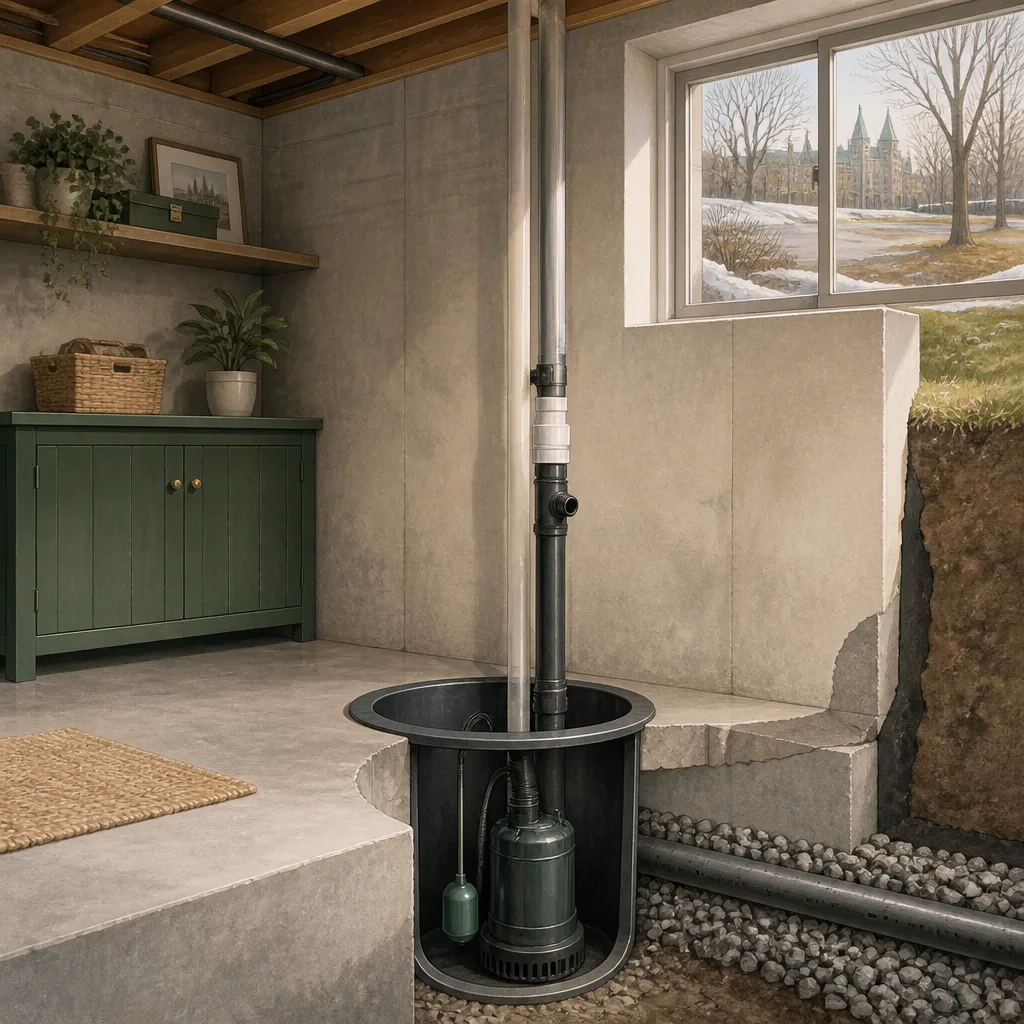
A sump pump problem often shows up as a change from the system’s usual behaviour. The pump may not start as water collects, may run for an unusually long time, or may switch on and off repeatedly. A new hum without the familiar pumping sound, grinding or rattling, a high-water alarm, or water visibly rising in the basin are useful observations to report. None of these signs identifies a failed part by itself: a control, power issue, obstructed discharge, incoming water or another condition can produce overlapping symptoms.
The location of the water matters too. A damp wall, water at a floor drain, and a rising level inside the sump pit are not interchangeable clues. Water outside the basin does not automatically mean that the pump is broken, and a quiet pump does not prove the basin is dry. If water is entering elsewhere, use the basement flood assessment guide to record the location and timing without treating those observations as a diagnosis. Keep people and pets away from water that may be contaminated.
Points to carry forward
- Describe what changed, when it began and where water appeared.
- Treat sounds, alarms and run patterns as clues, not a diagnosis.
- Keep clear of potentially contaminated water.
Put electrical safety before any repair check
A sump pump combines water and electrical equipment. If water has reached, or may have reached, outlets, a furnace, electrical equipment or the panel, do not enter the basement to inspect the pump or shut off a breaker. Hydro Ottawa and Ottawa Public Health advise people to stay out of flood-affected areas when electrical hazards may be present; follow current instructions from the utility and emergency responders. Do not touch a submerged pump, cord, plug, outlet or control, even if the power appears to be off. Water-damaged equipment can remain hazardous after the visible water recedes.
Do not pull a plug, reset a breaker, use an extension cord, or bring a portable generator into a home, basement, garage or other enclosed area to keep the pump running. A generator’s exhaust can be lethal, and improvised electrical connections can create shock or fire hazards. If a flooded area may be energized, contact the appropriate utility or emergency service from a safe location and wait for confirmation that the area is safe. After a flood, have affected electrical equipment assessed by a licensed electrical professional before returning it to service. Pump repair can wait until access is safe.
Points to carry forward
- Do not enter a wet area where electrical equipment may be affected.
- Never handle a wet pump, cord, outlet or panel.
- Use utility, emergency and licensed electrical guidance for hazards.
What to observe before requesting service
From a dry, safe location, write down the sequence of events: when the alarm sounded, whether the pump was running, whether water was rising or receding, and whether a storm, thaw or power interruption occurred. Note whether the concern has happened before and what changed since the last service visit, if known. A short timeline is more useful than a guess such as “the motor is burned out.” If the manufacturer and model are visible without opening a cover or approaching water, record them; never reach into the basin or move equipment to find a label.
You can also note whether an exterior discharge point appears to be flowing, blocked or frozen, but only observe from a safe, accessible place. Do not dismantle piping, clear a buried outlet, force a float, remove the pump or pour water into the basin to test it. Those actions can expose you to electricity, damage a component or change the condition a professional needs to assess. Photographs may help show a sound condition or alarm display, but take them only from a dry position. If you cannot safely see the system, leave the inspection to a qualified person.
Points to carry forward
- Record timing, weather, alarms, power interruptions and visible symptoms.
- Photograph only from a dry, safe place.
- Do not open, test or dismantle an unknown pump assembly.
What a sump pump repair visit may assess
A useful service assessment looks at the pump as part of a system, not just as a motor in a pit. Depending on safe access and the installation, the professional may examine the basin, float or control, pump operation, check valve, discharge piping and outlet, visible wiring and any backup equipment. They may ask when the pump last worked normally, how often it runs, whether water was present elsewhere, and whether the issue followed an outage or a change in weather. This is a way to narrow the investigation; it does not mean a particular cause can be confirmed remotely.
Ask the provider to explain what was inspected, what was found and which observations support the proposed work. If an electrical fault or flood-damaged wiring is suspected, ask whether a licensed electrician must assess or complete that part. A plumbing visit should not be treated as proof that every electrical or foundation-water issue has been checked. If the pump is operating but water continues to enter the basement, ask whether the source or drainage path needs a separate assessment. Written findings help distinguish a repair recommendation from an assumption based only on a warning sound or a single wet spot.
Points to carry forward
- Ask which pump, control, valve and discharge components were checked.
- Confirm when electrical work requires a licensed electrician.
- Request a clear explanation of findings and remaining unknowns.
Repair or replacement depends on the actual system
There is no reliable one-line rule that says every older pump should be replaced or every pump that still runs should be repaired. The decision depends on the equipment’s condition, the failed component, parts availability, the basin and discharge arrangement, how the pump is being used, and whether problems have recurred. Ask what the proposed repair is expected to address, what it will not address, and whether the existing equipment can be checked after the work. If replacement is recommended, ask why the current unit is unsuitable to retain and how the new pump will fit the existing basin, controls and discharge route.
Ottawa’s changing seasons make the surrounding system worth discussing. During wet weather or a spring thaw, a pump may run more as water reaches the basin; a discharge outlet exposed to freezing conditions may also warrant attention. Those conditions alone do not establish that a pump has failed. Ask how the outlet is intended to work in the property’s layout, whether any backup or alarm is compatible, and who should assess power-related changes. Avoid adding a second pump or redirecting discharge without advice specific to the home. A written scope should identify parts, labour, any separate electrical work, testing, access limitations and what follow-up is included, without relying on a general lifespan estimate.
Points to carry forward
- Base the choice on observed condition, compatibility and repair findings.
- Ask for the reason behind replacement and what will be tested afterward.
- Include discharge, backup, electrical and follow-up responsibilities in writing.
Keep sump-pump work separate from sewer-backup work
A sump pump moves water collected in a sump basin; it is not a device for removing sewage from a floor drain or toilet. A backwater valve belongs to a different, sanitary-drainage pathway. The guide comparing a backwater valve and a sump pump explains why the two systems are not substitutes. If the reported water came through plumbing fixtures or a floor drain, ask whether sanitary drainage should be investigated. If it appeared at the sump, foundation or another location, describe that fact and let a qualified professional determine what it means. For the limits of a backwater valve, see what a backwater valve can—and cannot—prevent.
When comparing service information, one example is PlumbingNow.ca’s sump-pump service page. Treat it as provider information, not an independent diagnosis or a guarantee about what a particular home needs. Before authorizing work with any provider, ask who will attend, what the assessment covers, what is excluded, whether electrical or foundation expertise is needed, and how the recommended repair addresses the observed symptom. The goal is to match the work to the water pathway and equipment, not to buy a device based on the word “flooding.” Keep invoices and service notes with the pump model and any available instructions.
Points to carry forward
- A sump pump and a sanitary backwater valve address different pathways.
- Describe where water appeared before choosing which system to investigate.
- Keep the proposed service scope and equipment records for future reference.
Common questions
Sump pump repair FAQs
Can I test a sump pump by pouring water into the basin?
Do not test an unfamiliar or potentially unsafe pump that way. Follow the exact manufacturer instructions only when the area and equipment are dry and safe; otherwise ask a qualified professional to inspect it.
Does a backwater valve repair a sump-pump problem?
No. A sump pump manages water collected in its basin; a backwater valve is part of a suitable sanitary drainage path. Have the observed water source assessed before choosing work.
Should a sump pump be repaired or replaced?
That depends on the pump’s condition, the failed component, parts, compatibility with the basin and discharge, and the service findings. Ask for the reason and limits of either recommendation in writing.
What if the pump has stopped during a flood?
If water may have reached electrical equipment, stay out of the affected area and contact the utility or emergency services from a safe place. Do not touch the pump or attempt an electrical reset.
Further reading
Official references
Rules and program details can change. Check the current source before making a decision about work on your home.
Continue reading
The next useful question.
When the question is about your home
An on-site conversation can clarify what a general guide cannot.