
In this guide10 sections
- 01Why the discharge point matters
- 02Inspect gutters and visible outlets safely
- 03Look at grading as a whole
- 04Check low openings and adjacent features
- 05Differentiate surface water and sanitary flow
- 06Choose a discharge arrangement carefully
- 07Understand what a sump can do
- 08Investigate recurring moisture
- 09Permits, City information and program claims
- 10A practical inspection sequence
- ↗Official references
Before you begin
How downspout discharge and grading can contribute to foundation water, and why that is a different question from sanitary backflow.
Why the discharge point matters
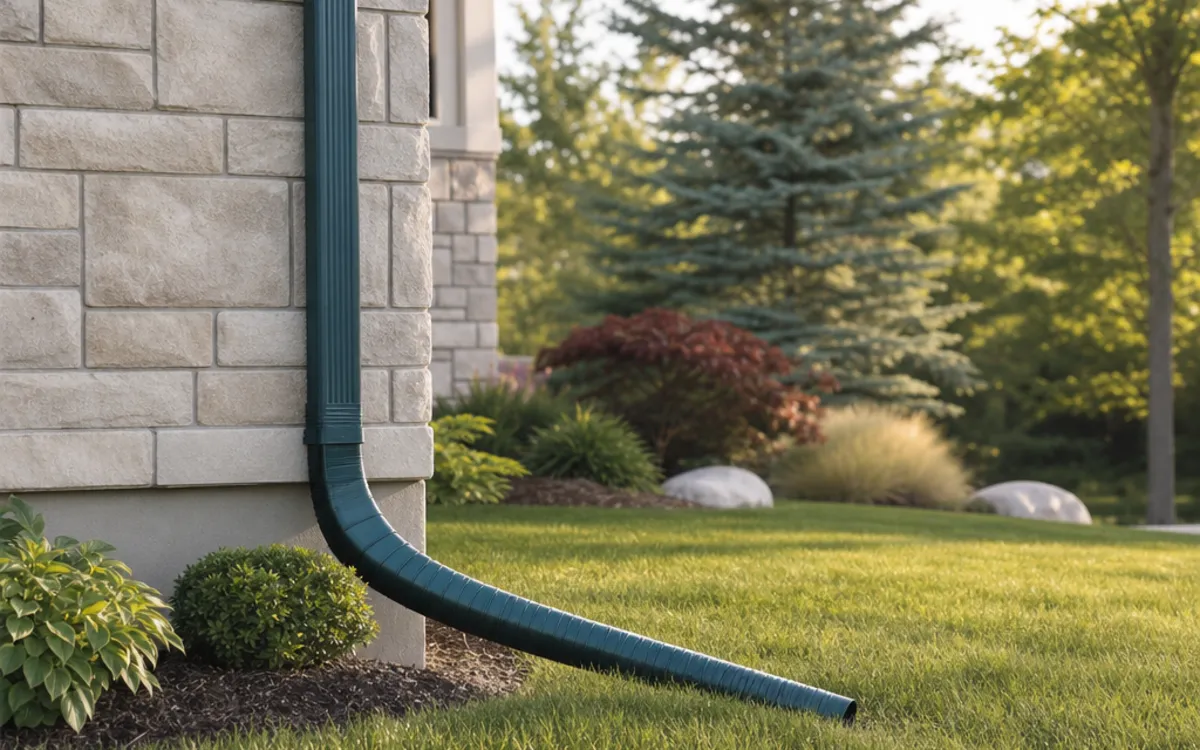
A roof collects rainfall across a large area and sends it through gutters and downspouts. If a downspout releases water directly beside a foundation, that concentrated flow can contribute to local pooling, soil saturation or erosion, especially where the ground already slopes toward the building or drains poorly. This is one possible contributor to foundation-area water, not proof that every damp basement is caused by a downspout. Gutters may be blocked, leaking or overflowing; water may also come from grading, window wells, groundwater or plumbing. Observe the route during ordinary rain if it is safe, then compare it with the location and timing of any indoor moisture. Do not select a permanent change until the property’s drainage context is understood.
Also consider where water enters the site from adjacent surfaces and where it can safely leave. The same discharge detail may behave differently after soil settles, landscaping changes or an extension shifts during seasonal freezing. Note whether water emerges from an elbow or joint before reaching the ground, since a leak partway down a wall can wet a different area than the outlet. Do not assume a dry day reveals the route used during rain.
Points to carry forward
- Note the discharge point, pooling and visible erosion after rain.
- Compare exterior observations with the indoor entry location.
- Treat a downspout as one possible factor, not a diagnosis.
Inspect gutters and visible outlets safely
From the ground, look for a detached elbow, a visibly crushed extension, debris at an accessible outlet or water marks beneath a gutter joint. A gutter that overflows during rain may need cleaning or repair, but roof access is hazardous and should not be attempted from an unstable ladder or in wet conditions. The downspout’s visible appearance does not show whether an underground connection is open, legal or appropriate for continued use. Avoid inserting tools into buried lines or directing a hose into an unknown drain. If the route disappears underground or repeatedly backs up, ask a qualified professional to identify the system and safe inspection options. Preserve photos and note which observations were made from the ground.
A seasonal inspection from a safe position can identify visible changes, but it cannot confirm concealed pipe condition. Describe exactly what was visible and avoid presenting an inaccessible outlet as inspected or clear.
Points to carry forward
- Inspect from a stable location without climbing onto a wet roof.
- Do not assume a buried outlet connects to a particular system.
- Get qualified help for inaccessible or repeatedly blocked routes.
Look at grading as a whole
The slope immediately around a home is only one part of how water moves across a lot. Settled soil, garden beds, paved surfaces, retaining features and neighbouring elevations can alter where rainfall collects. Look for persistent puddles, rills or soil washed away after rain, but do not add fill or reshape a yard based on a single observation. A change that sends water away from one wall could direct it toward a neighbour, a walkway or another low opening. Property-specific grading work may need professional advice and must respect applicable local requirements. Record the existing condition first, including where water arrives and leaves the area, so proposed changes can be evaluated for their wider effects.
Photographs from several points can show the relationship between the foundation, paved areas and low spots. If work is considered, ask how the proposed grade will behave at property edges and around entrances in both rain and snowmelt. Include hard surfaces such as patios and driveways in the observations; their edges can channel flow differently from soil. Note recent landscaping or settlement, because a formerly effective slope can change over time.
Points to carry forward
- Observe the broader route across the property, not one spot alone.
- Avoid directing runoff onto neighbouring land or public paths.
- Ask before significant grading or drainage changes.
Check low openings and adjacent features
Basement window wells, exterior stairwells, garage entries and low doors can collect runoff if water is directed toward them or if drainage is obstructed. Look for leaves, snow, sediment, new staining and the way adjacent surfaces slope. A visible grate or drain does not prove that it is connected to a working outlet, and a clear opening does not eliminate groundwater or foundation leakage. Do not flood a well or stairwell to test an unknown drain. If water repeatedly collects there, a qualified assessment can consider the opening, drainage route and nearby grade together. Keep photographs and note weather conditions; an event record can help distinguish a surface route from a separate plumbing symptom.
Observe after more than one rainfall when possible, since a short shower may not reveal an overflow or slow-draining condition. Note whether nearby downspouts discharge into the area or whether wind-driven rain may be relevant.
Points to carry forward
- Inspect wells and low openings from a safe, accessible position.
- Record obstruction, staining and water accumulation after rain.
- Do not use an unknown drain as a test outlet.
Differentiate surface water and sanitary flow
Water at a foundation joint or window well suggests an exterior or building-envelope pathway to investigate; wastewater coming from a floor drain or plumbing fixture raises a sanitary drainage concern. Timing during a storm is relevant but not conclusive, because rain can coincide with several conditions. A sump pump may collect groundwater and discharge it through its own route, which is not the same as either a downspout or sanitary backflow. Record where water first appeared and whether fixtures were used. A backwater valve is intended for reverse flow in the connected sanitary line, not to reroute roof water, repair grading or waterproof a foundation. Conversely, a downspout extension does not remedy a sanitary backup.
A useful assessment may need to consider both indoor symptoms and outside drainage, but these systems should not be conflated. Ask how the route was identified and which additional evidence would change the conclusion.
Points to carry forward
- Record whether water appeared at plumbing or the building envelope.
- Keep sump, surface-water and sanitary observations distinct.
- Choose an assessment based on the observed pathway.
Choose a discharge arrangement carefully
A downspout extension, splash block, surface channel or other approach may be appropriate in some settings, but there is no universal distance or layout that suits every property. Space, slope, soil, winter conditions, neighbouring features and local rules all matter. An extension that ends in a walkway can create a slip hazard; one that becomes disconnected or freezes can send water back toward the wall. Do not connect roof drainage to an unknown pipe or alter a public connection without confirming what is allowed. Ask a qualified professional to explain the intended route and seasonal upkeep. Confirm applicable Ottawa requirements before making a connection or substantial alteration, since official requirements and program terms may change.
Ask how the chosen arrangement will be checked after installation and who should correct a disconnected or damaged extension. Plans should account for winter access and not rely on a route that is routinely blocked by snow or storage. A temporary extension can move during mowing, snow clearing or freeze-thaw cycles, so include a safe way to notice displacement. Clarify whether it should be removed or repositioned seasonally, and avoid placing it where people may trip.
Points to carry forward
- Consider slope, winter operation, access and neighbouring properties.
- Do not connect to an unidentified pipe or public system.
- Check current local requirements before altering drainage.
Understand what a sump can do
A sump pump is designed to collect and discharge water delivered to its pit through the property’s particular drainage arrangement. It depends on the condition of the pump, power supply, controls and discharge route, and its effectiveness cannot be assumed from the presence of a pit alone. Observe visible operation only from a safe, dry location and follow the manufacturer’s instructions. A sump does not necessarily collect all water around a foundation and does not address reverse flow in a sanitary sewer. A backwater valve does not operate a sump or discharge groundwater. If both systems exist, ask how they are intended to function independently and whether any routing or maintenance requirement applies. Keep each piece of equipment’s instructions and service records together.
If the pump is unusually active or its discharge appears to return toward the house, record the observation and seek qualified advice. Do not change an outlet or electrical arrangement based only on a general checklist.
Points to carry forward
- Follow the pump manufacturer’s guidance for checks and service.
- Note alarms, unusual operation and blocked visible discharge.
- Do not equate sump protection with sanitary backflow protection.
Investigate recurring moisture
For repeated dampness, build a record across more than one weather event: exact location, rainfall or thaw conditions, duration, visible exterior water routes, pump activity and any fixture-related symptoms. Photographs can show changes, but avoid entering wet or unsafe spaces. A qualified professional can assess the relevant components and explain what is directly observed, what is inferred and what remains unknown. Depending on the symptom, investigation may concern gutters, grading, a window well, sump equipment, foundation conditions or sanitary piping. One repair should not be represented as solving unrelated pathways. Ask what additional observations or access would be needed before recommending invasive work, and request a written scope for proposed changes.
Ask whether the recommendation addresses the source or only manages a visible consequence, and whether other routes remain unexamined. This makes the limits of the work clear before comparing estimates or approving disruption. Also ask what conditions would indicate that the first measure did not resolve the observed issue. A clear follow-up criterion makes later review more practical without implying that one change controls every moisture source.
Points to carry forward
- Track repeat events with dates, locations and weather context.
- Ask what is observed versus inferred during an assessment.
- Request a clear scope before invasive investigation or repairs.
Permits, City information and program claims
Ottawa’s official resources explain wastewater, backwater-valve permits and the residential protective-plumbing program. Those pages should be checked directly for current details; this guide cannot determine whether a property qualifies or whether particular drainage work needs approval. Do not assume an incentive applies to downspout changes simply because a program addresses another protective-plumbing measure. Ask the City about requirements relevant to the exact project and retain any official response. Ask a contractor to separate proposed surface drainage work from sanitary plumbing work in the estimate. A permit, grant or reimbursement decision is specific to its applicable rules and application, not a general consequence of installing a device.
A project that combines surface drainage and plumbing may involve different scopes, approvals or documentation. Confirm each question with the appropriate source and retain the response with the related work record.
Points to carry forward
- Verify current program eligibility and terms with the City.
- Ask about permit requirements for the specific project scope.
- Keep surface drainage and sanitary plumbing proposals distinct.
A practical inspection sequence
Start with safe ground-level observations of gutters, downspouts, pooling and low openings. Record the interior location and timing of any moisture, and keep pump and plumbing observations separate. Then seek an assessment targeted to the likely route, asking what the work can address, what it cannot, how discharge will be managed and what seasonal maintenance is expected. Avoid last-minute changes during a storm or work that transfers water to another property. Revisit the site after a later rain to see whether a documented condition changed, while remembering that different rainfall and soil conditions make events hard to compare. This process organizes decision-making; it does not promise a dry basement or replace official or property-specific advice.
Save the before-and-after notes together, including conditions that did not change. If symptoms persist, use that information to ask whether the initial assessment should be expanded or whether another pathway needs attention.
Points to carry forward
- Observe first, then target assessment to the identified pathway.
- Ask how the proposed work handles seasonal conditions and upkeep.
- Keep dated records of changes and later observations.
Further reading
Official references
Rules and program details can change. Check the current source before making a decision about work on your home.
Continue reading
The next useful question.
When the question is about your home
An on-site conversation can clarify what a general guide cannot.