
In this guide09 sections
- 01The direction of flow
- 02How the moving part responds
- 03What happens when it closes
- 04What it can and cannot protect
- 05Signs that deserve investigation
- 06Assessment before a recommendation
- 07Safe use and maintenance
- 08Questions to ask a plumbing professional
- 09Interpreting the limits honestly
- ↗Official references
Before you begin
A plain-language explanation of reverse flow in a sanitary sewer, the moving flap inside a valve, and what the device cannot address.
The direction of flow
In normal conditions, wastewater from sinks, toilets, tubs and other connected fixtures travels through a home's sanitary drainage piping and building sewer toward the public sewer or another approved receiving system. A backwater valve is fitted into an appropriate part of that drainage path. Its purpose is to limit sewage moving in the opposite direction if pressure or a high level in the downstream sewer tries to push wastewater back toward the building. It is a protective component in a specific pipe route, not a device that watches or controls every drain in a home.
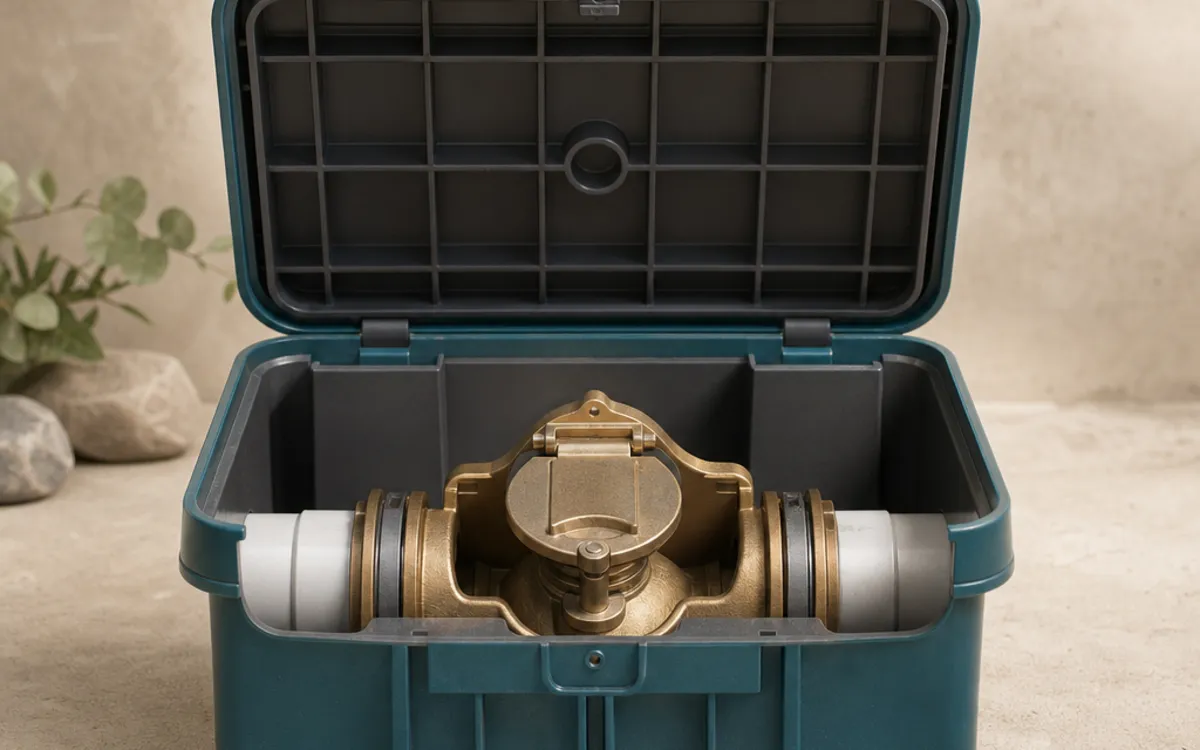
The exact arrangement depends on the property and installed assembly. A valve may have a body, a movable flap or gate, a cover and access provisions, but products differ. The cover visible at a basement floor is not enough to tell how the whole system is connected, whether the valve is in the relevant branch, or whether it is operating freely. Understanding normal flow first makes it easier to discuss what the valve could protect and what still needs separate investigation.
Points to carry forward
- Trace the question to the sanitary building sewer rather than assuming all water enters one route.
- Ask which fixtures and branches are protected by the proposed or existing location.
How the moving part responds
Many common designs use a hinged flap that rests open enough for ordinary wastewater to pass downstream. When downstream water begins to reverse direction, the movement or pressure can move the flap toward a seat, restricting that reverse path. Some models use a different gate or arrangement, so it is important to identify the actual product before describing its mechanism. The useful principle is that the assembly responds to flow conditions in the pipe; it does not predict a sewer event or pump water out of a basement.
The valve needs an unobstructed movement and a suitable seal to perform as intended. Deposits, paper, grease, wipes, foreign objects, corrosion, damage or an unsuitable installation can interfere with closing or reopening. A homeowner should not infer condition from the idea that the flap ought to move. Inspection requires safe access and enough knowledge to avoid disturbing a contaminated or pressurized drainage system. A qualified person can identify the valve, examine its components and explain what testing is appropriate for that specific installation.
Points to carry forward
- Ask for the make and model if it can be safely identified.
- Do not put hands or tools into an unknown sewer opening.
What happens when it closes
When a backwater valve restricts reverse flow, it can also temporarily restrict wastewater leaving the home through that same section of pipe. The valve cannot distinguish sewer water from wastewater produced inside the house. If it is closed while fixtures continue to discharge, the home's wastewater may have nowhere to go through the blocked route and could back up at a fixture or another opening. The precise result depends on plumbing layout and where discharges connect.
This is why valve operation is not a reason to ignore changes in drainage or to continue using water as though nothing has happened. If a suspected sewer backup is occurring, stop using toilets, sinks, laundry equipment and other connected fixtures as practical, keep people away from affected wastewater, and seek qualified help. Follow emergency and public-health guidance if sewage has entered the building. Never try to force a flap open to restore flow during an active event: that could remove the barrier when reverse pressure remains. Ask the inspecting professional what signs should prompt an immediate call and what occupants should do while waiting.
Points to carry forward
- A closed valve can stop ordinary household discharge as well as reverse flow.
- During a suspected backup, reduce water use and keep clear of contaminated water.
What it can and cannot protect
A correctly selected, located, installed and maintained valve may help limit a particular route of sanitary sewer backflow. Whether it protects a given fixture or area depends on the connection layout, elevation, local requirements and the valve's condition. No single description applies to every property. It is sensible to ask a professional to map which branches are upstream of the valve and which may remain outside its protection, rather than treating the device as a whole-house shield.
The valve is not a general flood barrier. It does not stop groundwater passing through a foundation, seepage at a wall-floor joint, storm water entering a window well, water from poor surface grading, a leaking supply line, or a sump-pump failure. Foundation drainage and sump arrangements have their own piping and failure modes. Rainwater or storm drainage may also follow a route distinct from the sanitary sewer. Identifying the source matters because choosing the wrong intervention can leave the actual pathway untreated. A useful assessment describes observed water, timing and location before recommending a component.
Points to carry forward
- Separate sanitary backflow from foundation seepage, storm water and plumbing leaks.
- Ask the assessor to state both protected and unprotected drainage branches.
Signs that deserve investigation
A sewer-like odour, gurgling fixtures, slow drainage in several locations, wastewater emerging from a low fixture, or a history of repeated backups can justify a plumbing assessment. None of these signs alone proves that a backwater valve is missing or defective. A local blockage, a downstream sewer problem, a venting issue, a damaged pipe or another condition may produce overlapping symptoms. Similarly, water on a basement floor after rainfall is not automatically sanitary sewage; its route and characteristics need careful evaluation.
Keep a factual record if symptoms recur: which fixtures were affected, what other water-using activity was occurring, approximate timing, weather conditions, and whether the liquid appeared to be clear water or wastewater. Do not taste, directly handle or deliberately smell suspect liquid. Photographs from a safe distance and prior service notes may help a professional understand the pattern. If sewage is present, avoid contact and follow appropriate cleanup and health advice. Emergency conditions, active discharge or immediate hazards call for prompt professional or municipal assistance, not a do-it-yourself test.
Points to carry forward
- Record symptoms and conditions without entering contaminated areas.
- Do not treat one symptom as proof of a particular failed component.
Assessment before a recommendation
A sound assessment starts with the building's drainage history and visible evidence, then confirms the relevant pipe route as far as practical. The professional may review available plans, locate cleanouts or access points, and determine whether further inspection of the sanitary line is appropriate. Access methods and equipment vary; a camera inspection, where feasible, is not a substitute for every other check and cannot establish facts about pipes it does not reach. Existing installations may also be concealed, altered or undocumented.
Ask the assessor to explain the observed condition in ordinary language, how it relates to the proposed valve location, and what remains unknown. A recommendation should distinguish a needed repair from an optional protective measure and explain alternatives where they are appropriate. Ask whether opening a floor, exposing a pipe or checking branches is required before the scope can be firm. Do not assume a valve can be added anywhere simply because a cover is visible. In Ottawa, confirm current permit or program information directly with the City where relevant; the guide cannot decide a property's code compliance or eligibility.
Points to carry forward
- Request the reasoning linking observed evidence to the proposed work.
- Clarify what is known now and what could change after access is opened.
Safe use and maintenance
Maintenance depends on the actual valve, its installation and manufacturer instructions. Keep the access area clear and avoid covering it with permanent finishes or heavy stored items if access is needed for inspection. Do not pour chemicals into a drain as a way to clean a valve, and do not remove a cover or manipulate a mechanism unless the assembly is identified and you are competent and equipped to do so safely. Sewer openings can expose people to contaminated material, sharp edges and harmful gases; a seemingly simple cover is not proof of a safe task.
Ask the installer or service professional what inspection interval or indicators apply to the specific model and local conditions. Request that any service record name the component, note what was examined, identify a defect or limitation, and explain follow-up work. If the assembly is inaccessible or the cover is damaged, report that rather than trying to improvise a repair. Avoid placing wipes, grease, sanitary products or other unsuitable solids into plumbing; this is good drainage practice but does not replace inspection. A maintenance plan should be specific enough that future owners can understand it.
Points to carry forward
- Follow model-specific instructions and keep safe service access available.
- Retain dated inspection and repair notes with the home's plumbing records.
Questions to ask a plumbing professional
A clear conversation can prevent confusion between a device recommendation and a diagnosis. Ask the professional to identify the sanitary route, the proposed valve type and the branches it would protect. Ask whether an existing valve is present, how its condition was evaluated and whether the work depends on opening concrete or exposing piping. Invite an explanation of risks, alternatives and the limitations that remain after installation. If a quote describes a broad “flood protection” outcome, ask what specific water pathway that statement refers to and what it does not cover.
Before authorizing work, understand how access will be made, how the line will be tested, what happens if the existing pipe is damaged, and which restoration tasks are included. Ask how the component will remain accessible for service and what documentation will be supplied. For local permit questions, consult current City of Ottawa guidance and ask the responsible authority about the exact scope. The answer should not be inferred from an unrelated home's layout, a photograph, or a product brochure.
Points to carry forward
- Request a written scope that identifies location, function, exclusions and testing.
- Ask who to contact if the valve closes or household drains stop functioning.
Interpreting the limits honestly
A backwater valve is one element in a building's drainage system, and its protective value depends on conditions beyond the component alone. Sewer levels, the connection arrangement, maintenance and how household water is used during a closure all matter. A device cannot promise that a basement will stay dry, prevent every sewer-related problem, or remove water after it enters. Avoid claims that imply certainty without defining the exact route, operating conditions and maintenance assumptions.
For a specific Ottawa home, current municipal rules and any program terms should be verified at the time of a project; policy and eligibility details can change. The City resources supplied with this guide are starting points, not an inspection or compliance decision. A building professional can provide site-specific observations, while the City or permit authority answers questions about official requirements. Keep those roles distinct. Good decisions follow a documented assessment, realistic scope and safe maintenance plan rather than a guarantee based only on the presence of a valve.
Points to carry forward
- Treat protection as limited to the identified drainage pathway.
- Verify current Ottawa requirements and program terms with the City.
Further reading
Official references
Rules and program details can change. Check the current source before making a decision about work on your home.
Continue reading
The next useful question.
When the question is about your home
An on-site conversation can clarify what a general guide cannot.