
In this guide10 sections
- 01What a drain camera actually observes
- 02Define the question before booking
- 03Plan access and understand what may stop progress
- 04Recognize visible findings—and their limits
- 05Understand a camera’s blind spots
- 06Ask for a useful record of the inspection
- 07Interpret findings with the right professional
- 08Connect the result to basement-water assessment
- 09Avoid unsafe tests and unnecessary work
- 10Use the inspection to plan follow-up
- ↗Official references
Before you begin
What a camera may reveal inside an accessible pipe, and why it cannot answer every foundation or flooding question.
What a drain camera actually observes
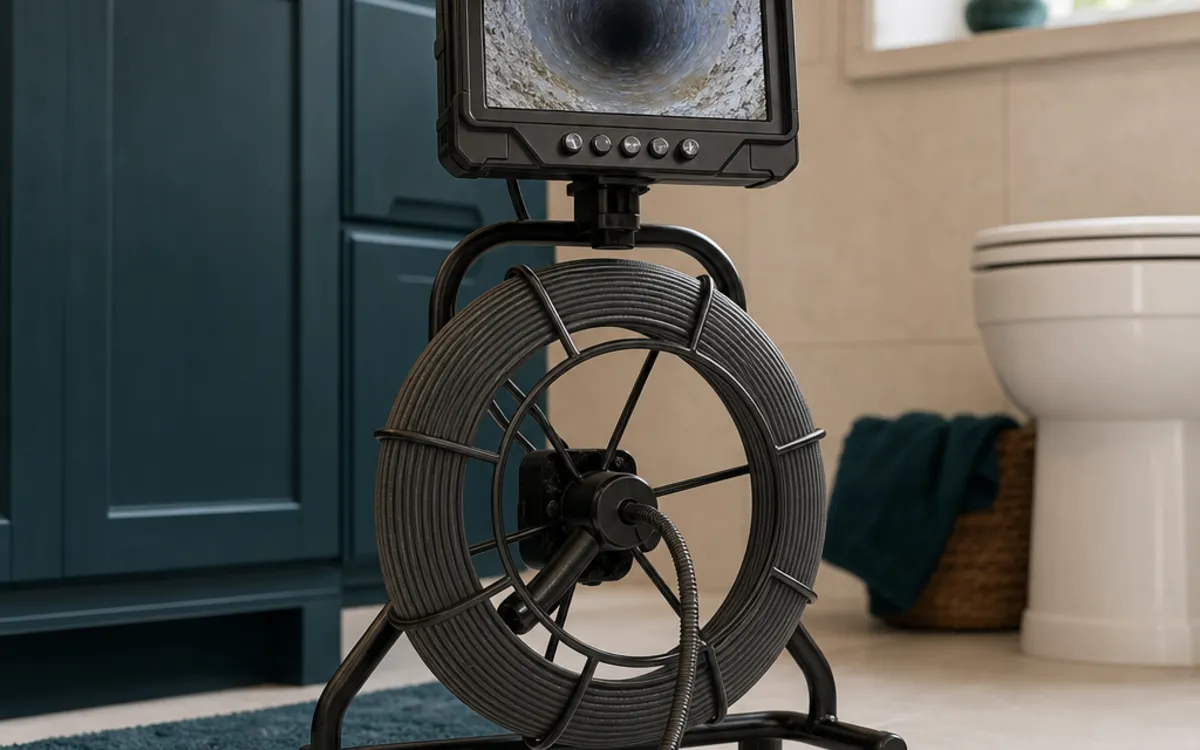
A sewer or drain camera places a small camera into an accessible pipe and transmits a view of the interior surface along the route it can travel. Depending on access, visibility and equipment, the operator may see an obstruction, roots, a crack, a joint offset, standing material, a connection or a change in pipe shape. The view is limited to the section reached and the surfaces visible at the time. A camera is therefore a useful investigative tool, not a complete survey of every private drain, municipal sewer or water pathway around a home.
The recording also depends on how the inspection is performed. A lens can be obscured by water, debris, grease, a bend or a blockage; distance markings and orientation may have limitations. A still image can make a feature easier to discuss but may not show its extent. Ask the operator to distinguish what is directly visible from an interpretation, and to say when the view is too poor to support a conclusion.
Points to carry forward
- Treat the image as a view of the accessible pipe section, not the entire property.
- Ask which observations are visible facts and which are interpretations.
- Note where poor visibility limits a conclusion.
Define the question before booking
A camera inspection is most useful when you can state the decision it is meant to inform. Examples include checking a reported restriction in a building drain, understanding a suspected damaged section, or examining a route that has suitable access. It is less useful as a generic response to “the basement got wet” if nobody has first considered whether water came from a sanitary pipe, foundation, storm runoff, sump system or another source. Different questions may require different professionals or methods.
Before booking, explain the symptom, prior work and the access points you know about. Ask whether the proposed inspection can reach the relevant section, what the operator hopes to learn, and what result would alter the next step. If the goal is to assess exterior grading, groundwater, foundation seepage or pump performance, an internal pipe camera cannot directly answer those questions. Establishing scope first helps avoid mistaking a clear-looking pipe segment for proof that every possible cause has been ruled out.
Points to carry forward
- State the symptom and the specific decision the inspection should inform.
- Ask whether the relevant line can be reached from available access.
- Do not use a camera as a substitute for investigating other water pathways.
Plan access and understand what may stop progress
The operator needs a safe, usable entry point and a route the camera can negotiate. The access may be a cleanout or another suitable opening, but its location and connection should be confirmed rather than assumed. Tight bends, pipe diameter, accumulated material, a full blockage, fragile or damaged pipe, and the camera head’s size can all affect how far it travels. Access may also require moving stored items or removing a cover, which should be handled by a qualified person rather than forced by a homeowner.
Ask whether the work includes identifying the starting point, recording the distance travelled and documenting where the inspection stopped. If the camera cannot pass, the result is not necessarily evidence that the entire line is damaged; it may simply show that the view is blocked or access is unsuitable. Conversely, a camera that advances some distance has not necessarily inspected all branches or connections. A clear scope includes both the intended route and the conditions that would make the inspection incomplete.
Points to carry forward
- Confirm the access point and planned route before work begins.
- Ask how distance, direction and the stopping point will be recorded.
- Do not force a camera or open unfamiliar plumbing yourself.
Recognize visible findings—and their limits
An inspection may show material obstructing a pipe, a visible crack, a joint that appears displaced, roots entering an opening or a connection that can be seen from the camera’s position. Such findings can help a professional decide whether cleaning, further assessment or repair should be considered. But the camera view alone may not establish the severity, cause, structural significance or full length of a defect. Water, scale, reflections and camera angle can change the apparent size of a feature, and an image can omit the context needed for a sound repair decision.
Ask for the operator’s reasoning and whether the finding was seen directly, inferred from movement or based on another symptom. A visible crack does not automatically prove it caused basement flooding; a route with no obvious defect in the inspected footage does not rule out an unseen branch, an intermittent condition or a non-pipe source. Interpret the result together with the reported event, the plumbing layout and any other relevant assessment. Avoid accepting a repair recommendation based only on a dramatic screenshot without an explanation of scope and options.
Points to carry forward
- Ask what a visible feature means and what it does not establish.
- Relate pipe observations to the actual symptom and inspected route.
- Request explanation before authorizing work based on a still image.
Understand a camera’s blind spots
A pipe camera cannot inspect through solid pipe walls or see the surrounding soil. It does not directly measure exterior grading, groundwater movement, foundation cracks, sump operation or surface drainage. It may not reveal every branch, connection or inaccessible section, and it cannot always determine the exact relation between a private pipe and public infrastructure. An apparently open section at inspection time also does not guarantee that it will remain clear or that flow behaves the same under every condition.
A sewer camera is not a pressure test, a full building plumbing survey or a guarantee against future backup. It cannot establish that a backwater valve is present, correctly installed, accessible or functioning unless a relevant assembly is actually inspected and the method supports that conclusion. Even then, the operator should explain precisely what was observed. When the concern is water entering at a wall or slab, ask what non-camera assessment is appropriate. Identifying the tool’s blind spots protects against both false reassurance and unnecessary repair.
Points to carry forward
- A camera does not directly assess foundation, soil, grading or sump conditions.
- Ask which branches and pipe lengths were not reached.
- Do not infer future performance from one inspection-time view.
Ask for a useful record of the inspection
Before work starts, ask what deliverables are included: a written summary, video, still images, distance notes, route description or verbal explanation. A recording is most useful when it is labelled with the date, starting access and direction, and when the operator explains where the camera stopped. If only a short clip is provided, ask whether it shows the complete inspected length or selected findings. Keep the original file and report with earlier plumbing or water-event records.
The written record should identify limitations such as obscured visibility, uninspected branches or a blockage that prevented progress. Ask the operator to describe urgent concerns separately from maintenance suggestions and to explain any recommended follow-up. A video without context can be hard for another professional to interpret, while a concise report can preserve key details for comparison. You do not need to interpret the footage yourself; seek clarification if an image appears inconsistent with the written conclusion. The purpose of documentation is traceability, not a promise that every hidden condition was discovered.
Points to carry forward
- Request a dated report and clarify what video or stills are included.
- Make sure the access point, direction and stopping point are identified.
- Keep the report with related maintenance and event records.
Interpret findings with the right professional
The person operating the camera may be able to explain the pipe view, but decisions about repair scope should be based on the property, applicable requirements and the actual issue. Ask whether the finding requires a plumber, another qualified specialist or additional investigation. If a report suggests a private-side repair, clarify the limits of the inspected section and who is responsible for verifying the proposed scope. Where the concern involves public wastewater service, municipal contacts and private plumbing professionals have different roles; do not assume a camera report settles ownership or responsibility.
In Ottawa, City wastewater information can provide general context about wastewater and sewers. It is not a property-specific diagnosis. A camera inside a private pipe also does not establish whether a protective plumbing program or other City process applies. Ask what evidence would support the next step and what approvals or permits should be checked before construction. If the finding is uncertain and work would be disruptive, a second qualified opinion may help, especially when the proposal does not explain how the visible condition relates to the symptom.
Points to carry forward
- Ask who can evaluate the finding and define any repair scope.
- Separate private plumbing questions from municipal service questions.
- Check current City information where municipal requirements may apply.
Connect the result to basement-water assessment
When a camera inspection is part of a basement flood investigation, keep the pipe findings beside—not instead of—the event record. Compare the inspected route with where water appeared, whether fixtures were involved, what weather was occurring and whether a sump or other equipment showed a change. The timing may suggest useful follow-up, but it does not independently prove that a pipe feature caused the event. A dry inspection after the incident can also miss an intermittent restriction or conditions that have changed since cleanup.
If the observed water appeared at a floor drain, a camera may help examine a relevant accessible line, but the visible drain alone does not confirm the connection or source. If water came through a wall-floor joint, other assessment may be needed even when a drain segment looks unobstructed. Keep the question specific: “What does this route show?” is different from “Why did the basement become wet?” This distinction makes the camera one part of a reasoned investigation rather than a stand-in for it.
Points to carry forward
- Compare the inspected route with the event location and timeline.
- Use other assessment for foundation, sump or exterior drainage questions.
- Avoid treating correlation between water and a finding as proof of cause.
Avoid unsafe tests and unnecessary work
Do not pour chemicals, send improvised equipment into a drain, remove a cleanout cap under pressure or deliberately run multiple fixtures to provoke a backup. These actions can expose a person to contaminated water, damage plumbing or make conditions worse. If there is an active overflow or suspected sewage, keep clear and call qualified help. A camera inspection should be planned and operated by someone equipped to manage the access and interpret the result; it is not a homeowner demonstration.
Likewise, do not approve cleaning or replacement solely because a camera is available or a feature looks concerning on screen. Ask what work is proposed, what evidence supports it, what risks arise if it is deferred and what alternative explanations remain. If cleaning is recommended before reassessment, clarify whether it may remove evidence or change the view. Proper decisions balance condition, urgency, access and consequence. A restrained investigation can be more valuable than an invasive step that does not answer the original question.
Points to carry forward
- Never reproduce a backup or open a pressurized cleanout as a test.
- Keep away from active sewage and involve qualified professionals.
- Ask for the reasoning, alternatives and risks before authorizing work.
Use the inspection to plan follow-up
After reviewing the report, write down what is known, what was not inspected and what action—if any—follows from the result. If a repair is planned, ask how completion will be documented and whether a post-work inspection is appropriate for the specific scope. If no defect was seen, do not treat that as a universal clearance; decide whether the original symptom still needs investigation through another pathway. Preserve the footage and note any changes to the plumbing so future professionals can compare the same route.
For later maintenance, ask the professional what signs warrant another inspection and whether a regular schedule is actually suitable for the pipe and its use. There is no need to repeat a camera inspection without a reason or to promise that repeat viewing prevents failure. The useful outcome is a better-defined decision, including uncertainty. A limited result can still be helpful when it rules out only the inspected section and directs attention toward a more relevant next question.
Points to carry forward
- Record findings, uninspected areas and decisions separately.
- Ask whether post-repair verification fits the specific work.
- Schedule further inspection based on a reason, not a blanket promise.
Further reading
Official references
Rules and program details can change. Check the current source before making a decision about work on your home.
Continue reading
The next useful question.
When the question is about your home
An on-site conversation can clarify what a general guide cannot.