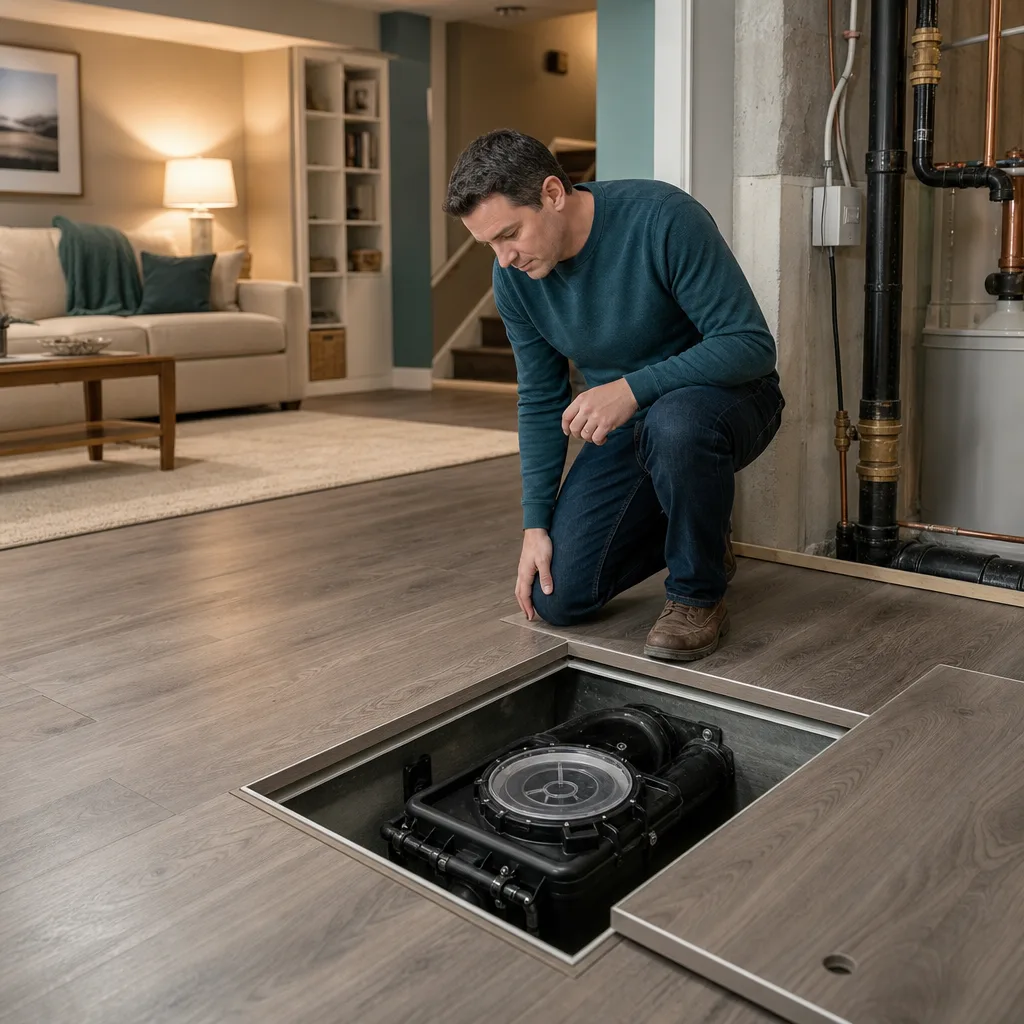
Kanata homeowners encounter very different planning conditions across Beaverbrook, Katimavik, Glen Cairn, Bridlewood, Kanata Lakes, and newer neighbourhoods in Kanata North and South. A house's apparent era can begin the conversation, but it cannot confirm its private sewer layout, whether protective plumbing was installed, or whether later renovations preserved access. A backwater-valve decision should therefore start inside the property—with records, visible drainage, and a professional assessment—not with assumptions about the surrounding street.
The device has a focused purpose: it can close against reverse flow in the drainage line where it is correctly selected and installed. It is not a universal flood barrier. This guide frames the questions that matter in Kanata, including finished-basement disruption, existing-device verification, permit and rebate sequencing, and the distinction between sewer backup and surface or foundation water. It offers no do-it-yourself installation steps and cannot determine insurance coverage or City program approval.
Let Kanata's layered growth prompt verification
Kanata was planned and built in stages, and its housing ranges from earlier garden-city neighbourhoods and established subdivisions to contemporary intensification and greenfield development. Renovation adds another layer: basement bathrooms may have been added, utility rooms enclosed, or an original valve covered by flooring. Two similar façades can conceal different pipe routes and access constraints. Verify build and permit information where available, then ask a plumber to locate the relevant sanitary or storm service.
Ottawa states that homes built after January 1, 2004 require a valve on the private storm sewer service under the Ontario Building Code, and that Ottawa homes built after January 1, 2012 require one on the private sanitary service. Those dates are useful record-checking prompts, not proof of presence, suitability, or working condition. Confirm the actual installation and any subsequent modifications.
Related reading
Separate a sewer backup from other basement water
A backwater valve responds to flow trying to return through a connected drain. Water arriving at a foundation crack, window well, walkout, wall-floor joint, or failed sump follows another route. Before choosing equipment, record where water first appeared, its character, weather and plumbing use at the time, and whether neighbours or City services reported a broader issue. Avoid declaring a cause from timing alone.
Kanata contains sloped terrain, watercourses, engineered drainage features, and varied lot grading, but none establishes a specific home's failure mechanism. Review eavestroughs, downspout discharge, exterior grading, sump equipment, window wells, and sewer-side plumbing as separate parts of one assessment. A valve may be appropriate for one pathway while other work remains necessary for another.
Map the private drainage before opening a finished floor
The assessment should identify the line proposed for protection, direction of flow, branches that matter, a suitable accessible location, and whether an existing valve or cleanout is present. Camera inspection and electronic locating can be useful where conditions permit. Footage can show the accessible pipe interior at that moment; it cannot guarantee the condition of every concealed connection or eliminate the need for professional judgment.
Finished Kanata basements often turn access into a major cost and design question. A valve must not disappear beneath built-in storage, a new wall, or continuous flooring. Ask the plumber to mark the proposed opening and explain required working clearance before accepting the quote. If a home office, bedroom, or recreation space is affected, discuss dust control, contents protection, concrete reinstatement, and precisely which finish repairs are excluded.
Related reading
Plan for what happens when the valve closes
During normal flow, wastewater passes outward; under reverse flow, the valve closes. While closed, household discharge cannot leave normally through that route. Residents should reduce water use and avoid adding wastewater until normal operation is confirmed. The valve type and location must suit the drainage application, and an access cover is essential for inspection and servicing.
The device does not repair a collapsed lateral, clear a blockage upstream, power a sump pump, waterproof walls, or divert surface runoff. Nor is it fail-proof: debris, damage, poor installation, inaccessible placement, or neglected maintenance can impair operation. Ask the professional to explain what the selected valve protects, what remains unprotected, and how occupants can recognize and respond to a closure or drainage problem.
Keep the Ottawa permit visible in the project schedule
Ottawa's official page says a building permit is required to install a backwater valve. Confirm the current submission and inspection requirements before excavation. Put responsibility for the application, fees, inspection booking, and corrections into the contract rather than relying on a verbal understanding. Permit review is distinct from a sales estimate and should not be treated as an optional rebate document.
Coordinate floor closure with inspection. Keep the permit, approved plan or details, invoices, valve model, installation photographs, and final inspection result. This package is useful for future maintenance, resale, and discussions with the City or insurer. It does not promise that an insurer will alter coverage or that a rebate application will be approved.
Related reading
Check the Residential Protective Plumbing Program before committing
The City program provides financial assistance to qualified Ottawa property owners for approved protective plumbing work. The official page lists devices, eligibility rules, maximum rebate categories, required documentation, and application information. Because terms can change, rely on the current City material and direct confirmation, not an old neighbourhood post or an assumed amount.
Ask whether pre-work steps apply, which permit and inspection evidence is needed, and how invoices should describe labour and materials. Separate unrelated drainage repairs and decorative restoration in the quote. Plan to afford the project if assistance is delayed, reduced, or denied. Lister Plumbing can quote service, but only the City decides program eligibility and only your insurer decides coverage.
Compare quotes by protected line and restoration boundary
Each proposal should state whether it concerns sanitary or storm drainage, the valve model and location, how those choices were verified, excavation size, permit handling, required inspection, concrete repair, testing, access cover, cleanup, and warranty terms. A low total is hard to evaluate if it omits locating, permit fees, or finish restoration. Ask for allowances and exclusions in plain language.
For condominium or common-element properties, clarify ownership and obtain any required authorization before altering plumbing or floors. For detached homes, ask whether exterior investigation is part of the assessment. In either setting, require written approval for changed conditions such as an unexpected branch or deteriorated pipe. A quote should never claim that the valve eliminates all flooding.
Compare proposed schedules as well as prices. Ask how long the drain may be unavailable, whether occupants can remain in the home, when inspection must occur, and what happens if the inspector requests a correction before concrete restoration. Households with remote work, young children, mobility needs, or only one bathroom may need a specific access and sanitation plan. A realistic sequence prevents pressure to conceal work before approval or accept an unexplained change.
Related reading
Use official planning context without turning it into a risk score
Kanata North and Kanata South continue to evolve through development, infill, transportation projects, and community planning. Official plans help homeowners understand intended growth, but they are not plumbing diagrams and do not predict a private sewer backup. Likewise, a nearby pond or creek does not prove that wastewater can reverse into a particular basement.
Use Ottawa's interactive flood map for known riverine-hazard information and contact the relevant conservation authority when a property-specific riverine question matters. Then return to the building: inspect private drainage, grading, foundation entry points, and equipment. Keeping municipal planning, riverine mapping, and private-plumbing diagnosis in their proper roles produces a stronger decision than broad claims about an entire Kanata neighbourhood.
Related reading
Make valve access part of the finished-basement design
A removable cover should remain visible and reachable without dismantling cabinetry or damaging flooring. Store the model instructions and service records, and place a reminder in the household maintenance calendar. Follow manufacturer guidance for the installed device; if the mechanism is damaged, obstructed, odorous, or unfamiliar, use a licensed plumber rather than forcing components.
The City encourages maintenance of protective plumbing and says a licensed plumber can inspect a valve when the homeowner is unsure. Maintenance also includes behaviour: avoid flushing wipes, grease, or unsuitable material; address slow drainage instead of assuming the valve is responsible; and tell future occupants what the cover serves. An inaccessible valve is harder to inspect precisely when confidence matters.
Related reading
Create a property record that outlasts the installation
Before work, make a simple plan showing the sewer route as understood, cleanouts, sump, floor drains, proposed valve, and where photographs were taken. Add the professional's inspection notes and any camera reference. After work, update the plan with the final position and protected service. This is especially useful when a finished Kanata basement gives few visual clues to plumbing below the slab.
Keep City correspondence, permit and inspection material, the signed scope, change orders, itemized paid invoice, model literature, warranties, and maintenance entries in one digital and paper file. Record facts rather than marketing language: installation date, device, line, location, and observed service. A strong file cannot guarantee future performance or an insurance decision, but it reduces guesswork for maintenance, renovations, sale, or a later drainage investigation.
Share essential operating information with all occupants. They should know that the cover is not a floor drain, should remain clear, and may need professional attention if drainage changes. If a basement tenant or guest cannot reasonably access the device, provide a contact and a simple instruction to reduce water use during suspected backup.
A Kanata homeowner's go-or-pause checklist
Proceed when the water pathway has been considered, the relevant line and valve location are identified, permit responsibilities are documented, access will remain permanent, limitations are understood, and the cost works without guaranteed funding. Pause when the recommendation rests solely on construction year, no one can say which line is protected, or a finished floor would conceal the device.
Also pause for promises of universal flood prevention, automatic rebates, or insurance savings. Seek clarification from the City for permits and funding, from the insurer for policy decisions, and from qualified professionals for plumbing and building conditions. A deliberate review is not delay for its own sake; it prevents an apparently simple device purchase from becoming an incomplete flood-protection plan.
Kanata backwater valve FAQ
My Kanata home was built after 2012. Can I assume it has a sanitary valve?
No. Ottawa's stated date requirement is a useful clue, but records, actual installation, accessibility, alterations, and condition still require verification. Ask a professional to locate and identify the device rather than relying on age.
Is a camera inspection always required before installation?
Not in every case. It can help identify line condition and connections where access permits, but the plumber should explain why it is or is not useful. A camera view is evidence, not a guarantee of the entire system.
Can a valve stop water entering a Kanata walkout or window well?
No. Those are surface or building-envelope pathways. Correct grading, drainage, window-well measures, and building repairs may be relevant. A backwater valve is designed for reverse flow through connected drainage.
Does Ottawa require a permit for this work in Kanata?
Yes. The City's dedicated guidance says backwater-valve installation requires a building permit. Verify current details and inspections before work and keep the final documentation.
Am I guaranteed an Ottawa rebate?
No. Assistance depends on current program criteria, approved work, timing, and complete documentation. Only the City can decide an application, so budget without treating a rebate as certain.
What if the valve closes during a storm?
Reduce household water use because discharge may not leave through the protected line while it is closed. Follow the installed model's guidance and seek professional help if drainage does not normalize or the valve's condition is uncertain.
Can I cover the access lid to preserve my basement design?
Do not make it inaccessible. Integrate a removable, reachable cover into the floor design and maintain working clearance. Confirm exact access requirements with the installer and inspection authority.
Sources and official references
- City of Ottawa backwater valve permit guidance
- City Residential Protective Plumbing Program
- City guidance on service-line failure risk
- City basement flooding prevention
- City interactive flood plain map
Programs, permits and bylaws change. Confirm current requirements with the City of Ottawa before acting.
Questions about your Kanata home?
Ask a local plumber, without pressure.
Requests are sent to Lister Plumbing, who serve homes across all Ottawa areas listed here. A request is not a commitment, and no price is promised before someone looks at your plumbing.