Stittsville combines a historic village core and established streets with extensive newer development extending toward Kanata and south of the Queensway. That layered growth makes construction year and neighbourhood context useful questions, but poor substitutes for inspecting the house itself. A backwater-valve assessment must identify the actual private drain, any existing protection, the connected branches, and the most plausible pathway for basement water.
When correctly designed and maintained, a backwater valve can resist reverse flow through the service it protects. It cannot hold back water entering across a lot, through a window or foundation, or because a sump system failed; it also cannot repair a damaged private lateral. This Stittsville guide helps owners plan investigation, access, permits, Ottawa program questions, and long-term care while avoiding unsupported claims about local sewer arrangements or past projects.
Account for both village fabric and growth-area housing
Near Stittsville Main Street, an older property may have additions, replaced drains, finished basements, or incomplete records. In newer subdivisions, original protective plumbing may exist but still needs to be located, identified, and checked for access and condition. No development era makes assessment unnecessary. Begin with build and permit records, renovation history, visible cleanouts, floor drains, sump equipment, and prior water observations.
The City's Stittsville Main Street planning material speaks to community form, not private plumbing. Use official neighbourhood planning to understand growth and character, but never infer a home's sewer design or flood probability from it. A qualified professional must verify hidden conditions at the property.
Trace the water pathway before prescribing a valve
Record where water first appeared: a floor drain or fixture, sump pit, wall-floor joint, foundation crack, window well, door, or exterior opening. Also record rain or snowmelt conditions, household drainage use, odour, colour, and whether the sump was operating. These details help distinguish reverse sewer flow from surface water, groundwater, a plumbing blockage, or building-envelope entry.
Do not investigate contaminated water or energized wet areas yourself. Use emergency, electrical, restoration, plumbing, or building professionals as conditions require. Once immediate hazards are controlled, assess each pathway separately. A backwater valve may address one identified exposure, while grading, downspouts, window wells, waterproofing, sump maintenance, or pipe repair address others.
Verify existing protection in newer Stittsville homes
Ottawa says Ontario Building Code requirements apply to private storm sewer service valves in homes built after January 1, 2004, and that Ottawa requires a private sanitary service valve in homes built after January 1, 2012. Those milestones can focus a document search. They do not confirm that a particular home has both services, that a device is visible, or that later work preserved it.
Ask a plumber to locate and identify any valve and explain what it protects. If a cover is discovered beneath carpet or storage, do not assume the mechanism is ready for use. It may need inspection, maintenance, or a better access arrangement. Replacing a device should follow findings, not precede them.
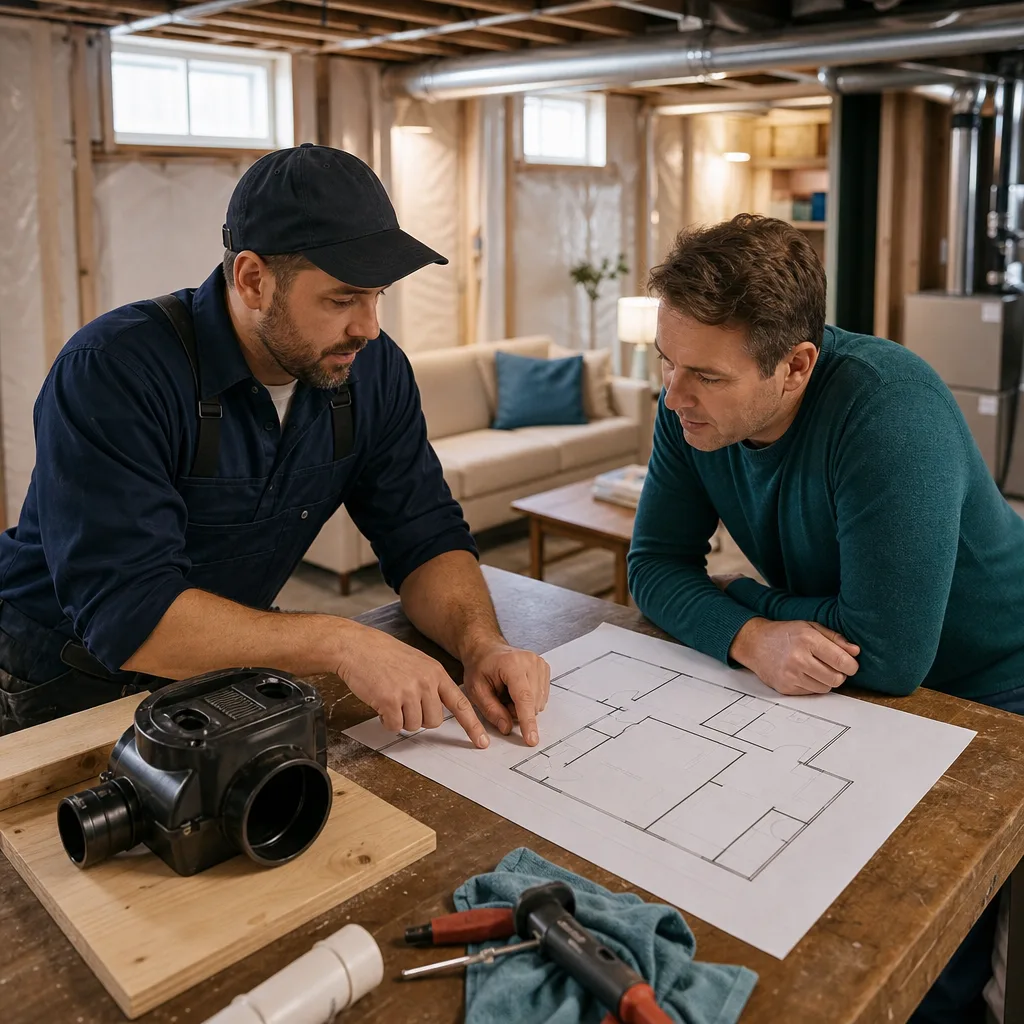
If original builder documents are available, compare their valve symbol and service notes with the finished basement rather than treating the drawing as proof of current condition. Construction changes and later renovations can affect location or access. Record discrepancies and ask the plumber or City what evidence is needed to resolve them. A plan, invoice, and visible cover each answer different questions; none alone confirms present operation.
A homeowner planning basement finishing should locate protective plumbing before drawing walls, cabinets, bathrooms, or storage. Provide the designer with access and working-clearance requirements and carry the location onto the final plan. Moving a planned partition early is usually simpler than creating a decorative hatch after construction or discovering that a removable panel does not provide enough room for maintenance.
Related reading
Use camera and locating work for a defined question
Camera inspection may help establish accessible pipe condition, connections, and the reason for slow drainage; locating can help translate that view to a floor position. Ask what question the work is intended to answer and request an explanation of visible findings. A camera cannot see every concealed branch, pass every obstruction, or guarantee future pipe performance.
The proposed scope should identify sanitary or storm drainage, flow direction, upstream branches, and a serviceable valve location. If inspection finds roots, damage, deposits, or an offset, separate necessary lateral work from valve installation. A protective device cannot compensate for a structurally failed or obstructed line.
Related reading
Schedule the City permit and inspection before restoration
The City of Ottawa's official guidance says installing a backwater valve requires a building permit. Verify current forms, fees, and inspection stages. Put responsibility for application, inspection booking, access, and corrections in the written agreement. Permit review is part of compliant installation, not simply paperwork for a possible rebate.
Keep the installation exposed as required and do not let concrete, flooring, or cabinetry conceal inspection points prematurely. Retain the permit, approved details, final inspection record, valve model, invoice, photographs, and instructions. Records support future service and factual insurance discussions but do not guarantee coverage or funding.
Related reading
Check Residential Protective Plumbing Program rules early
Ottawa's program offers financial assistance to qualified property owners for approved protective plumbing devices, including certain sanitary and storm backwater valves. An installation in Stittsville is not automatically approved. The City evaluates eligibility under its current applicant, property, work, permit, inspection, cost, timing, and documentation rules.
Read the official program material and clarify any pre-work requirements before authorizing excavation. Ask for an itemized invoice separating valve work from lateral repair and floor finishes. Preserve proof of payment and inspection records, but choose a project you can fund even if the City denies or reduces assistance.
Related reading
Keep Carp River context separate from sewer diagnosis
The Carp River and its corridor are prominent in the wider Stittsville-Kanata landscape. Homeowners should use Ottawa's interactive map and relevant conservation-authority information for known riverine hazards rather than drawing conclusions from distance alone. Flood-plain information is not a map of private sanitary connections.
A property outside a mapped riverine area can still have drainage, grading, sump, foundation, or sewer issues. Conversely, a backwater valve cannot stop river or surface water entering by another path. For a purchase, addition, or basement renovation where hazards matter, seek current parcel-specific planning, conservation, plumbing, building, and insurance advice.
Related reading
Price the opening, access, and restoration—not only the valve
A complete proposal identifies the protected line, device, location and reasoning, investigation, excavation, disposal, permit and inspection work, testing, concrete replacement, access cover, cleanup, restoration limit, and warranty. Ask whether flooring, heated-floor repair, paint, baseboard, moving contents, and matching materials are included. Undefined restoration can exceed the device cost.
Ask how unexpected branches or deteriorated pipe will be documented and approved. For condominiums or common elements, settle ownership and permissions first. Lister Plumbing can be contacted through its Ottawa service page, but service coverage is not proof of prior Stittsville work or a promise of a particular result.
Use routine storm readiness without relying on last-minute action
A severe-weather forecast is not the time to discover that storage covers the valve, a sump alarm battery is dead, or occupants do not know which water uses create discharge. Keep access clear throughout the year, follow equipment maintenance schedules, and maintain safe ways to receive municipal weather or emergency information. Never open or dismantle a valve during suspected reverse flow merely to check it.
Outside, observe from a safe location whether downspouts discharge as intended and whether private catch points are visibly obstructed. Do not enter flowing water, lift municipal covers, or attempt hazardous drainage work. After an event, document unusual plumbing behaviour and arrange professional assessment rather than assuming the valve failed or succeeded from basement appearance alone.
Preparedness also includes a contact list for the plumber, insurer, restoration provider, utility emergencies, and occupants who may need assistance. This planning does not guarantee a loss-free event. It shortens decision time and keeps a mechanical valve in the broader context of household safety.
After nearby road, utility, landscaping, or home-renovation activity, note any new slow drains, gurgling, settlement, or changes around private drainage features and seek assessment when warranted. The observation does not prove that construction caused a plumbing issue, and homeowners should not enter work zones or interfere with public infrastructure. It gives the professional a dated history to consider alongside inspection findings.
Leave a clear record for the next owner or renovator
Create a basement sketch marking the valve, cleanouts, floor drains, sump, and the service identified by the installer. Add permit and inspection documents, pre-closure photographs, signed scope, change orders, paid invoice, model instructions, warranty, and maintenance dates. Record only verified facts; do not label untraced piping from memory.
Before future flooring, cabinetry, or wall work, give the renovator the record and require the access cover to remain serviceable. At sale, describe the device accurately without guaranteeing performance. The record helps another professional begin efficiently, but current inspection is still appropriate when condition matters.
Provide the same factual package to an insurer when requested and ask for policy interpretations in writing. Sewer-backup, overland-water, and groundwater terms may differ. Ask specifically about limits, deductibles, exclusions, contents, additional living expenses, and any maintenance expectations. An inspected valve is not an insurance policy, and insurance is not physical prevention. Revisit those questions when renewing, renovating, changing occupancy, finishing more basement space, or changing providers.
Design permanent access into the basement finish
Keep the approved access cover visible and removable with enough clearance to service the mechanism. Do not place fixed cabinetry, a wall, or permanently bonded floor material over it. If the room is redesigned, show the cover to the renovator and preserve its function. Store model, permit, inspection, and service records in a household file.
Follow the manufacturer's maintenance directions for the installed model. Arrange professional inspection if operation is uncertain, the mechanism is obstructed or damaged, odours appear, or drainage changes. Do not force components. Household members should know that wastewater generation needs to be reduced while the valve is closed.
Related reading
Use a go-or-pause test before signing
Go forward when the relevant line, water pathway, valve application, accessible location, permit responsibility, inspection stage, restoration boundary, price, and maintenance plan are understood. Include complementary measures where the assessment identifies other pathways. Ask the insurer separately about sewer-backup and overland-water definitions, limits, deductibles, and records.
Pause when the recommendation depends only on house age, promises a dry basement, assumes rebate approval, or leaves the access cover hidden. Also pause if no one can explain what happens when the valve closes. A property-specific scope is more valuable than urgency based on broad claims about Stittsville.
Stittsville backwater valve FAQ
Do newer Stittsville subdivisions already include valves?
Some construction-date requirements may apply, but age is not proof of actual devices, protected services, accessibility, condition, or later alterations. Check records and have a professional locate and identify what exists.
Does the Carp River determine whether my basement needs a valve?
No. Riverine flood information and sewer-backup assessment answer different questions. Use official mapping and conservation-authority advice for river hazards and property-specific plumbing review for reverse-flow exposure.
Will a backwater valve stop snowmelt from reaching my foundation?
No. Surface drainage, grading, downspouts, window wells, and foundation conditions need separate review. A valve works only on reverse flow through the line it protects.
Is an Ottawa permit mandatory in Stittsville?
Yes. The City's official page says installation requires a building permit. Confirm current application and inspection requirements and assign responsibility in the contract.
Can I count on the City rebate?
No. Eligibility and amounts depend on current program rules and complete supporting documents. Verify before work and make the financial decision without assuming approval.
Why must the valve lid remain accessible?
The mechanism needs inspection, cleaning, and possible service. Hiding it under permanent flooring or cabinetry makes maintenance difficult and may compromise the installation plan.
Does a valve replace sewer-backup insurance?
No. It reduces one physical pathway but cannot eliminate all failures or losses. Discuss policy coverage, exclusions, deductibles, and documentation directly with your insurer or broker.
Sources and official references
- City backwater valve permit guidance
- City Residential Protective Plumbing Program
- City service-line risk guidance
- City basement flooding prevention
- City interactive flood plain map
Programs, permits and bylaws change. Confirm current requirements with the City of Ottawa before acting.
Questions about your Stittsville home?
Ask a local plumber, without pressure.
Requests are sent to Lister Plumbing, who serve homes across all Ottawa areas listed here. A request is not a commitment, and no price is promised before someone looks at your plumbing.