Merivale is better understood as a long, changing corridor than as a single uniform subdivision. The City’s Merivale Road North Community Design Plan addresses the northern corridor, while current Baseline–Merivale planning and a functional design study consider growth and future integrated road, sewer and watermain renewal. Those public projects provide useful planning context, but they do not identify the material, route or condition of a private building drain.
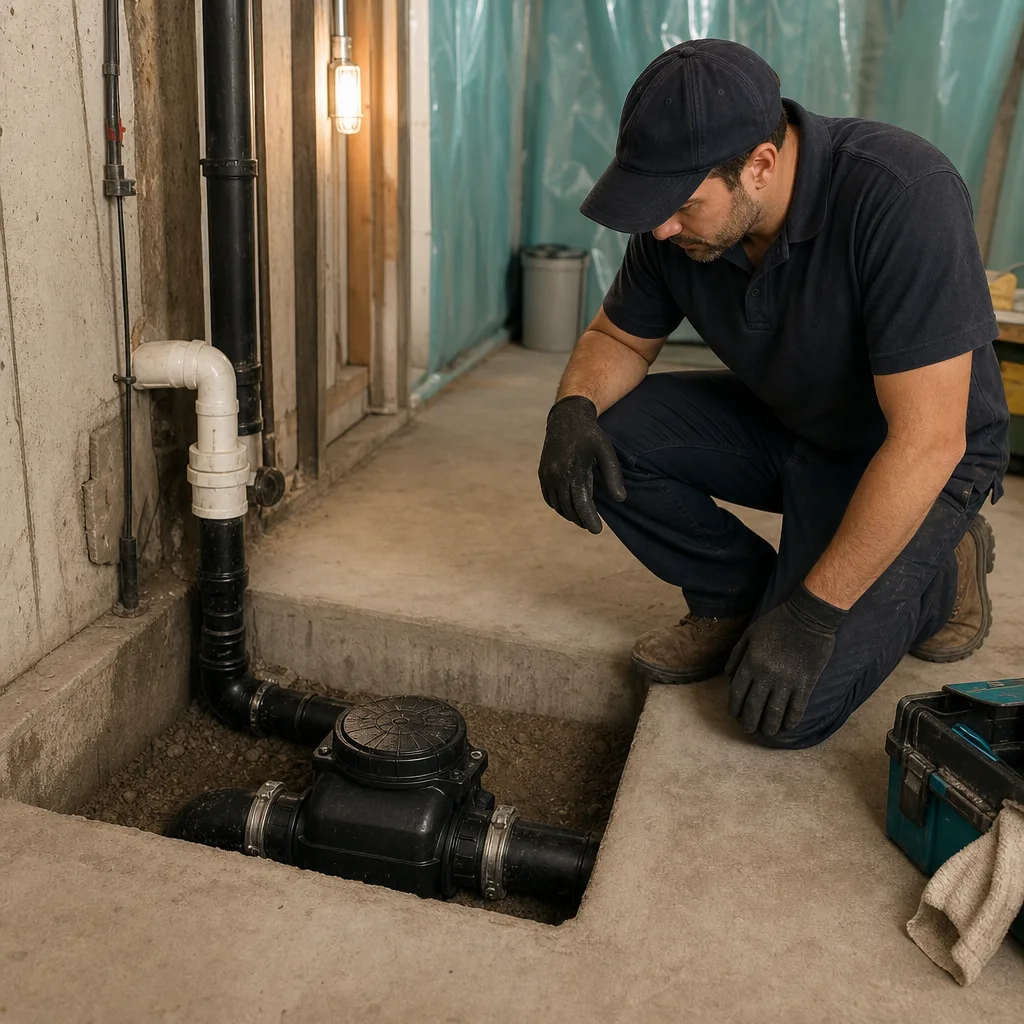
A backwater valve allows wastewater to leave normally and closes when sewer flow reverses. It can reduce damage from that specific pathway; it cannot stop groundwater, roof runoff, foundation leakage, a failed sump pump or a blockage on the house side. This guide turns Merivale’s corridor context into practical questions without claiming any local installation history or uniform sewer condition.
Use corridor plans as context, not a plumbing diagnosis
The Merivale name spans different building forms around Carling, Baseline, Clyde and farther south. A converted property near the northern commercial corridor can present different access and ownership questions from a detached house on a side street. Establish the legal address, building type, unit boundaries and municipal services before requesting a recommendation.
The City says its Merivale Road North functional design study is being undertaken in advance of an upcoming integrated road, sewer and watermain renewal project. A homeowner may reasonably ask how confirmed construction could affect access or timing, but should not infer that a public-main renewal repairs a private drain. Request project-specific information from the City and property-specific findings from a plumber.
Do not treat age, streetscape or a neighbour’s device as proof. Gather the home’s permits, renovation history, flood observations, insurance correspondence and known drain work. Evidence makes a quote more precise and helps separate a preventive upgrade from an unresolved defect.
Identify the water pathway before selecting equipment
Sewage or water rising through a floor drain or low plumbing fixture may indicate reverse drainage, but symptoms still need professional assessment. Water at a wall joint, window well or service penetration points toward other pathways. A musty finished basement with no observed event is not enough to prescribe a valve.
Document timing, weather, odour, affected fixtures and how the water receded. If contaminated water or electrical hazards are possible, keep people out and contact appropriate emergency and restoration services. Do not remove a drain cover during an active event to investigate.
A valve does not clear roots, scale, grease or a collapsed lateral. It also cannot guarantee that all branches are protected. Ask the plumber to explain the proposed failure pathway in plain language and state what the installation will not address.
Map a Merivale building drain before cutting concrete
A professional review should locate accessible cleanouts, trace fixtures and determine likely flow direction. Camera inspection is valuable where renovations have hidden the original route or where blockage and deterioration are concerns. A locator can relate the camera head to the floor, reducing speculative excavation.
The video only records surfaces it can reach and see. It may miss branches, cannot see through pipe walls and does not certify an entire service. Ask for insertion point, distance, observations and limitations in writing. If cleaning is needed for a useful view, authorize that separately.
Retain video and a marked plan. Before slab cutting, discuss utilities, dust isolation, contents, hazardous-material concerns, concrete depth and finish-floor removal. These are real scope items, not incidental details.
Related reading
Follow Ottawa’s permit and inspection sequence
The City of Ottawa maintains a dedicated page for backwater-valve permits, including application and inspection information. Check the current version for the proposed property and scope. Agree who submits, pays, responds to comments, books inspection and obtains closure.
An inspection checks applicable compliance at a stage when work is visible. It is not an engineering guarantee, rebate approval or promise of insurance coverage. Do not permanently conceal the installation before required inspection. Keep the permit identifier and result in the property file.
Do not use this article as a do-it-yourself sequence. Altering a sanitary building drain affects multiple fixtures and involves excavation, contamination and concealed-service risks. Product selection, branch protection, slope, venting and access require professional review.
Related reading
Check Ottawa rebate eligibility before commitment
Ottawa’s Residential Protective Plumbing Program offers financial assistance to qualifying owners for eligible protective plumbing. The current rules determine eligibility, application timing, required investigation, supporting records and limits. A Merivale address and compliant installation do not automatically produce a payment.
Read current City material before signing. Ask how prior assistance, property use, taxes, ownership or work already started could affect the application. Obtain address-specific clarification for ambiguity and keep the response. Never represent a contractor’s estimate as municipal approval.
Budget the full cost without assistance. Itemize permit, camera work, valve installation, concrete, flooring and cleanup. This makes proposals comparable and prevents a rebate assumption from driving an unsuitable technical choice.
Compare quotes around access, branches and restoration
A complete proposal identifies device type, location, protected fixtures, pipe work, investigation, permit responsibility, inspection coordination, testing and exclusions. It should explain what happens if the opened floor reveals an unexpected branch, damaged pipe or conflicting service.
Merivale’s mixed building forms make ownership important. Condominium, rental and commercial-residential properties may require approval beyond the person occupying the basement. Confirm who owns the drain and slab, who may authorize work and whether shutdown notice is needed.
Specify dust control, debris removal, concrete replacement and final flooring. Require a permanent, reachable access cover; a valve hidden beneath tile, shelving or cabinetry cannot be inspected properly. Compare equal scopes rather than totals.
Prepare occupants for a closed valve
While the valve blocks reverse flow, wastewater produced inside may be unable to pass it. Occupants should minimize or stop flushing, showering, laundry, dishwashing and other water use during a suspected closure. Otherwise private piping can fill and overflow indoors.
Ask for a handover demonstration covering normal position, access, signs requiring service and emergency contacts. Do not open a cover during active surcharge or force the mechanism. Post concise instructions where owners, tenants and caregivers can find them.
Coordinate separate plans for sump-pump or power failure if relevant. The valve is one layer, not whole-property flood protection, and it does not issue a warning by itself.
Preserve access through every basement renovation
Inspect and service according to manufacturer instructions and professional advice. Debris and deposits can prevent full closure. A service review can assess the flap or gate, seat, seals and cover without pretending to predict every future event.
Record model, date, service and observations. Call a plumber for binding, damage, leakage, odour or recurring accumulation. Do not pour chemicals into the drain or substitute unapproved parts as a shortcut.
When flooring or cabinetry changes, keep the cover visible, level and removable. Give records and water-use instructions to buyers and tenants. Maintenance supports reliability but does not guarantee a dry basement.
Related reading
Close out the project with evidence
Collect the itemized invoice, permit and inspection status, product literature, warranty, before-and-after photographs, camera files and a sketch of protected branches. Confirm restoration scope and access before final payment.
Send requested material to the insurer and ask about disclosure, deductibles, exclusions and maintenance expectations. Municipal and insurer decisions are separate; neither a permit nor possible rebate guarantees claim coverage.
File relevant City corridor notices separately. If public works later occur near the property, ask the project contact what is actually included rather than assuming the private valve or lateral will be altered.
Merivale’s corridor evolution also makes future renovation planning important. If a basement is converted, a unit is added or plumbing fixtures move, give the designer the valve record before drawings are finalized. A new connection made downstream of protection, or a finish placed over the cover, can undermine the original intent. Require revised drainage documentation after the alteration and ask whether municipal review is needed.
For occupied rental or mixed-use property, convert technical handover into an operating procedure. Name the person authorized to call for service, identify the shut-down message to occupants, and keep a printed copy where it remains available during a power or internet outage. Do not ask tenants to dismantle the valve. Provide a route for reporting slow drainage, odour, cover leakage or water entry before the symptoms become an emergency.
Seasonal property checks should remain pathway-specific. Before spring thaw and major storms, visually review accessible downspouts, window wells and the sump arrangement without claiming they predict sewer behaviour. Separately confirm that the valve access has not been covered by stored goods. After any suspected closure or backup, arrange appropriate professional assessment and contaminated-water cleanup; do not simply reopen the space and resume normal water use.
A careful project also respects uncertainty. If a camera cannot pass, plans conflict with visible piping or the proposed device cannot remain accessible, pause and investigate rather than pricing the unknown as though it were settled. Ask each bidder to state assumptions in writing. This makes later changes fairer and helps the owner choose a scope based on evidence, not confidence alone.
Finally, treat public renewal timing as a coordination question. A confirmed street project may influence when owners want interior disruption, but delaying necessary private repairs can have consequences and rushing ahead may duplicate access work. Ask the municipal project contact what is fixed, what remains conceptual and whether private-side coordination is offered. Then make the decision with the plumber using the house condition and household tolerance for disruption. If a proposal relies on future City work, require the assumption to be stated and verified. Public consultation maps can evolve, construction limits can change, and private-side work may remain entirely the owner’s responsibility. A dated written answer is more useful than an informal prediction. Revisit scheduling if the municipal project changes, but do not alter or abandon required maintenance while waiting. Update every contact and record after ownership changes.
Merivale backwater valve FAQ
Does planned Merivale road and sewer work mean my private drain will be replaced?
Not necessarily. Public project limits and private-property responsibilities are distinct. Review current City documents and ask the project contact about the address; have a plumber assess the private drain independently.
Can a backwater valve solve every basement water problem?
No. It addresses reverse flow in protected drainage. Groundwater, grading, window wells, foundation leakage, plumbing leaks, sump failure and private blockages require separate measures.
Does Ottawa require a permit?
The City publishes a specific permit process for backwater valves. Confirm current requirements and required inspection before work, and establish who will submit and close the file.
Is a City rebate guaranteed?
No. Assistance is conditional on current Residential Protective Plumbing Program rules and documentation. Verify eligibility before commitment and budget for the full project.
Why consider a camera inspection?
It can document accessible pipe condition and help trace a route before opening a finished floor. It cannot reveal every branch or hidden condition, so its limits should be recorded.
Can water be used when the valve closes?
Water use should stop or be sharply reduced because household wastewater may not pass the closed device. Continued discharge can cause an interior overflow.
What records should a Merivale owner keep?
Keep permits, inspection results, invoices, product and warranty data, photographs, drain video, a location sketch, service records and written insurer correspondence.
Sources and official references
- Merivale Road North Community Design Plan
- Merivale Road North Functional Design Study
- Baseline–Merivale Secondary Plan
- City of Ottawa backwater valve permit page
- City of Ottawa Residential Protective Plumbing Program
- Lister Plumbing service page
Programs, permits and bylaws change. Confirm current requirements with the City of Ottawa before acting.
Questions about your Merivale home?
Ask a local plumber, without pressure.
Requests are sent to Lister Plumbing, who serve homes across all Ottawa areas listed here. A request is not a commitment, and no price is promised before someone looks at your plumbing.