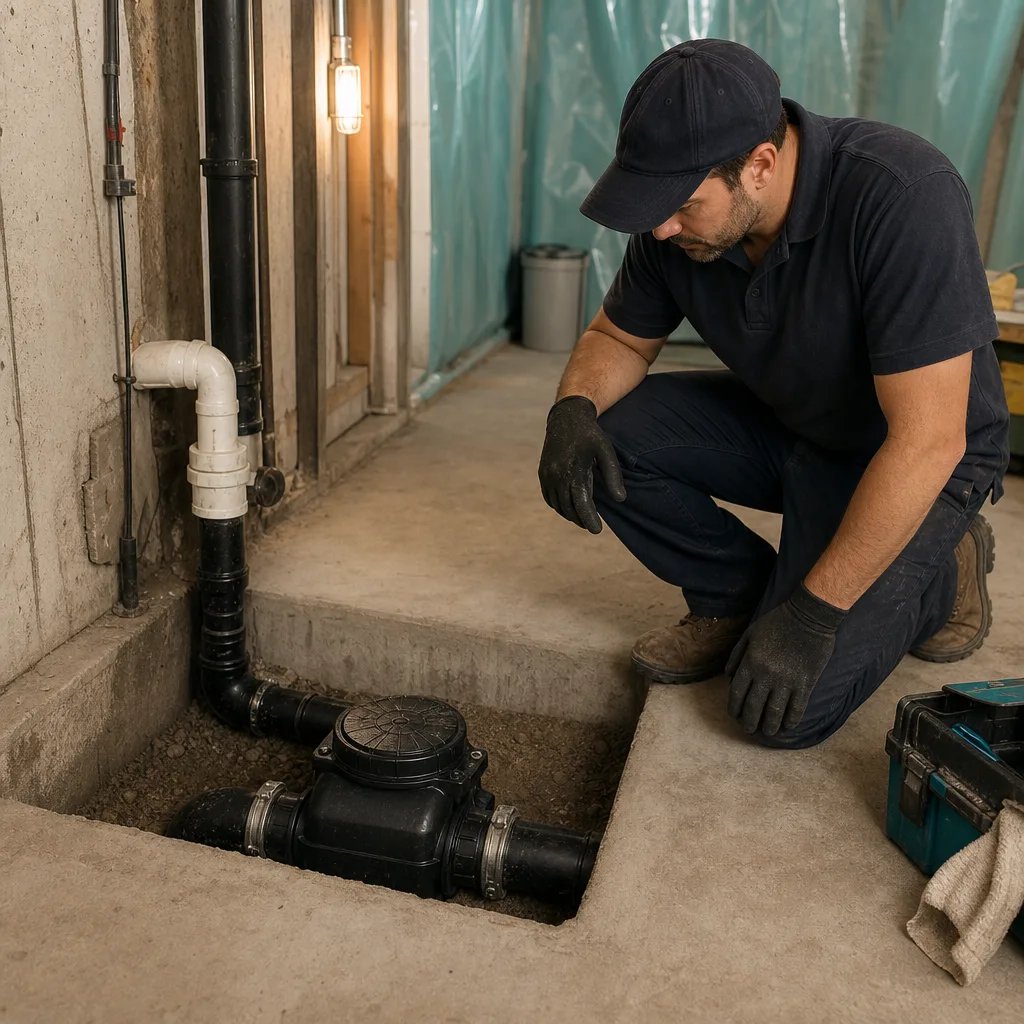
Nepean is not one uniform building era. Its broad geography includes established neighbourhoods around Merivale, Centrepointe, Leslie Park, Bells Corners, Parkwood Hills, and areas reaching toward the Greenbelt and Rideau River. Houses may have decades of additions, basement conversions, plumbing replacements, and changes to exterior drainage. That makes a backwater valve primarily a property-investigation question: what line serves this house, what is already installed, and which route actually allowed water to enter?
A properly chosen valve can reduce the chance of sewage or storm drainage reversing through the pipe it protects. It cannot waterproof a foundation, prevent surface runoff, repair a damaged lateral, or guarantee a dry basement. This guide helps Nepean owners organize assessment, permit, rebate, quote, insurance, and maintenance decisions without claiming that any street has a particular sewer configuration or history.
Treat an established Nepean house as a unique retrofit
Original drawings may no longer describe a house that has gained a basement bathroom, laundry relocation, addition, or secondary unit. Before discussing a valve location, gather permits and renovation documents, identify visible floor drains and cleanouts, and note where the building sewer appears to leave. A professional should reconcile records with what exists rather than selecting a location from age or neighbourhood alone.
Access can be the defining challenge. Terrazzo, tile, heated flooring, built-ins, and finished ceilings below plumbing branches all change disruption and restoration. Ask for the proposed access opening to be marked and the permanent cover explained. The least visible location is not necessarily the most serviceable or hydraulically appropriate one.
Before disturbing an older floor assembly, ask who will assess materials that could require special handling. Flooring, adhesive, pipe insulation, or other concealed finishes should not be casually cut when their composition is unknown. The valve contractor's scope should identify whether testing, abatement, or specialist work is excluded and how the opening will be made only after relevant safety questions are resolved. This is a renovation-planning precaution, not a claim that any particular Nepean house contains a hazardous material.
Measure more than the valve cover. Confirm the working space a technician will need to remove internal components, see the direction-of-flow marking, clean the body, and replace seals without damaging adjacent finishes. A narrow closet or tight mechanical room may look convenient on a drawing but prove impractical once a furnace, water heater, laundry appliance, or storage door is considered. Review clearances on site before the floor is opened.
Identify the entry route before selecting protection
Sewer backup may appear at a floor drain or low fixture, while groundwater or surface water may show at cracks, walls, window wells, or doors. A roof leader discharging too close to the foundation presents a different issue from reverse sanitary flow. Write down the first location, timing, odour or clarity, plumbing use, rainfall, snowmelt, and sump behaviour. These observations help a professional form and test possibilities.
Do not expose yourself to contaminated water to investigate. Keep away from affected electrical systems and use appropriate emergency and restoration help after an incident. A preventive-plumbing assessment can follow, but it should not substitute for safe cleanup or for structural, grading, and waterproofing advice where those disciplines are relevant.
Related reading
Define exactly what the proposed valve will protect
The valve allows normal outward flow and closes against reverse flow. The plumber should state whether the proposal concerns sanitary or storm drainage, which basement fixtures or branches are upstream, and what remains outside its protection. Device selection and placement require professional review because an incorrectly understood branch can undermine the intended result.
When closed, the protected drain cannot discharge normally, so occupants need to limit water use. The valve does not manage water that bypasses the drain, and no mechanical device is infallible. Debris, wear, damage, poor access, or an installation problem can affect performance. Those limits belong in the decision—not in fine print after work.
Related reading
Investigate older private piping and later alterations
Where a line's route or condition is uncertain, a drain camera and locating work may inform the scope. The inspection can reveal visible defects, deposits, offsets, roots, or connections in the accessible section. It cannot see through opaque water, inspect every branch, or promise how a pipe will perform later. Request useful footage or findings and a plain-language interpretation.
If deterioration or blockage is found, ask whether it must be corrected before or as part of valve work. A valve is not a repair for a broken sewer lateral. Separate diagnosis, necessary pipe repair, protective-device installation, and cosmetic restoration on the estimate so each choice and potential rebate category can be understood.
Related reading
Plan around Ottawa's building permit and inspection
Ottawa says a building permit is required to install a backwater valve. Check the current City requirements for the actual scope before work begins. The contract should assign the permit application, fees, inspection booking, access for inspectors, and responsibility for corrections. A professional installation does not make the municipal process optional.
Keep work visible for required inspection and do not let restoration race ahead of approval. Retain the permit and final inspection record with the approved details, invoice, valve model, photographs, and maintenance instructions. This evidence can help future owners and insurers understand the installation, although it cannot guarantee a claim decision, premium change, or resale outcome.
Related reading
Sequence rebate questions before excavation
Ottawa's Residential Protective Plumbing Program may assist qualified property owners with approved measures, including sanitary or storm backwater valves. Read the official program page for current eligibility, amounts, documents, and process. A Nepean address alone establishes neither eligibility nor approval, and previous program terms may not be current.
Ask the City whether any step must occur before installation and what permit and inspection evidence accompanies an application. Ensure invoices itemize the eligible device work separately from lateral repair, flooring, cabinetry, or decorating. Make the protection decision on its merits and budget for the full contract; a pending or expected rebate is not payment certainty.
Related reading
Account for Nepean's varied property and ownership types
Detached homes, semis, row houses, condominiums, and multi-unit conversions can involve different ownership boundaries and approvals. Before altering a slab or drain in a condominium or common-element setting, establish who owns the pipe and floor and obtain required authorization. For a rental or secondary unit, coordinate lawful access and communicate how a closed valve affects water use.
The Greenbelt and nearby waterways shape Nepean's geography, but they should not be turned into blanket flood claims. Ottawa's interactive map addresses known riverine hazards and is informational; the relevant conservation authority can provide current property-specific information. Riverine mapping does not diagnose private sewer backup, and sewer protection does not replace river or surface-water planning.
Related reading
Demand a quote that describes the retrofit, not just the device
The written scope should identify the protected line, valve make or performance description, exact location, investigation included, demolition, soil and concrete handling, permit and inspection duties, testing, access cover, cleanup, and restoration limit. Ask whether taxes, fees, camera work, and disposal are included. In an older finished basement, define who handles hazardous-material concerns before disturbing suspect materials.
Changed conditions should trigger a documented explanation and price authorization. Compare proposals on the same scope rather than headline price. Lister Plumbing publishes an Ottawa installation service page and can be contacted for an assessment; that link is not evidence of completed Nepean projects, a testimonial, or a result guarantee.
Related reading
Protect access through the next basement renovation
Keep the access cover unobstructed and enough surrounding clearance for inspection. Do not bury it under glued flooring, cabinetry, or a partition. Save the manufacturer's instructions, model information, installer record, permit, and service history. Mark the location on a simple house plan so it is not lost when finishes or ownership change.
Follow device-specific maintenance guidance and arrange professional inspection if the gate or flap appears obstructed, components are damaged, drainage changes, or you are unsure how to proceed. Do not force the mechanism or improvise parts. Ottawa's homeowner guidance emphasizes maintaining protective plumbing; reliable access is the first requirement for doing so.
Related reading
Coordinate valve planning with secondary units and renovations
If the basement is being converted, legalized, or extensively renovated, do not treat protective plumbing as an isolated last-minute add-on. New bathrooms and laundry can change branch arrangements, while fire separations, sound assemblies, accessibility, and finished-floor design can constrain access. Have the designer, plumber, and permit professionals coordinate the as-built drainage and the removable valve cover.
Ask whether the valve will protect every intended basement fixture or only a defined branch, and have that answer documented. A future occupant should not need to remove a wall or built-in to reach it. Plumbing approval does not replace any other building, zoning, or rental requirements associated with the project, and the presence of a valve does not make a basement suitable for occupancy by itself.
Turn installation documents into a usable house record
Create a labelled folder containing the pre-work assessment, camera findings if any, written scope, permit, approved details, inspection result, change orders, invoice, proof of payment, model instructions, warranty, and dated photographs before and after concrete placement. Mark the valve and cleanouts on a simple basement sketch. This helps distinguish the protected line from assumptions during later work.
Give the insurer facts, not promises: the installed model, line, professional invoice, permit, inspection, and maintenance plan. Ask how the policy treats sewer backup, overland water, groundwater, additional living expense, contents, deductibles, and exclusions. Retain written answers. Protective plumbing and insurance are complementary controls; neither makes the other unnecessary.
Also document the boundary between the private sewer service and City infrastructure as it is explained for the property. If inspection identifies a defect away from the proposed valve, confirm who is responsible for that location before approving repair. The City publishes homeowner-responsibility guidance, but a camera distance or rough floor mark alone may not establish a legal property line. Survey, service, and municipal records may be needed to turn a diagnosis into the correct repair request.
Build a whole-property protection plan
Combine the sewer-side decision with review of lot grading, downspouts, window wells, foundation openings, sump and backup power where applicable, and appropriate household insurance. Each measure addresses a pathway or consequence. Ask the insurer to define sewer-backup and overland-water coverage, limits, deductibles, exclusions, and documentation needs in writing.
Proceed only when the diagnosis, protected line, access, permit path, restoration boundary, maintenance plan, and realistic limitations are clear. Pause if the pitch promises complete flood prevention, assumes a rebate, or treats every Nepean property as equivalent. Careful scoping may feel slower, but it is essential in a retrofit where hidden conditions carry much of the cost and risk.
Nepean backwater valve FAQ
Are older Nepean homes automatically good candidates for a valve?
Age alone does not decide. A professional should identify the private drainage, entry pathway, pipe condition, branches, existing devices, and feasible accessible location. Other measures may be equally or more important depending on the diagnosis.
Can a plumber install through my finished basement without a permit?
Ottawa states that backwater-valve installation requires a building permit. Confirm current submission and inspection steps, assign responsibility in writing, and preserve access until the required inspection is complete.
Will a valve fix a cracked or root-affected sewer lateral?
No. It controls reverse flow when operating correctly; it does not repair structural damage or remove an obstruction. Investigate the line and scope necessary repairs separately.
Does living near the Greenbelt or Rideau River prove sewer-backup risk?
No. Geography and riverine mapping do not diagnose a private sewer. Use official flood information for river hazards and a property-specific plumbing assessment for sewer pathways.
Could my Nepean retrofit receive an Ottawa rebate?
Possibly, if the owner, property, work, timing, permits, inspections, and documents satisfy the current program. Only the City can decide. Verify before work and do not treat funding as guaranteed.
What should remain visible after the basement floor is repaired?
The valve's approved access cover must remain readily reachable with working clearance. Do not hide it beneath permanent flooring, furniture that cannot be moved, walls, or cabinetry.
Does a permitted valve guarantee sewer-backup insurance?
No. Coverage depends on the specific policy, endorsements, limits, exclusions, and insurer decisions. Ask the insurer directly and retain installation and inspection records.
Sources and official references
- City of Ottawa Residential Protective Plumbing Program
- City backwater valve permit guidance
- City basement flooding prevention
- City service-line responsibility and risk
- City interactive flood plain map
Programs, permits and bylaws change. Confirm current requirements with the City of Ottawa before acting.
Questions about your Nepean home?
Ask a local plumber, without pressure.
Requests are sent to Lister Plumbing, who serve homes across all Ottawa areas listed here. A request is not a commitment, and no price is promised before someone looks at your plumbing.