A backwater valve is a one-way protective device on a building drain. Under normal conditions wastewater leaves the house; if flow reverses from the public sewer, the valve closes to help stop that reverse flow from reaching low fixtures. That focused purpose matters in Convent Glen, an established northwest Orléans community between the Ottawa River, the Greenbelt, Champlain Street and St. Joseph Boulevard. A homeowner should assess the actual house, not infer plumbing conditions from its proximity to the river, a park, a road or another property.
This guide explains how to commission an installation without claiming that every Convent Glen home has the same drain arrangement or exposure. Lister Plumbing has confirmed service coverage in the area, but no local project record has been supplied for this article. The sound starting point is evidence: fixture elevations, the route and condition of the sanitary building drain, existing protective devices, exterior grading and any documented history at the address.
Start with the house, not a Convent Glen assumption
Convent Glen and Orléans Wood contain an established residential fabric, but neighbourhood boundaries do not reveal whether one house has a finished basement, a below-grade bathroom, an older floor drain, a sump system or previous plumbing alterations. Even attached homes on the same street can differ. Collect renovation permits, inspection notes, insurance correspondence and any invoice identifying the sewer lateral before asking for a recommendation.
Write down what you are trying to protect. A basement with a toilet and shower presents different potential entry points than storage space with only a floor drain. Note whether water previously appeared through a fixture, foundation joint, window well or sump opening. Reverse sanitary flow is only one pathway. A valve cannot correct poor lot grading, a leaking foundation, a failed sump pump, a blocked private lateral or water entering at a window.
Convent Glen’s Ottawa River edge is locally meaningful, yet river flooding and sewer backup are not interchangeable diagnoses. The community association’s published boundaries are useful geographic context, not a property-level risk map. Ask a qualified plumber to connect observed symptoms to a plausible pathway before selecting equipment.
Map the sanitary route before opening the floor
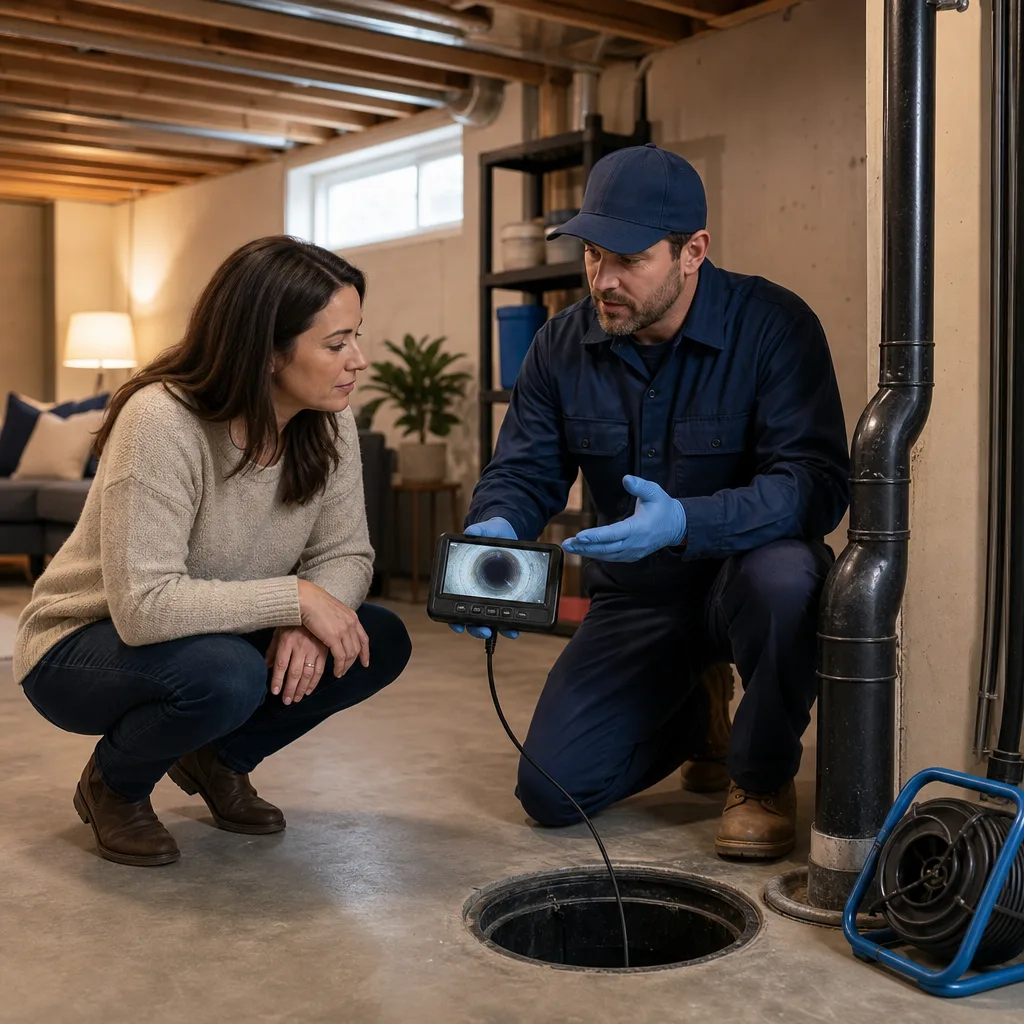
Installation planning normally begins by locating the building drain and determining which fixtures it serves. A plumber may review accessible piping, cleanouts and fixture locations, then recommend a camera inspection or other investigation when the route or condition is uncertain. The objective is not merely to find pipe, but to identify a compliant location where reverse flow can be controlled without creating an unintended trapped or unprotected branch.
Camera work can document offsets, roots, cracks, deposits and branch connections in the portion it can see. It does not see through soil, certify every hidden fitting or guarantee the remaining life of a lateral. Ask for an explanation of where the camera entered, how far it travelled, what reference points were used and whether locating equipment is needed before excavation.
This evidence is especially valuable before cutting a finished basement slab. A quote based only on a guessed route can omit flooring removal, concrete restoration or rerouting around utilities. Keep the video and written findings with the house file; they provide a baseline for later maintenance and future owners.
Use Ottawa’s permit and inspection path
The City of Ottawa publishes a dedicated backwater-valve permit page with application requirements, fees and required inspection information. Requirements can change, so verify the current page before work rather than relying on an old neighbour’s invoice. Establish in writing who prepares drawings, submits the application, schedules inspections and closes the permit.
Do not conceal the valve or permanently restore the floor before the required municipal inspection has occurred. The inspector’s role is code compliance; it does not guarantee that the device will prevent every flood, that an insurer will approve coverage or that a rebate will be paid. Keep the permit number, inspection outcome, model information, photographs and final invoice together.
This is not a sensible do-it-yourself excavation. Cutting concrete can encounter utilities, and altering a sanitary drain can affect every connected fixture. Product selection, branch layout, venting, access and testing require professional review. Use the project’s actual scope and current municipal direction, not generic online installation steps.
Treat the Ottawa rebate as conditional assistance
Ottawa’s Residential Protective Plumbing Program provides financial assistance for qualifying protective work, including eligible sanitary and storm backwater valves. Eligibility, approved costs, application timing, documentation and maximum assistance are governed by current program rules. Being a Convent Glen resident, receiving a quote or obtaining a permit does not by itself guarantee payment.
Read the current program material before authorizing work. Ask whether pre-approval or a preliminary investigation is required, which invoices must be itemized, and what proof of payment and inspection records are expected. If the property has already received assistance, has mixed residential use or presents unusual ownership, contact the City for an address-specific answer.
Build a budget that remains workable if assistance is delayed or denied. Separate plumbing, permit, investigation, concrete, finish-floor and cleanup costs so comparisons are meaningful. Never allow a rebate estimate to replace technical diagnosis.
Build a quote around access and restoration
A useful quote identifies the proposed valve type and location, fixtures or branches protected, investigation allowance, excavation limits, permit responsibility, inspection coordination, testing, disposal and restoration. It should also list exclusions. In a finished lower level, clarify who moves contents, removes flooring, controls dust, replaces concrete and restores the final floor covering.
Require an accessible service opening. Hiding the cover under fixed cabinetry or flooring defeats routine inspection and makes an urgent check slower. Discuss how the cover will sit relative to the finished floor and how occupants can reach it without tools or heavy furniture. In townhouses or condominiums, confirm ownership and alteration approval before assuming a private contractor may cut the slab.
Compare scope rather than a single total. One proposal may include camera work and permits while another assumes clear access and leaves restoration to the owner. Ask how unforeseen branches, damaged pipe or unsuitable conditions will be priced and approved before extra work begins.
Plan household use when the valve closes
When a normally open backwater valve closes against reverse flow, wastewater from the home may also be unable to leave through that protected drain. Residents should minimize or stop water use during the event. Flushing toilets, running laundry, showering or operating a dishwasher can load the piping behind a closed valve and cause an internal overflow.
Ask the installer to explain the model’s normal position, what occupants may observe during closure and when professional help is appropriate. Post a short response note near the access cover and include household members who were not present at handover. Never open a cover during suspected pressurized backup merely to look inside.
A valve is a passive mechanical device, not an alarm or unlimited storage system. A family emergency plan should also cover sump-pump failure, surface water and power interruption where those hazards are relevant to the property.
Keep the flap, seat and access cover serviceable
Debris, grease and deposits can interfere with sealing. Follow the manufacturer’s instructions and the installer’s recommended inspection schedule. A professional service visit can check movement, seating surfaces, seals, cover condition and visible damage. Frequency should reflect the product and observed conditions rather than an invented neighbourhood rule.
Keep the access area dry, visible and unobstructed. Record the model, installation date and each inspection. Call a plumber if the cover leaks, the mechanism is damaged, drains behave unusually or the device repeatedly collects material. Do not force components, substitute incompatible parts or pour chemical cleaner into the system as a maintenance shortcut.
Maintenance reduces avoidable failure risk but cannot turn the valve into a guarantee. Pipe blockage downstream, an unprotected connection or water entering from another pathway may still cause damage.
Related reading
Coordinate sewer protection with river-edge drainage realities
Convent Glen’s location near the Ottawa River and Greenbelt makes watershed language familiar, but a homeowner still needs parcel-specific observations. After heavy rain or thaw, safely note downspout discharge, low spots, window wells, foundation cracks and sump behaviour. Do not redirect water onto a neighbouring property, sidewalk or road.
Keep roof water directed away from the foundation where lawful, maintain grading and clear private drainage features. These measures address water outside the sanitary pipe; they complement rather than duplicate a backwater valve. If water enters where walls meet the slab, engage an appropriate drainage or foundation professional instead of assuming a larger valve is the answer.
Municipal infrastructure projects or new transit nearby should not be used to infer the private lateral’s condition. Convent Glen Station and corridor planning describe community change, not hidden plumbing in a particular home.
Related reading
Close the project with a durable house record
Before final payment, obtain the permit and inspection status, itemized invoice, product literature, warranty terms, camera files if commissioned, photographs before closure and a clear explanation of the protected fixtures. Verify that the access cover opens and that its location is marked on a simple basement plan.
Send the relevant documents to the insurer and ask direct questions about notification, deductibles, exclusions and any maintenance evidence it expects. Municipal inspection and rebate approval are not insurance approval. Retain written responses rather than relying on a phone summary.
If selling, give the record to the next owner and explain the water-use restriction during closure. Good documentation preserves the value of an installation better than an unlabelled cover whose purpose nobody understands.
Convent Glen backwater valve FAQ
Does every Convent Glen basement need a backwater valve?
No area-wide answer is responsible. Need depends on the property’s drain layout, fixture elevations, existing protection, condition and history. Have a qualified plumber assess the address and distinguish sanitary backup from groundwater or surface entry.
Does being near the Ottawa River prove sewer-backup risk?
No. River flooding, overland drainage, groundwater and sanitary sewer reversal are different pathways. Location provides context but not diagnosis. A backwater valve addresses reverse flow through connected drainage, not water through windows or foundations.
Is an Ottawa permit required?
Ottawa publishes a permit process specifically for backwater valves. Confirm current requirements for the proposed scope before work and arrange required inspection before concealment. The contractor and owner should agree who handles every step.
Will Ottawa reimburse the full Convent Glen installation cost?
Do not assume so. The Residential Protective Plumbing Program has current eligibility rules, eligible-cost definitions, limits and documentation requirements. Approval and payment are not guaranteed; obtain the City’s current guidance and budget independently.
Can I keep using water if the valve has closed?
Minimize or stop household water use. Wastewater may not be able to leave while the valve blocks reverse flow, so toilets, showers and appliances can create an internal overflow. Follow the installer’s model-specific emergency guidance.
Should a camera inspection be included?
It is often useful when pipe routing or condition is uncertain, particularly before disturbing a finished floor. It cannot reveal every hidden detail, so ask what was inspected, how far the camera travelled and how findings affect the proposed location.
How often should the valve be maintained?
Use the manufacturer’s instructions and the installer’s recommendation, adjusted for observed debris and operating conditions. Keep the cover accessible and document service. Arrange professional review if components bind, leak or show damage.
Sources and official references
- City of Ottawa Residential Protective Plumbing Program
- City of Ottawa backwater-valve permit page
- Convent Glen–Orléans Wood Community Association boundaries
- OC Transpo Convent Glen Station
- Lister Plumbing backwater valve installation
Programs, permits and bylaws change. Confirm current requirements with the City of Ottawa before acting.
Questions about your Convent Glen home?
Ask a local plumber, without pressure.
Requests are sent to Lister Plumbing, who serve homes across all Ottawa areas listed here. A request is not a commitment, and no price is promised before someone looks at your plumbing.