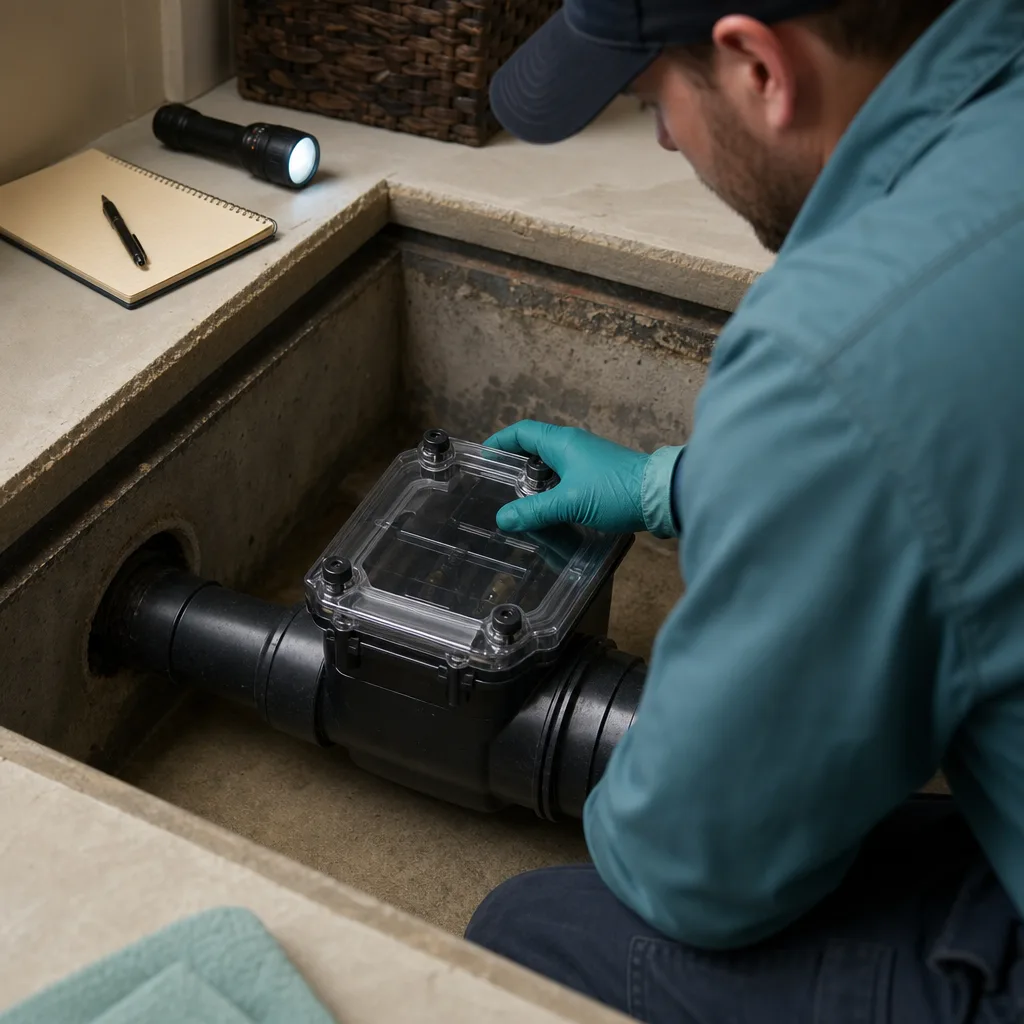
Orléans stretches across established and newer neighbourhoods east of Ottawa's Greenbelt, from areas near St-Joseph Boulevard to communities south toward Innes Road and east toward the urban boundary. Housing type, construction period, basement finish, lot slope, and renovation history vary substantially. Those differences matter more to a backwater-valve decision than a broad assumption about the east end. The starting point is a property-specific review of the private drainage and the route by which water could enter.
A backwater valve has a precise role: when correctly selected and installed, it permits normal outward drainage and resists reverse flow through the line it protects. It does not control rain entering a window well, seepage through a foundation, surface flow, sump failure, or every blocked drain. This homeowner guide explains a disciplined assessment, permit, rebate, installation, and maintenance path for Orléans without claiming local project experience or assigning a sewer configuration to any neighbourhood.
Read the house, not an Orléans-wide risk story
A property in Queenswood or Convent Glen may have a different construction and renovation history from one in Avalon, Fallingbrook, Chapel Hill, or newer eastern development. Even houses built together can diverge after basement bathrooms, additions, repairs, or finished-floor changes. Gather permits, plans, invoices, and prior inspection information, then ask a qualified plumber to identify what is present.
Avoid assuming that a newer-looking home contains an accessible, maintained valve, or that an older home contains none. Ottawa publishes construction-date information that can prompt a records search, but only physical verification establishes whether a device exists, which service it protects, and whether it remains operable after alterations.
Distinguish sewer reversal from slope, surface, and foundation water
Orléans includes rolling terrain and lands associated with waterways, but topography does not diagnose a basement event. Sewage or drainage rising at a low fixture suggests a different investigation from clear water appearing at a wall, walkout, window, or sump. Note the first visible point, weather, household water use, odour, colour, duration, and equipment behaviour without entering contaminated water.
Review downspouts, grading, window wells, exterior openings, sump systems, and private sewer condition as separate pathways. A backwater valve may form part of the answer after reverse-flow exposure is identified. It should not be sold as a substitute for correcting a negative grade, repairing a foundation, maintaining a sump, or managing surface runoff.
Identify the protected service and connected branches
The assessment should name the proposed sanitary or storm line, establish flow direction, consider upstream branches, and choose a location that can be excavated, inspected, and permanently accessed. A camera inspection or locating equipment may help where route or condition is uncertain. Ask for an interpretation rather than raw footage alone; the visible section is not a complete map or performance warranty.
If an existing valve is found, identification and condition come before replacement. Determine its application, accessibility, observed state, and available records. If the line contains damage, roots, an offset, or deposits, ask whether repair is needed independently of protective plumbing. A valve does not cure a deteriorated lateral or blockage.
Ask the assessor to distinguish a cleanout from backwater-valve access rather than identifying a round cover by appearance alone. A cleanout provides an entry point for drain service; it does not necessarily contain a mechanism that closes against reverse flow. Photograph labels and the surrounding location, but leave opening and identification to someone who can do it safely. An accurate inventory prevents a quote for duplicate or irrelevant work.
Where a camera inspection is proposed, agree on a reference point and how distances will be reported. Footage should be tied to an accessible feature rather than described only as metres from an unspecified opening. If a defect is observed, ask whether its material, severity, and exact location can truly be determined from the image or whether another investigation is required before repair pricing.
Related reading
Prepare the household for a closed valve
During reverse flow, the mechanism closes. Water generated inside then cannot leave normally through the protected route, so residents should minimize showers, laundry, dishwashing, flushing, and other discharge until conditions normalize. Ask the installer how the selected device operates, what signs merit service, and which fixtures are upstream.
This operating reality is especially important in multi-generational or multi-unit households, where not everyone may see a basement cover or know an event is occurring. Provide simple, model-specific instructions without attempting to force or dismantle the device. A valve is a risk-reduction measure, not permission to ignore slow drainage or continuing backup symptoms.
Make the Ottawa permit an early project requirement
The City of Ottawa states that installing a backwater valve requires a building permit. Verify the current application and inspection process for the proposed work. The written contract should say who obtains the permit, pays fees, books inspections, exposes the work, and corrects deficiencies. Do not accept the idea that a permit matters only when pursuing a rebate.
Hold floor closure and finish restoration until the required inspection stage is complete. Retain the permit, approved details, invoice, valve model, photographs, final inspection record, and maintenance information. These documents support later service and factual conversations with buyers or insurers, but they cannot guarantee a claim outcome, premium adjustment, or resale value.
Related reading
Verify Ottawa program eligibility and documentation
Ottawa's Residential Protective Plumbing Program describes assistance for qualified owners undertaking approved protective work, including sanitary and storm backwater valves. Eligibility depends on the current program, not simply an Orléans address. Review the official page before work and ask the City about applicant, property, device, timing, permit, inspection, invoice, and submission conditions.
A clear estimate should separate the valve installation from unrelated drain repair and decorative restoration. Keep proof of payment and all required records, but budget on the possibility that an application is delayed, reduced, or refused. No plumber can approve municipal funding, and no informational website can guarantee it.
Use flood maps for river questions, not sewer conclusions
The Ottawa River and smaller waterways are part of the broader east-end setting. Ottawa's interactive map can help identify known riverine flood hazards, and the City directs owners to conservation authorities for current property-level information. A mapped riverine hazard and a sewer-backup pathway are different questions; one does not prove the other.
Likewise, being outside mapped riverine areas does not rule out private drain, grading, foundation, or surface-water problems. If a purchase or renovation depends on flood exposure, seek property-specific municipal, conservation-authority, building, plumbing, and insurance advice. Do not rely on a neighbourhood name or a backwater valve as a single answer.
Related reading
Coordinate the access cover with a finished Orléans basement
Before excavation, mark the opening and discuss contents protection, dust control, concrete reinstatement, disposal, and finish boundaries. Tile, laminate, carpet, heated flooring, cabinetry, and partitions can change both cost and future access. A quote should specify whether matching materials and decorating are included, excluded, or impossible to match.
The access cover must remain reachable after restoration. Do not hide it beneath permanent flooring or built-ins. In a condominium or common-element property, confirm ownership and approvals before altering a slab or drain. In a rental or secondary unit, coordinate lawful access and ensure occupants understand water-use limits during a closure.
Compare complete scopes instead of valve prices
Request the identified line, proposed valve and location, investigation included, excavation, permit responsibility, inspections, testing, concrete repair, access cover, cleanup, restoration, warranty, and exclusions in writing. Ask what findings can change the scope and require authorization before extras proceed. This makes competing proposals comparable.
Lister Plumbing provides an Ottawa backwater-valve service page and can be asked for an assessment. That availability is not a claim that it completed local projects or achieved particular outcomes. Evaluate any provider on the property-specific reasoning, written scope, permit plan, and willingness to explain limitations.
Related reading
Resolve townhouse and condominium boundaries before work
Orléans includes many row-house and condominium settings where a pipe, slab, exterior cleanout, or restoration area may fall within shared or corporation-controlled property. Obtain the declaration, maintenance responsibility information, and written authorization that apply rather than assuming the homeowner can alter every visible component. Ask whether adjacent units share any relevant infrastructure, but do not accept an answer based only on building appearance.
The plumbing assessment should identify only what can be verified and should flag ownership questions for the corporation or appropriate legal documents. Coordinate water-use notices, inspection access, noise, parking, and restoration through the required channel. A City permit does not override private approvals, and private approval does not replace the City permit.
For a freehold row house, shared walls still affect dust, noise, and access even when the drain is private. Define the work zone and emergency contact. These steps are practical coordination, not evidence that the neighbouring homes need the same device.
Build a factual record for maintenance and insurance
Save the drain assessment, photographs, permit, inspection result, signed quote, change orders, itemized invoice, proof of payment, model literature, warranty, and service dates. Add a simple sketch showing the access cover and protected service. Label records in the household's preferred language or both languages so future occupants understand them.
Ask the insurer to define sewer backup, overland water, groundwater, and river flooding under the actual policy. Confirm limits, deductibles, exclusions, protective-device expectations, and whether documentation affects underwriting. Do not interpret an installer recommendation as coverage advice. A valve reduces a physical pathway; insurance addresses specified financial consequences subject to contract terms. Recheck those answers whenever the policy, occupancy, basement use, or property ownership changes.
When service is requested in French or English, confirm that the written scope, operating explanation, and close-out documents are understood in the household's chosen language. Technical terms such as sanitary service, storm service, cleanout, access cover, and reverse flow should be attached to the correct physical item. Clear communication is a safety and maintenance tool, not merely a translation preference.
Keep bilingual household records clear and practical
In a household that uses English, French, or both, label the access and keep simple operating information everyone can understand. Store model instructions, permit details, inspection records, and service dates together. The aim is not a technical manual for occupants; it is shared awareness of the device's location, purpose, and the need to limit drainage if it closes.
Follow manufacturer-specific inspection and cleaning guidance, and call a licensed plumber when condition or operation is uncertain. Never force damaged components or improvise replacements. Keep the cover clear during storage and future renovations. Ottawa recommends maintaining protective plumbing; reliable access and accurate records turn that recommendation into a manageable routine.
Related reading
Orléans backwater valve FAQ
Does every newer Orléans home have a working backwater valve?
Do not assume it. Construction requirements and dates can guide a records search, but presence, protected service, access, modifications, and condition require physical verification by a qualified professional.
Can a valve stop water flowing down a sloped driveway or into a walkout?
No. That is a surface-water pathway. Review grading, drainage, thresholds, and other building measures. The valve addresses reverse flow through the drainage line it protects.
Is a permit required for Orléans installation?
Yes. Orléans is within the City of Ottawa, whose official guidance says backwater-valve installation requires a building permit. Confirm current submission and inspection requirements before work.
Does Ottawa automatically rebate the work?
No. Current program eligibility, approved measures, timing, permits, inspections, costs, and documentation govern the decision. Verify directly with the City and budget without assuming approval.
Should camera inspection be in every quote?
Not necessarily. It is useful when line route, connections, or condition need investigation, but the professional should explain its purpose and limitations for your property.
What should occupants do if the valve closes?
Reduce water use so wastewater is not added behind the closed valve. Follow the selected model's instructions and contact a professional if normal drainage does not return or device condition is uncertain.
Will an installed valve lower my insurance premium?
Possibly or not, depending on the insurer and policy. Ask about sewer-backup and overland-water coverage, limits, exclusions, documentation, and underwriting; no installer can promise a premium outcome.
Sources and official references
- City of Ottawa backwater valve permits
- City Residential Protective Plumbing Program
- City basement flooding prevention
- City interactive flood plain map
- City urban flooding questions
Programs, permits and bylaws change. Confirm current requirements with the City of Ottawa before acting.
Questions about your Orléans home?
Ask a local plumber, without pressure.
Requests are sent to Lister Plumbing, who serve homes across all Ottawa areas listed here. A request is not a commitment, and no price is promised before someone looks at your plumbing.