Findlay Creek sits within Ottawa’s growing Leitrim community, where successive development phases have produced a mix of house plans, lot conditions and basement finishes. That setting calls for verification, not an assumption that every house built in the same broad era has identical protective plumbing. A useful backwater-valve plan begins at the building drain, follows the actual branches and records any device already installed.
A sanitary backwater valve allows normal outward flow and is intended to resist reverse flow when the downstream sanitary sewer is surcharged. It is not an all-purpose flood barrier. It cannot correct poor grading, a leaking foundation, an overflowing window well, a failed sump system or groundwater pressure. The guidance below helps owners commission professional advice without offering risky do-it-yourself installation instructions.
Findlay Creek’s ponds, natural features and community-scale drainage planning should not be used to infer the condition of private sanitary piping. Municipal planning explains the broader neighbourhood; the homeowner decision still depends on the exact connection, foundation, grading and equipment serving the address.
Use the Leitrim growth context carefully
The City’s Leitrim Community Design Plan describes a planned urban community in south Ottawa. That planning context is useful for understanding growth, roads, land uses and stormwater planning at a community scale; it does not reveal the private plumbing beneath a particular Findlay Creek floor. Even neighbouring models can differ because of construction phase, options, later renovations or site constraints.
Gather the occupancy or construction year, survey, available builder drawings, renovation records and any plumbing invoices. Ask the assessor to distinguish confirmed facts from inferred routing. If a basement access cap is visible, do not call it a valve until its purpose is identified. If an existing valve is found, its service area, condition and accessibility matter more than its mere presence.
Related reading
Diagnose the water pathway before choosing equipment
Residents may use “basement flooding” to describe very different events. Sewage or wastewater emerging from a floor drain suggests a different investigation from clear water at a foundation joint, rain entering a window well, or seepage after snowmelt. Photos, dates, weather conditions, fixture behaviour and the point of first entry can help a qualified professional classify the event without overstating certainty.
A sanitary valve addresses backward flow through the piping it protects. Sump pumps, grading, downspouts, foundation drainage and surface-water controls have different jobs. City prevention advice includes several measures because no one device covers every pathway. Where the cause is uncertain, spend first on diagnosis rather than purchasing a component from a generic checklist.
Related reading
Trace drains before concrete is opened
A plumber may use accessible cleanouts, measurements and a camera to understand pipe direction and select an inspection point. Camera work can reveal portions of the drain and visible defects, but it cannot promise a complete map of every concealed branch. Ask what was directly observed, what remains unknown and whether selective exposure could alter the proposed scope.
The chosen location should protect the intended fixtures, comply with current requirements and preserve access for inspection and cleaning. Request a marked sketch and written scope covering the valve, fittings, excavation, disposal, permit, inspection, concrete replacement and floor-finish exclusions. A clear scope also makes competing quotations comparable.
Related reading
Treat an existing device as a maintenance question
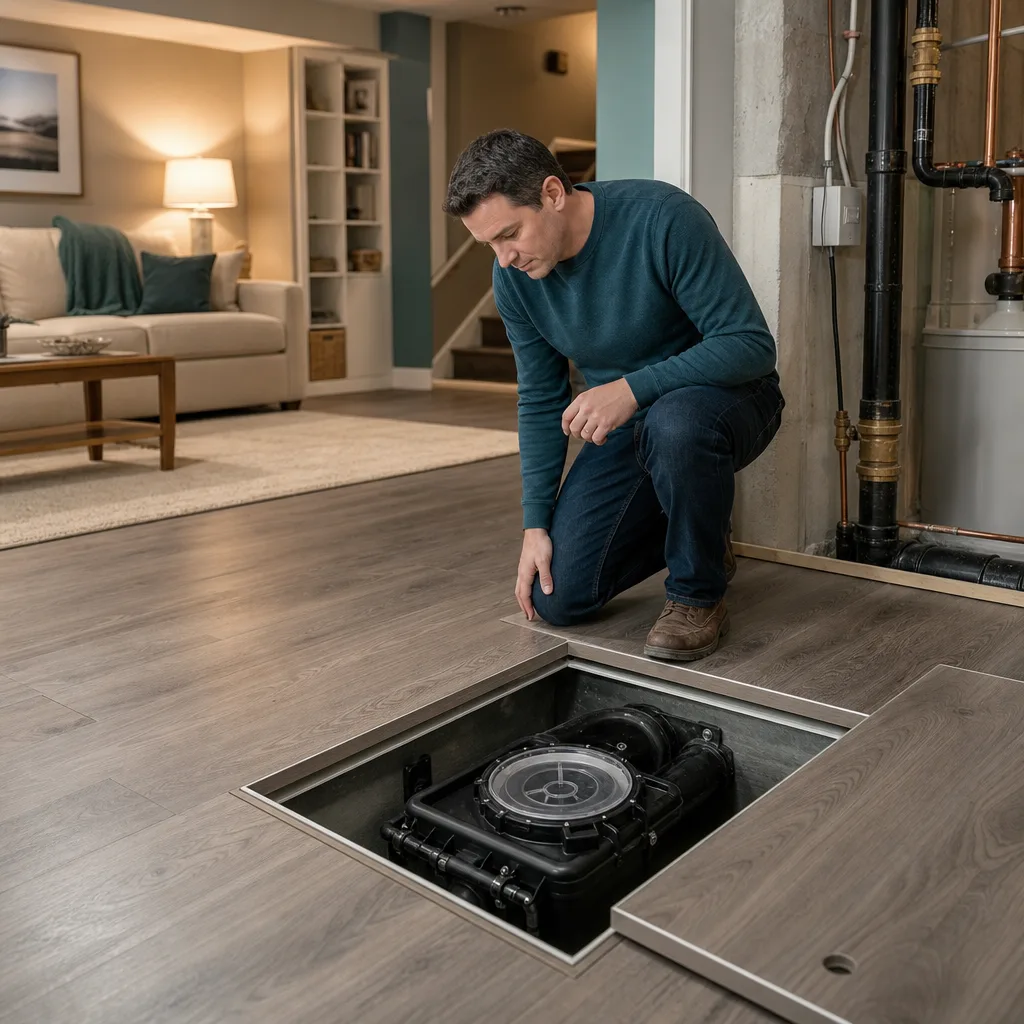
Many Findlay Creek owners reasonably ask whether their relatively recent house already includes protective plumbing. The answer must come from records and field identification, not community age. A round cover may serve a cleanout, sump or valve. Opening plumbing components without understanding conditions can expose occupants to wastewater and should be left to a qualified person.
When a valve exists, obtain its model if legible, installation location, branch coverage and maintenance instructions. Check whether flooring or built-ins obstruct access and whether moving parts can be removed as designed. Replacement may be appropriate if damaged or unsuitable, but adding another valve without a design review can create drainage restrictions rather than better protection.
- Compare any builder drawing with the visible installation and current basement layout; later bathroom or laundry work may have changed which branches pass the device.
- Have a professional check the cover, removable components and sealing surfaces rather than treating an inaccessible or seized assembly as functional protection.
- Ask whether the valve serves all basement fixtures, only a floor drain, or a larger building drain. The answer affects both expectations and behaviour during closure.
- Locate the manufacturer’s instructions for the exact model. Generic online maintenance videos may show a different mechanism, fastener arrangement or safe servicing procedure.
- Document the device with a location sketch and photographs after professional review, then store that information with permits and home-maintenance records.
- If no device is confirmed, return to property-specific assessment. The absence of an obvious access cap does not by itself establish the final design or installation location.
Keep permit review ahead of excavation
Ottawa publishes a page specifically addressing permits for backwater valves. Requirements can depend on the scope and current rules, so confirm them with the City and project professional before work begins. A retail product listing, past neighbourhood installation or old permit does not authorize a new project.
Assign responsibility for the application, responses, inspection booking and corrections in writing. Confirm what must remain uncovered for inspection and do not rush restoration ahead of approval. Keep the permit, approved documents, inspection result, photographs and final invoice together. They support future service and property records, although they cannot guarantee insurance coverage or rebate approval.
Related reading
Verify Ottawa rebate conditions for the house date
The Residential Protective Plumbing Program has published eligibility conditions, including criteria tied to the property and construction date. This is especially important in a newer-growth community: do not assume a useful device will automatically qualify for public funding. Read the current City page and contact the program before signing if a rebate affects affordability.
Ask which estimate, permit, inspection, invoice and proof-of-payment documents are required and when each must be obtained. Save complete records rather than screenshots of a summary. The City alone decides applications under the terms then in effect; neither this article nor a contractor can promise eligibility, payment amount or processing outcome.
Related reading
Design service access into the finished basement
In a finished Findlay Creek basement, valve installation may affect flooring, subfloor, concrete and nearby finishes. Before approval, identify who moves contents, controls dust, checks utility clearances and restores each layer. Discuss uncertainty allowances because buried pipe depth or direction may differ from records. Photograph the exposed piping before closure when inspection rules allow.
The access cover is a permanent service feature, not temporary construction damage to hide. It should remain visible or clearly mapped, open without destroying finishes and permit the manufacturer’s inspection procedure. Plan furniture and cabinetry around it. Add a label and location sketch to the electrical-panel or home-maintenance file so a future occupant can find it promptly.
Understand normal operation and backup behaviour
A normally open valve permits household wastewater to leave. During downstream reverse flow its closure is intended to block that route, which means drainage through protected piping may be unavailable. Follow professional and municipal emergency guidance and avoid using fixtures during a suspected sewer surcharge. Never remove a cover while sewage is backing up.
The valve’s protection is limited to connected branches and depends on condition, installation and circumstances. It is not a guarantee against damage. Store valuables above floor level, keep emergency contacts available and prevent children or pets from entering contaminated areas. If wastewater appears, prioritize safety and professional response over investigating the mechanism yourself.
Put the valve on a documented inspection schedule
Waste, wipes, grease and other debris can interfere with drainage equipment. Follow the specific manufacturer’s care instructions and arrange qualified inspection and cleaning at the recommended interval and after a suspected event. Do not flush products labelled “flushable” as an excuse to ignore municipal wastewater guidance; household habits affect the entire private drain.
Combine the appointment with a review of the sump system, alarms or backup power if present, visible drainage and downspout discharge. Record dates, observations, parts and photographs. Gurgling, slow drainage, odour or repeated stoppage warrants diagnosis rather than forceful cleaning through an unknown valve assembly.
Related reading
Select a professional scope, then speak with insurance
Compare proposals by investigation, valve specification, protected piping, permit handling, restoration, warranty terms and exclusions—not only total price. Ask whether camera assessment, tax, inspection attendance and floor finishing are included. Reject categorical promises that one device prevents all basement flooding. Lister Plumbing confirms Findlay Creek within its service coverage, but no local job history is asserted here.
Before installation, ask the insurer in writing how a valve may affect sewer-backup coverage, deductible, limits and maintenance evidence. Clarify distinctions among sewer backup, overland water and groundwater. An installation, permit or rebate does not bind the insurer. Retain the reply with the project file and revisit it at policy renewal.
- Require the proposal to state which fixtures are protected and how that conclusion was reached; “whole house” should not be accepted without a traceable design basis.
- Compare excavation, dust containment, disposal, concrete, subfloor and finished-floor responsibilities line by line. A device price without restoration context is not a complete project price.
- Ask how concealed conditions will be documented and approved before extra work proceeds. A written change process protects both homeowner and contractor when records differ from the exposed pipe.
- Schedule required inspection before trades return to close the floor, and keep photographs and measurements with the final documentation rather than only on a contractor’s phone.
Related reading
Findlay Creek backwater valve FAQ
Are all Findlay Creek homes too new for an Ottawa rebate?
Do not generalize by neighbourhood. The City publishes property and date-related eligibility rules that must be applied to the individual address and proposed work. Confirm directly with the Residential Protective Plumbing Program before relying on reimbursement, and preserve the documents it requests.
Does Leitrim stormwater planning mean a sanitary valve is unnecessary?
No. Community-scale stormwater planning and a private sanitary connection concern different systems and risks. Neither proves what equipment one house has or needs. A plumber should trace the private drainage, while surface and groundwater concerns should be assessed separately.
How can I tell whether the basement cap covers a valve?
Do not guess or pry open an unknown component. Check drawings and labels, then ask a qualified professional to identify it safely. If it is a valve, record the model, piping served and correct access procedure.
Will a valve stop clear water seeping at the wall-floor joint?
Not ordinarily. A sanitary valve is designed for reverse flow in protected sewer piping, not groundwater through the building envelope. Foundation drainage, grading, sump operation and waterproofing may need separate assessment.
Can a contractor start before the permit is issued?
Confirm the current City process before work. The project team should identify who obtains required approvals and what must remain exposed for inspection. Starting prematurely can create compliance, inspection and restoration problems.
Does installation guarantee sewer-backup insurance?
No. Coverage is governed by the policy and insurer. Ask in writing about eligibility, limits, deductible, exclusions and maintenance documentation. Municipal approval or rebate approval does not decide an insurance claim.
What should remain accessible after finishing the floor?
The valve’s service opening must remain accessible in the manner required by the approved installation and manufacturer. Keep a location sketch and avoid permanent cabinetry or flooring that must be destroyed for routine inspection.
Sources and official references
- City of Ottawa — Leitrim Community Design Plan
- City of Ottawa — Backwater valve permits
- City of Ottawa — Residential Protective Plumbing Program
- City of Ottawa — Prevent basement flooding
Programs, permits and bylaws change. Confirm current requirements with the City of Ottawa before acting.
Questions about your Findlay Creek home?
Ask a local plumber, without pressure.
Requests are sent to Lister Plumbing, who serve homes across all Ottawa areas listed here. A request is not a commitment, and no price is promised before someone looks at your plumbing.