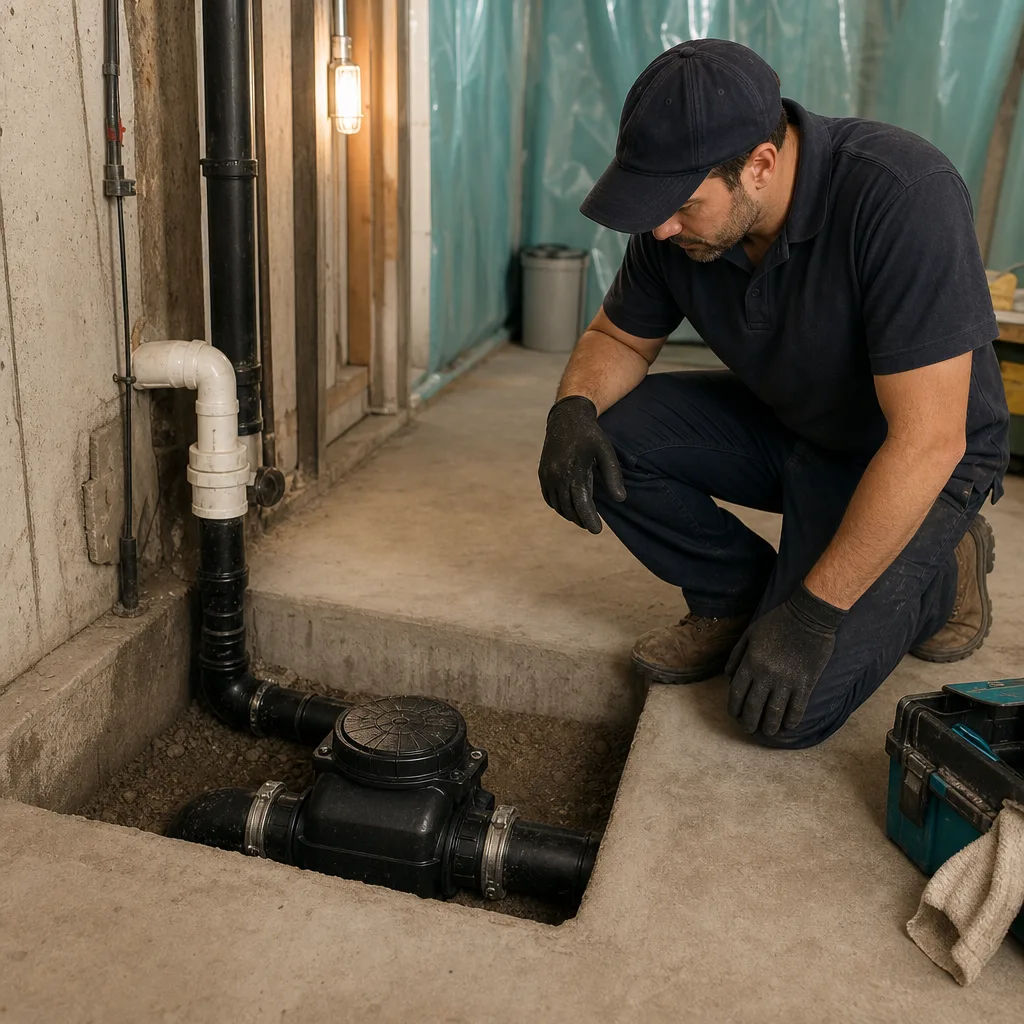
Backwater-valve advice written for a fully sewered urban street cannot simply be transplanted to Greely. Ottawa’s infrastructure planning describes rural servicing as predominantly private wells and on-site sewage systems, while some villages and specific developments have municipal or communal services. The first question for a Greely property is therefore not “Which valve?” but “What wastewater system does this building actually use?”
A valve can resist reverse flow through the pipe on which it is correctly installed. It cannot repair a full or failing septic system, correct a blocked private line, lower groundwater or prevent surface runoff from reaching a basement. Properties with different servicing need different diagnostics, approval paths and maintenance plans even when they share the same Greely mailing address.
This guide gives homeowners a safe decision framework without do-it-yourself cutting or installation directions. It uses official City planning context but makes no assumptions about an individual lot. Lister Plumbing has confirmed service coverage in Greely; no Greely job records were supplied, so the article contains no case study, performance claim or assertion about work on a local property.
Identify the wastewater service before discussing a valve
Find records that identify whether the property connects to a municipal sewer, a communal system or a private septic system. Useful documents may include purchase records, well and septic reports, development agreements, utility bills, permits and approved plans. Do not infer service type from lot size, road name or the presence of nearby development. The City’s Greely Community Design Plan provides planning context, not a parcel-level plumbing diagnosis.
For a private septic property, investigate tank condition, pumping history, effluent system and the building sewer leading to the tank with professionals qualified for that system. A conventional sanitary backwater valve marketed for sewer surcharge may not address the actual failure mechanism. On a connected property, establish the connection route and ownership boundaries before considering protective plumbing.
- Confirm service type from property records and observable system components.
- Record the location of tanks, pumps, alarms, cleanouts and any communal connection.
- Ask which authority reviews the proposed work before accepting a scope.
Related reading
Distinguish sewage backup from rural drainage problems
Slow fixtures, gurgling, sewage at a floor drain, a septic alarm and water entering around a foundation can point to very different problems. Document the first point of entry, odour and appearance, recent water use, rainfall, snowmelt, pump alarms and tank service. Avoid opening tanks or entering contaminated areas. Septic gases, unstable lids, sewage and electrical equipment create serious hazards.
A qualified assessment should determine whether the issue is inside the building drain, in the private service line, at a tank or pump, in an effluent system, or at a downstream sewer connection. A drain camera can inspect reachable piping but cannot evaluate an entire septic treatment system. Diagnosis prevents spending on a valve that does not match the pathway.
Related reading
Keep wastewater, groundwater and runoff solutions separate
Greely’s rural-village setting makes lot drainage and private infrastructure part of the planning conversation, but no neighbourhood-wide conclusion should be drawn about flood risk. A backwater valve only acts on reverse flow in its pipe. It does not stop saturated soil, foundation cracks, low window wells, roof discharge or runoff following a driveway toward the house.
A sump pump, where appropriate, removes collected water and depends on power, maintenance and a safe discharge location. Grading work must respect neighbours, drainage outlets and approvals. Septic function also depends on responsible water use and system condition. Treat these as coordinated but distinct systems, assigning each concern to a qualified professional.
For a connected property, map every protected branch
If records and assessment confirm a sewer connection for which backflow protection is relevant, the professional should trace the building drain, fixture branches and any separate storm piping. Basement bathrooms, laundry, floor drains and additions can complicate the route. The selected location must put the intended fixtures upstream without creating an inappropriate restriction or leaving an overlooked branch exposed.
Ask the assessor to explain the evidence for the location and the limits of what can be seen. Camera findings, cleanouts and pipe direction may help, but concealed renovation work creates uncertainty. The written proposal should say how concealed conditions will be handled and whether pipe cleaning or repair is a separate item.
Related reading
Ask different questions on private and communal systems
On a private septic system, ask whether the observed backup is caused by a blocked building sewer, overdue tank service, pump failure, effluent-field limitation, frozen component or excessive inflow. The proper remedy may involve septic service rather than protective plumbing. On a communal system, identify the operator, responsibility boundaries, alarms and any approval needed before changing private-side piping.
Do not add a check device based on internet instructions. Wastewater systems require venting, accessible maintenance and correct flow. An unsuitable restriction can conceal symptoms temporarily or push wastewater toward the lowest fixture. Professional review should account for manufacturer requirements, applicable codes and the actual downstream system.
Confirm which Ottawa approval path applies
The City of Ottawa states that installing a backwater valve requires a building permit. Private sewage systems can involve additional requirements depending on the work. Contact the City before construction to confirm the current permit, review and inspection path for the specific property and system; do not assume an urban backwater-valve permit covers changes to septic components.
Build inspection timing into the scope so work remains visible when required. Ask who submits applications, pays fees and responds to corrections. Retain approved documents, inspection records, invoices, equipment details and photographs. Clear records are especially important where a future owner may otherwise be unable to distinguish private, communal and municipal components.
Related reading
Do not assume the urban rebate fits the property
Ottawa’s Residential Protective Plumbing Program has detailed eligibility rules for specified protective plumbing measures, property dates, permits and documents. A Greely address within Ottawa is not enough to prove that a private-system project or particular device qualifies. Read the current rules and obtain direct program guidance before relying on reimbursement.
Ask whether the exact system and scope are eligible, which costs can be submitted and what evidence is required. Keep rebate decisions separate from technical decisions: a measure should address a diagnosed risk, while program staff decide funding. Insurers also apply their own contracts and may ask about wastewater service type, maintenance and alarms.
Include pumps, power and household water use
Rural wastewater arrangements may include pumps and alarms. Record what is powered, which circuits serve it, what an alarm means and whom to call. Backup power should be selected by qualified professionals for the actual load and safe connection method. A backwater valve does not keep a pump running during an outage and does not create storage capacity downstream.
During any backup or closed-valve condition, minimize toilets, showers, laundry and other discharge. Continued use can fill upstream piping and release wastewater at the lowest fixture. Post instructions where occupants can find them, include service contacts, and never enter a tank, pit or flooded electrical area.
Create one maintenance calendar for separate systems
List each asset separately: valve, septic tank, pump, alarm, sump system, generator and drainage features. Follow the manufacturer, septic professional and plumbing professional for service intervals rather than imposing one generic schedule. A valve needs accessible inspection and cleaning; a septic system needs its own monitoring and service based on design and use.
Keep lids and valve covers accessible, but prevent unsafe access to tanks. Record dates, findings and repairs, and preserve a site sketch. After a suspected surcharge or backup, arrange appropriate review even if the system appears to recover. Maintenance evidence supports troubleshooting but cannot guarantee a flood-free home.
Related reading
Require the proposal to name the system and problem
A credible Greely proposal should state the wastewater service type it assumes, the diagnosed pathway, the component being installed or repaired, permit responsibility, access, restoration and exclusions. It should not describe every property as municipally sewered or present a valve as routine without confirming the downstream system. Ask how the scope changes if records or excavation reveal a different arrangement.
Compare professional reasoning, maintainability and documentation rather than price alone. Reject guarantees of rebate approval, insurance acceptance or complete flood prevention. For plumbing assessment, Lister’s service page and quote request are available below; septic or drainage work may require other qualified specialists.
A useful site plan should show enough fixed features to orient future service: the house, driveway, known wastewater components, relevant cleanouts and access points. It need not pretend to be a legal survey, but it should clearly distinguish confirmed locations from approximate ones. On a larger Greely lot, that distinction can prevent later landscaping, paving or an addition from blocking essential access.
Also ask how seasonal conditions affect diagnosis and scheduling. Frozen ground, snow cover or saturated soil may limit exterior observations without proving that work is impossible or urgent. The professional should state what can be concluded now, what remains to be verified, and whether temporary precautions are appropriate. Evidence-based staging is safer than inventing certainty from a single visit.
At handover, collect approved documents, inspection results, photographs before closure, component models and contact information for each relevant service provider. Keep secure copies away from the mechanical room and any potentially wet basement storage. Future owners need to know which equipment belongs to plumbing, septic, drainage or electrical systems rather than assuming one contractor maintains everything. Update the file promptly after alterations, tank work, pump replacement or landscaping near a buried route.
Greely backwater valve FAQ
Do all Greely homes use septic systems?
Do not assume so. Ottawa planning material says rural servicing is predominantly private, while some villages and developments have municipal or communal services. Verify the individual parcel through records, bills and professional assessment before selecting any device.
Will a backwater valve fix a septic backup?
Not necessarily. A septic backup may arise from a blocked line, tank, pump, effluent system or excessive inflow. A valve does not repair those components and could be irrelevant to the diagnosed cause. Use qualified septic and plumbing professionals.
Can a Greely property receive Ottawa’s protective-plumbing rebate?
Being within Ottawa is only one consideration. The exact property, date, system, measure, permit and documentation must meet current program rules. Seek direct City confirmation, especially for private or communal wastewater systems.
Is an Ottawa building permit required for a valve?
The City states that backwater-valve installation requires a building permit. Work involving a private sewage system may have additional review. Confirm the property-specific approval path before work and schedule inspection before concealment.
Does a valve protect a basement from high groundwater?
No. It resists reverse flow in a protected pipe. Groundwater, foundation leakage, window wells and overland flow require separate investigation. A sump system may be relevant in some homes but performs a different function.
What should happen during a pump alarm or backup?
Minimize water use, keep people away from sewage and electrical hazards, and call the appropriate qualified service provider. Do not open or enter septic tanks or pits. Follow the system operator’s and municipal emergency guidance.
Can I add a check valve to septic piping myself?
This guide gives no DIY steps. Incorrect devices or locations can restrict drainage, conceal a failure or cause wastewater to emerge at a fixture. Obtain professional design and the approvals applicable to the actual system.
Sources and official references
- City of Ottawa: Greely Community Design Plan
- City of Ottawa: Infrastructure Master Plan rural servicing
- City of Ottawa: Backwater valve permits
- City of Ottawa: Residential Protective Plumbing Program
Programs, permits and bylaws change. Confirm current requirements with the City of Ottawa before acting.
Questions about your Greely home?
Ask a local plumber, without pressure.
Requests are sent to Lister Plumbing, who serve homes across all Ottawa areas listed here. A request is not a commitment, and no price is promised before someone looks at your plumbing.