Greenboro is an established south-Ottawa residential community near the Greenboro transit hub and the Sawmill Creek corridor. Those landmarks help describe the area, but neither transit infrastructure nor proximity to a creek reveals how a particular house drain is arranged. Backwater-valve planning must begin inside the property file and at the fixtures, not with a neighbourhood-wide assumption.
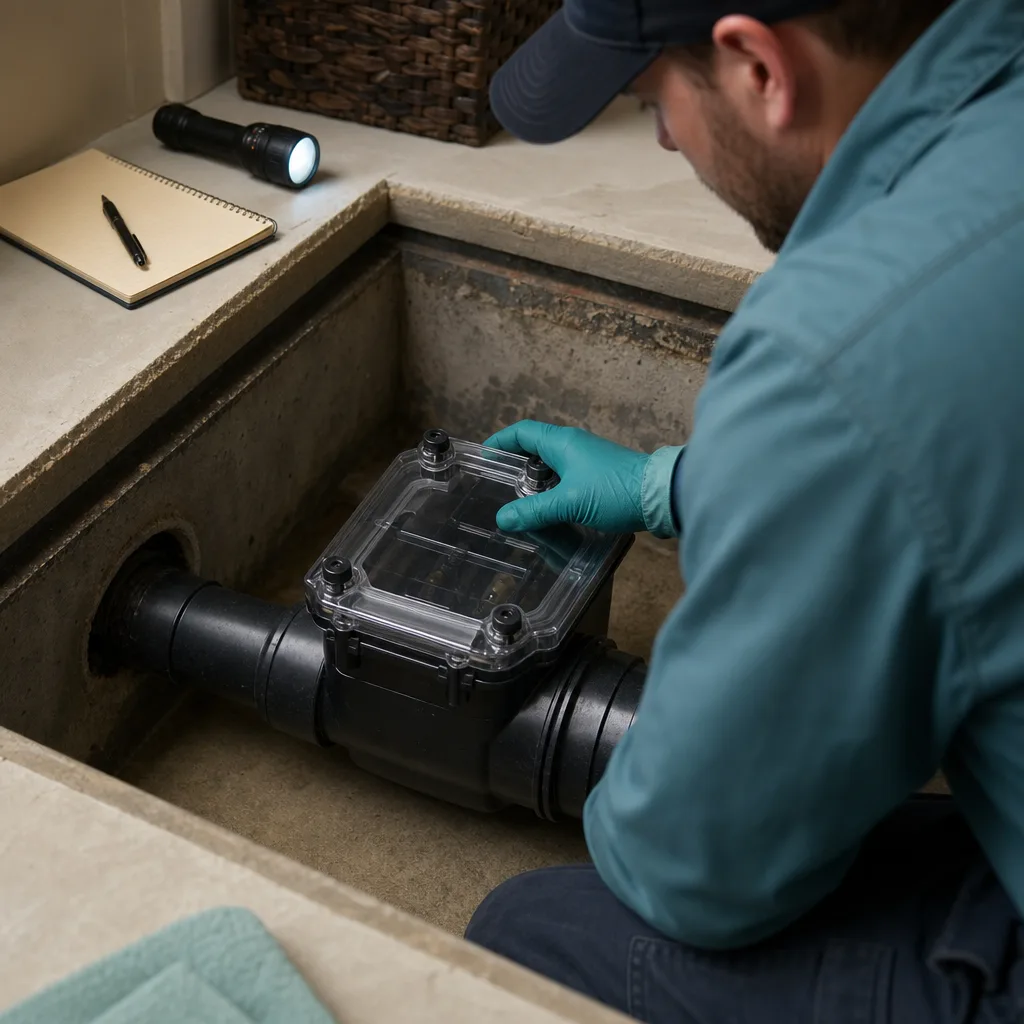
A sanitary backwater valve permits normal outward drainage and closes against reverse flow. It is one protective layer for one pathway. It does not stop groundwater, overland water, a leaking foundation, a blocked private lateral or sump-pump failure. This guide emphasizes the questions Greenboro owners should resolve before opening a finished basement floor.
Translate Greenboro context into property-level questions
Homes and townhouses around Greenboro, Conroy and South Keys can differ in tenure, renovation history, fixture elevation and access. Confirm whether the property is freehold, condominium or rental, and identify who owns and may alter the slab and drain. Never infer a shared sewer layout from similar exterior architecture.
Gather building and plumbing permits, renovation plans, invoices, insurance letters and photographs of previous incidents. List basement toilets, showers, sinks, laundry and floor drains, including fixtures hidden behind finished walls. Note existing sump equipment and any covers whose purpose is unknown.
Describe observed water by entry point and timing. Water rising from a fixture suggests a different investigation from seepage at the wall-floor joint after snowmelt. Treat the Sawmill Creek setting as watershed context only; it is not evidence that sewer water reached an individual home.
Define what the valve can and cannot protect
The proposed valve should be tied to a documented drainage pathway and identified fixtures. Ask the plumber to draw flow direction and mark every protected and unprotected branch. A device on one line cannot protect another connection that joins downstream.
A valve cannot repair cracks, regrade a yard, move roof water, power a pump or remove a lateral obstruction. If symptoms point to multiple pathways, coordinate plumbing, drainage or foundation expertise rather than expecting one device to solve all flooding.
No contractor, permit or article can promise a dry basement. Good planning reduces defined risks, preserves access and prepares occupants to respond. Be cautious of absolute claims based on a postal code or a neighbour’s experience.
Related reading
Trace hidden branches beneath a finished floor
A qualified plumber can review cleanouts, visible pipe and fixture relationships before recommending invasive work. A camera inspection may help document reachable pipe surfaces, branch openings, deposits, roots, offsets or damage. Electronic locating can help place observations relative to the basement.
A camera does not see through the pipe or guarantee that each concealed branch was found. Ask where it entered, how far it travelled, what prevented further travel and how locations were established. Request files and a written interpretation rather than only a verbal statement that the line looked fine.
If the floor must be opened, define responsibility for utility location, dust, furniture, flooring, concrete and debris. Finished-space restoration can materially affect cost and household disruption, so it belongs in the scope.
Related reading
Sequence Ottawa permission, work and inspection
Ottawa provides a dedicated backwater-valve permit page. Consult its current application, fee and inspection requirements for the actual scope. State in the contract who prepares information, applies, responds to the City, schedules inspection and secures final status.
Do not cover the work permanently before the required inspection. Municipal review concerns applicable compliance; it does not guarantee hydraulic performance in every event, rebate payment or insurer acceptance. Keep the permit and result with the device record.
This work is not a do-it-yourself basement project. Cutting a slab may encounter services, and altering drainage affects connected fixtures. A professional must address product suitability, connections, venting, slope, access and safe testing.
Related reading
Verify Residential Protective Plumbing Program details
The City’s Residential Protective Plumbing Program offers conditional financial help to qualifying Ottawa property owners for eligible measures. Current rules govern ownership, application timing, investigations, costs, maximums and records. A Greenboro location does not establish approval.
Read the current program before authorizing work and ask the City about ambiguous circumstances such as prior grants, condominium responsibility or mixed use. Preserve written answers, itemized invoices, proof of payment and inspections. A contractor cannot approve a municipal application.
Prepare a budget that works if reimbursement is unavailable. Separate camera, permit, plumbing, concrete, flooring and cleanup amounts. Technical suitability should lead; potential funding should not.
Related reading
Write access and condominium authority into the quote
The proposal should name the valve, location, branches protected, pipe work, investigation, permits, inspection coordination, testing, restoration and exclusions. Ask what change triggers extra cost and require approval before unplanned work.
For condominium townhouses, obtain governing documents and written authorization where needed. The nearest pipe is not necessarily exclusively owned. Shared shutdown, notification and restoration rules may apply. Tenants need owner authorization and clear scheduling.
Require a durable, accessible cover at finished-floor level. Do not place fixed cabinetry, heavy appliances or continuous flooring over it. Compare proposals by included scope and responsibility, not price alone.
Teach every occupant what closure means
A closed valve can stop sewer reversal while also preventing household wastewater from leaving through that point. During suspected closure, stop or sharply limit flushing, bathing, laundry and dishwasher use. Continued discharge can fill the private drain and overflow indoors.
Have the installer demonstrate normal condition, safe observation and when to call. Do not open a cover during active surcharge or force moving parts. Post concise instructions near the service record, especially in a rented or multigenerational home.
Plan separately for power loss and pump failure where applicable. A passive valve is not an alarm, does not store unlimited wastewater and does not address water arriving outside the sanitary system.
Coordinate creek-corridor awareness with lot drainage
Greenboro’s relationship to Sawmill Creek makes watershed and stormwater questions locally relevant, but parcel observations remain essential. From a safe location after rain, note downspout outlets, low grades, window wells, sump cycling and ponding. Do not redirect water onto public walkways or neighbouring land.
Maintain lawful roof-water discharge, grading and private drainage features. Seek appropriate expertise for foundation entry. These actions complement sanitary protection because they target different routes.
Transit construction or neighbourhood drainage work should never be treated as proof about a private lateral. Obtain current project information from official sources and have the building’s plumbing assessed directly.
Keep the Greenboro installation visible and serviceable
Follow manufacturer instructions and professional recommendations for inspection and cleaning. Grease, solids and deposits can prevent sealing. Frequency should reflect the product and findings, not an unsupported neighbourhood schedule.
Record model, installation, permit, service and observations. Call a plumber if movement is restricted, parts are damaged, the cover leaks or material repeatedly accumulates. Avoid chemical shortcuts and incompatible replacement parts.
Before final payment, collect invoices, warranty, photographs, camera files, inspection outcome and a protected-fixture sketch. Share requested records with the insurer and future occupants. Maintenance improves readiness but never guarantees coverage or prevents every flood.
Greenboro households should revisit the record before finishing or refurnishing the basement. Give flooring and cabinetry contractors the access location and clear-space requirement. Photograph the cover after work. A technically correct valve that cannot be reached promptly has acquired an avoidable operational weakness, even though the neighbourhood and municipal system have not changed.
Create a short event log for unusual drainage. Record date, weather, affected fixtures, sump activity, odour, duration and professional findings without asking occupants to expose themselves to sewage or electricity. Repeated slow fixtures during dry weather may point toward a private restriction rather than valve closure. The log helps a plumber evaluate patterns while avoiding a premature conclusion based on one storm.
If the property is rented, put water-use restrictions and reporting contacts in the tenant information package. The owner remains responsible for arranging qualified inspection and any required municipal process; occupants should not be expected to open or repair the device. For a condominium, send the completed record to the corporation when governing documents require it and retain acknowledgement.
Renovations deserve a new branch review. Adding a basement washroom, laundry sink or secondary unit can change which fixtures connect before or after the valve. Ask the designer and plumber to update the drain sketch, assess capacity and confirm permissions. Do not connect a new fixture wherever piping is easiest without checking whether doing so defeats protection or creates closure-related overflow.
After a suspected backup, safe recovery is more than cleaning the visible floor. Stop water use, keep people away from contaminated areas, notify responsible parties and use appropriate restoration support. Have the valve and related piping assessed before assuming it performed normally. Preserve photographs and professional reports for the owner, municipality or insurer while recognizing that documentation does not itself establish claim coverage.
Greenboro’s transit connections may make a car-free household’s service logistics different. Confirm arrival windows, access and whether an adult must remain while the floor is open. This is a scheduling issue, not a reason to infer anything about sewer condition. Build realistic time for inspection and restoration into plans rather than promising occupants that all finishes will necessarily return in one visit.
Before accepting restoration, inspect the access detail with the person who will maintain the property. The cover should be identifiable, removable and protected from routine damage without being sealed shut. Record measurements from two fixed reference points in case furnishings later hide the immediate view. Ask the installer what signs—such as leakage, unusual noise, persistent slow drainage or visible damage—justify a service call.
Keep insurance questions separate from the sales discussion. Tell the insurer what was installed, provide the requested permit and invoice evidence, and ask for written confirmation of any endorsement, discount, deductible or maintenance condition. Installation does not force an insurer to cover sewer backup, and a policy endorsement does not certify the plumbing design. Review the policy again when ownership, tenancy or basement use changes materially.
Related reading
Greenboro backwater valve FAQ
Does living near Sawmill Creek mean my Greenboro home needs a valve?
Location alone is not a diagnosis. A valve addresses reverse drainage, while creek, surface, groundwater and foundation pathways are different. Assess the building drain and site conditions.
Will a valve stop seepage at the basement wall?
No. It cannot seal foundations or change exterior drainage. Have wall or slab seepage assessed separately while considering sanitary protection on its own evidence.
Is an Ottawa permit required?
Ottawa publishes a backwater-valve permit and inspection process. Check the current page for the proposed work and agree who obtains and closes the permit.
Can a Greenboro owner count on a rebate?
No. The City program is conditional, with current eligibility and documentation rules. Confirm before commitment and plan to fund the entire scope.
Who approves work in a condominium townhouse?
Review the declaration, rules and ownership boundaries and obtain written authorization from the appropriate condominium authority. Municipal permission does not replace private approval.
Can residents use water while the valve is closed?
They should stop or minimize use because wastewater may not leave. Toilets and appliances can otherwise cause an internal overflow behind the valve.
What maintenance is needed?
Keep access open and follow manufacturer and plumber guidance. Document service and obtain professional attention for leakage, damage, binding or recurring debris.
Sources and official references
- City of Ottawa Residential Protective Plumbing Program
- City of Ottawa backwater-valve permits
- City of Ottawa Trillium Line extension traffic plan
- Lister Plumbing backwater valve service
Programs, permits and bylaws change. Confirm current requirements with the City of Ottawa before acting.
Questions about your Greenboro home?
Ask a local plumber, without pressure.
Requests are sent to Lister Plumbing, who serve homes across all Ottawa areas listed here. A request is not a commitment, and no price is promised before someone looks at your plumbing.