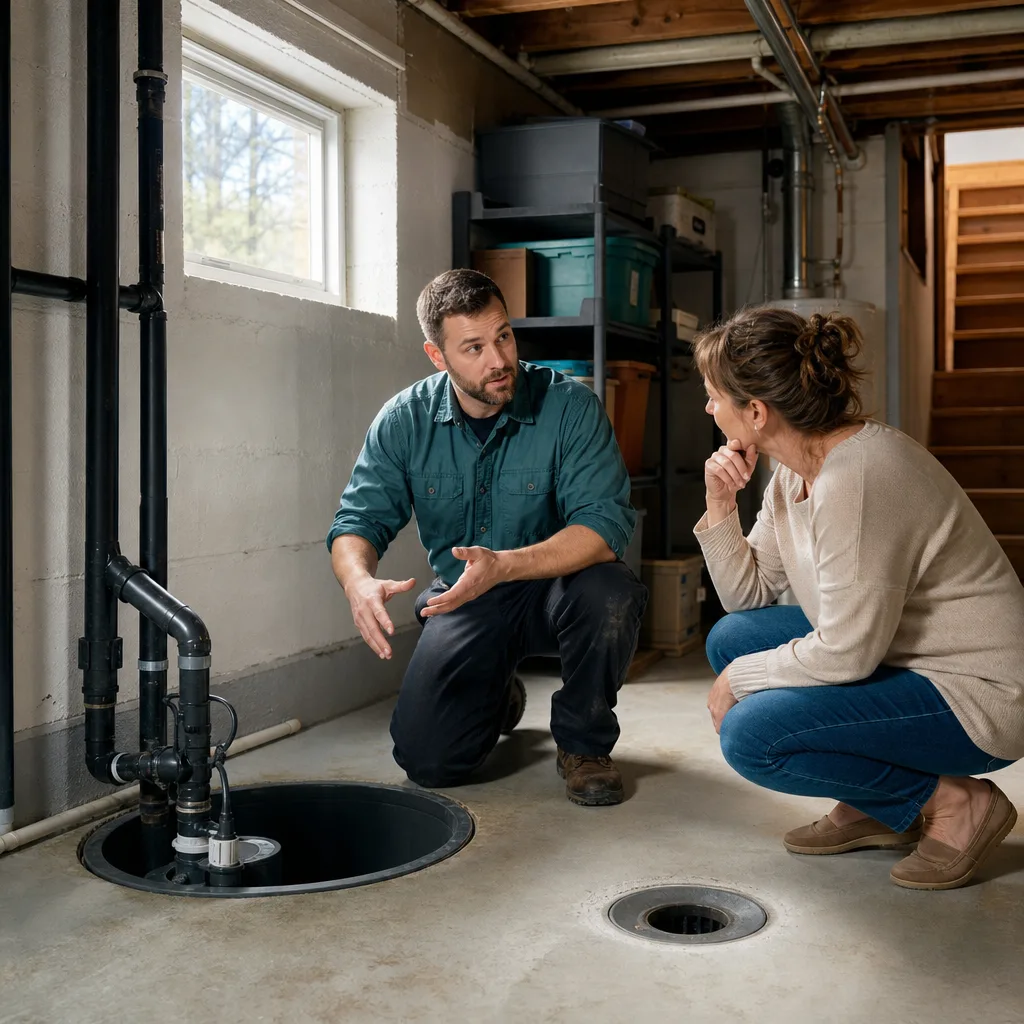
Manotick's setting on the Rideau River, village-scale core, established housing, newer development, and rural-edge properties make careful terminology essential. Riverine flooding, overland water, groundwater, sump inflow, septic-system concerns, and municipal sewer backup are not interchangeable. Before discussing a backwater valve, establish what wastewater system serves the property and which route a past or potential water event would follow.
A backwater valve can resist reverse flow only in a drainage line for which it is properly selected, permitted, installed, and maintained. It does not act as a river barrier, waterproof a foundation, or solve every onsite-wastewater problem. This guide organizes property-specific questions for Manotick homeowners while respecting the City's village planning context. It contains no do-it-yourself installation directions and no promise of municipal funding, insurance acceptance, or complete flood prevention.
First determine how the Manotick property is serviced
Do not assume every property associated with Manotick has the same water and wastewater servicing. Municipal services, private systems, lot boundaries, and building histories vary across village and rural contexts. Confirm records with the City and appropriate professionals. A device intended for a municipal sewer-backup pathway should not be recommended from a postal address alone.
Gather construction and renovation permits, surveys or servicing information, septic records if relevant, prior plumbing invoices, and the locations of visible drains, cleanouts, sump equipment, and access covers. If the servicing arrangement remains uncertain, resolve it before pricing invasive work. The answer governs which codes, permits, professionals, and protective measures are relevant.
For a property with onsite wastewater treatment, ask a qualified septic professional to assess tank level, effluent movement, alarms, pumps where present, and the condition or capacity questions relevant to the system. Do not install a sewer-oriented device as a shortcut around a saturated, obstructed, damaged, or poorly maintained onsite system. The household's water-use plan during an alarm may also differ from the response to municipal sewer reversal.
If a well serves the property, keep drinking-water safety decisions separate from wastewater backflow protection. Floodwater near a wellhead, changes in water quality, or suspected contamination require guidance from the appropriate public-health and qualified water professionals. A building-drain valve does not protect a well or certify potable water. Recording both systems on one site sketch can help owners avoid confusing their locations and functions.
Separate Rideau River exposure from sewer reversal
The Rideau River is central to Manotick's identity and an important consideration for some properties, but a backwater valve is not a river-flood defence. Ottawa's interactive map presents known riverine flood-hazard information and directs owners to conservation authorities for current property-level data. Use those official resources for river questions rather than inferring safety or risk from elevation, distance, or past appearance.
Sewer reversal, surface flow, shoreline or riverine flooding, foundation seepage, and sump-system failure require different assessments. A property can face more than one pathway, and reducing one does not eliminate the others. For a purchase, addition, or basement project, combine current conservation-authority and City information with professional site, drainage, plumbing, and insurance advice.
When reviewing a flood map, distinguish the mapped scenario and date from a site survey or guaranteed boundary. The City's map describes it as informational and points owners to the conservation authority for current data. Do not use an online screen measurement to choose equipment elevation, redesign grading, or support an insurance representation. Those decisions require the appropriate current property information and professional interpretation.
Respect village character while prioritizing safe access
The official Village of Manotick Secondary Plan aims to maintain village character in a growing, walkable community. That policy context helps explain why properties and streetscapes can differ from suburban growth areas, but it does not describe private plumbing. Older buildings, additions, crawlspaces, slab conditions, and sensitive finishes can complicate a retrofit and require tailored investigation.
Choose the valve location for hydraulic suitability, inspection, and permanent service—not merely to make the cover invisible. Discuss how excavation, concrete, heritage-sensitive or hard-to-match materials, cabinetry, and contents will be handled. Where planning or heritage questions might apply to broader associated work, confirm them with the City rather than assuming a plumbing permit resolves every approval.
Related reading
Document the first point of water entry
A low fixture or floor drain behaving abnormally suggests a different line of inquiry from clear water at a foundation crack, window, door, wall-floor joint, sump pit, or crawlspace. Note weather, snowmelt, plumbing use, pump operation, odour, colour, and timing. Do not contact sewage or enter wet areas with electrical hazards to gather evidence.
Use the observations to commission the right expertise. Plumbing assessment, sewer-camera work, septic evaluation, grading review, foundation advice, or conservation-authority information may each answer a different question. A valve should follow identification of a reverse-flow pathway rather than serve as a default response to any water in a Manotick basement.
Related reading
Trace the relevant pipe and assess its condition
For a municipally connected drain under consideration, a qualified plumber should identify sanitary or storm service, direction of flow, connected branches, existing devices, and a compliant accessible location. Camera inspection and locating can help where the pipe is reachable. Ask what the images show, what they cannot show, and how findings change the proposal.
Roots, offsets, deposits, damage, or a blockage may require repair independent of a valve. An inspection represents visible conditions at that time and does not certify every branch or future performance. If the property uses a private septic system, obtain advice appropriate to that system rather than treating municipal protective-plumbing guidance as automatically transferable.
Related reading
Confirm which Ottawa permits apply to the exact scope
For a backwater-valve installation, Ottawa's dedicated page says a building permit is required. Verify the current process with the City and explain the property's servicing arrangement and associated work. Put responsibility for applications, fees, inspection scheduling, access, and corrections in the contract. Do not assume that a standard proposal covers unusual site conditions or separate approvals.
Leave work visible for required inspection before restoration. Retain approved documents, permit and final inspection records, valve model, invoices, photographs, and maintenance instructions. Records create an auditable history, but neither a permit nor an inspection guarantees that an insurer will provide coverage or that all flooding pathways have been addressed.
Related reading
Do not assume the Ottawa rebate applies to every Manotick system
Ottawa's Residential Protective Plumbing Program supports qualified owners for specified approved measures. Applicant, property, servicing, device, timing, permit, inspection, invoice, and other criteria matter. Read the current official page and describe the exact property to program staff before work. A City of Ottawa address alone does not settle whether a proposed measure qualifies.
Request itemized pricing and preserve all required evidence. Separate the backwater valve from septic work, lateral repair, sump equipment, foundation work, and finish restoration. Budget for the full project without guaranteed assistance: only the City can approve a program application, and terms or maximums can change.
Require a scope suited to the building and site
A useful quote identifies the confirmed system and protected line, valve and location, investigation, excavation, permit and inspection duties, testing, access cover, disposal, restoration, warranty, and exclusions. For crawlspaces or unusual slabs, ask how safe working access and future service will be achieved. For finished spaces, define concrete, flooring, trim, paint, cabinetry, and matching-material limits.
Changes caused by hidden conditions should be explained and authorized in writing. Lister Plumbing publishes an Ottawa backwater-valve service page and can be contacted for property-specific assessment. That coverage does not establish that it has completed Manotick work, and it is not evidence about results, qualifications beyond what you independently verify, or rebate approval.
Plan for absences, power interruptions, and seasonal conditions
Some properties are unattended for periods or depend on pumps and alarms whose performance can be affected by power loss. A backwater valve is passive protection against a defined reverse-flow pathway; it does not power a sump, monitor a septic system, or notify an absent owner. Review each critical system separately and arrange appropriate professional maintenance, monitoring, and backup planning.
Give a trusted contact accurate locations and safe response instructions. The contact should know not to enter contaminated water, approach electrical hazards, force a valve, or continue heavy water use during a suspected closure. Emergency planning should identify the plumber, insurer, restoration assistance, utility contacts, and any onsite-wastewater specialist relevant to the property.
Winterization or seasonal reopening can reveal drainage changes, but it is not a substitute for device-specific inspection. Document unusual odours, slow flow, alarms, or pump behaviour and seek qualified help. No seasonal checklist can guarantee protection from river, surface, sewer, foundation, power, or equipment events.
Create one record for a complex Manotick property
Assemble verified servicing information, site or basement sketches, the plumbing assessment, camera findings, permit, inspection result, signed scope, change orders, paid invoice, model literature, warranty, photographs, and maintenance entries. Clearly distinguish municipal sewer components, onsite systems, sump equipment, and surface-drainage features so future work does not blur their functions.
Ask the insurer or broker how the actual policy addresses sewer backup, overland water, groundwater, river flooding, septic-related losses, power interruption, contents, and additional living expense. Terms, availability, limits, and deductibles vary. Provide installation facts when requested but do not assume one protective device secures or expands coverage.
Update the record after renovations or servicing and pass it to future occupants. Accurate documentation helps professionals start from evidence, but it is not a condition report forever; systems still require current inspection when operation or risk is in question.
Understand operation before relying on the device
Normal wastewater passes outward; reverse flow closes the valve. While it is closed, occupants should sharply reduce water use because discharge cannot leave through the protected route. Ask which fixtures are upstream and how to recognize a closure or malfunction. Multi-unit or guest-heavy homes need a simple communication plan.
No valve is fail-proof. Debris, damage, poor placement, installation defects, or missed maintenance can impair it. It also cannot prevent overland, river, foundation, sump, septic, or upstream private-drain failures. Ask the plumber to state the residual risks plainly and combine measures where the property assessment supports them.
Preserve access through seasonal use and renovations
Keep the cover visible, removable, and free of stored items. Do not conceal it below permanent flooring or built-ins. Save model instructions, permit papers, inspection results, and service history, and show the location to future occupants or contractors. Seasonal or infrequently used spaces still need a maintenance plan.
Follow the manufacturer's procedure and schedule for the installed device. If components are obstructed, damaged, unfamiliar, or associated with changing drainage, contact a licensed plumber instead of forcing them. Ottawa recommends maintenance of protective plumbing; access and records make competent service possible.
Related reading
Manotick backwater valve FAQ
Does every Manotick property connect to the same municipal sewer system?
Do not assume so. Village and rural-edge servicing can differ. Confirm the specific property's records and physical system with the City and qualified professionals before considering a municipal-sewer protective device.
Will a backwater valve protect against Rideau River flooding?
No. It resists reverse flow through a connected drain. Riverine, shoreline, and surface-water exposure require official mapping, conservation-authority information, site assessment, and other measures.
Can Ottawa rebate work on any private wastewater system?
Do not assume eligibility. The current Residential Protective Plumbing Program has property, applicant, device, permit, inspection, and documentation criteria. Describe the exact servicing and scope to the City before work.
Is a permit still required in the village?
Yes. Manotick is within Ottawa, and the City's backwater-valve guidance says installation requires a building permit. Other associated work may have separate requirements.
Can a valve fix roots or damage in an older drain?
No. It does not repair a lateral or clear an obstruction. Camera and locating work may help identify visible issues, which should be scoped separately.
What happens when the valve closes?
The protected line cannot discharge normally, so occupants must minimize water use. Follow model-specific guidance and call a professional if the device or drainage does not return to normal.
Does a permit guarantee insurance coverage?
No. Ask the insurer about sewer backup, overland water, river flooding, groundwater, limits, deductibles, exclusions, and documentation. Coverage decisions remain with the insurer.
Sources and official references
- Village of Manotick Secondary Plan
- City backwater valve permit guidance
- City Residential Protective Plumbing Program
- City interactive flood plain map
- City flood awareness and prevention
Programs, permits and bylaws change. Confirm current requirements with the City of Ottawa before acting.
Questions about your Manotick home?
Ask a local plumber, without pressure.
Requests are sent to Lister Plumbing, who serve homes across all Ottawa areas listed here. A request is not a commitment, and no price is promised before someone looks at your plumbing.