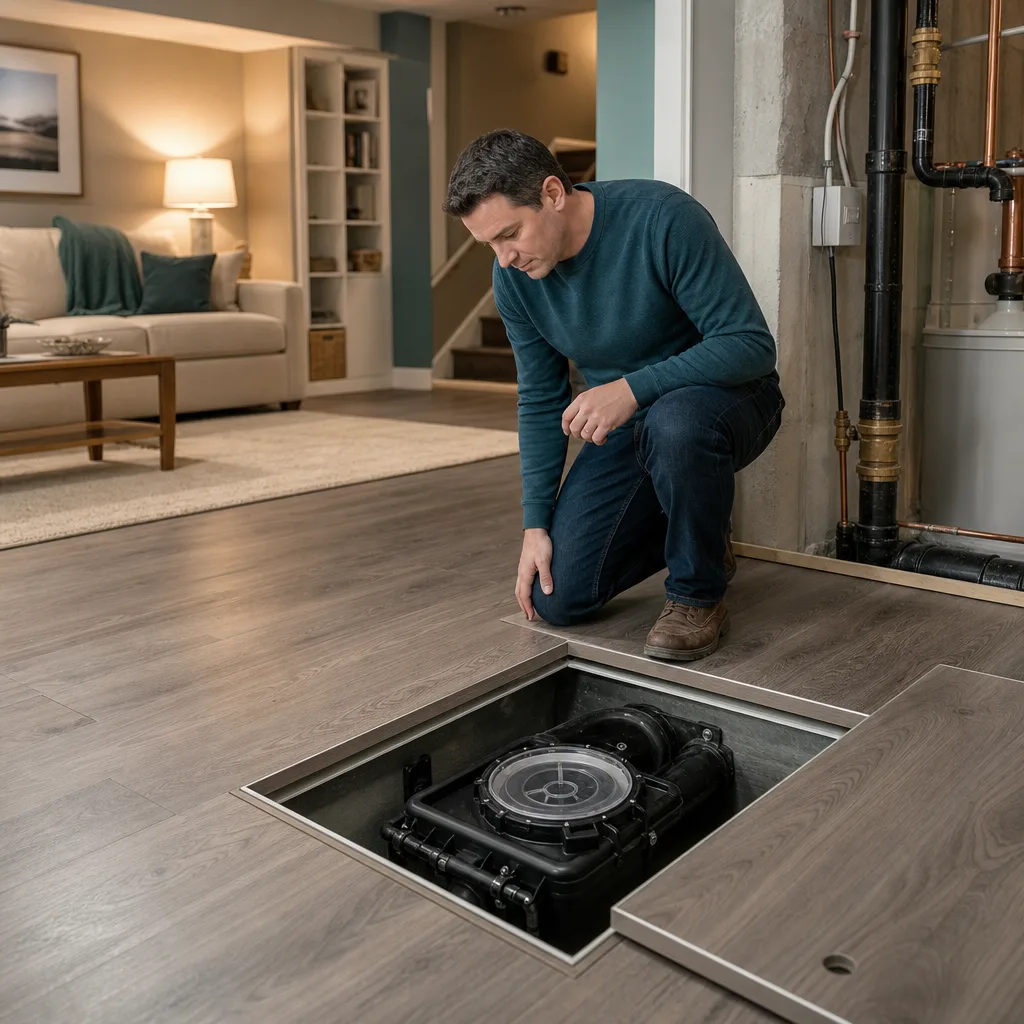
Hunt Club is not one uniform housing project. The name covers communities on both sides of Hunt Club Road, with low-rise homes, townhouse groups, apartment properties, commercial edges and major transportation corridors. For a homeowner, that variety makes a street-level assumption especially unreliable: tenure, shared services, building form and the location of below-grade fixtures can all change who should investigate and what work is feasible.
A backwater valve allows normal outward flow and is designed to close against reverse flow. It may reduce damage from a sewer surcharge reaching protected fixtures, but it does not control every source of basement water. Surface runoff, foundation leakage, a blocked private pipe, plumbing leaks and sump or power failures require their own diagnoses. Use this guide to organize a professional, permitted decision rather than as do-it-yourself installation instructions.
Define the Hunt Club property before defining the solution
Begin with ownership and drainage responsibility. A detached freehold house generally presents a different approval path from a condominium townhouse or unit in a multi-residential building. In a condominium, underground piping, slabs and exterior services may be common elements even when the access point appears inside a unit. Obtain written direction from the corporation or property manager before commissioning invasive work.
For a freehold property, assemble renovation records, previous drain work, fixture locations and any incident notes. Hunt Club Road is a useful geographic reference but says nothing conclusive about a private sewer. Ask where the building drain exits, what fixtures join upstream, and whether additions or basement bathrooms altered the original arrangement. A recommendation should follow that map.
Read the evidence from a basement incident carefully
Sewage or wastewater rising through a floor drain or low fixture points toward a drainage problem; clear water at a wall, window or foundation joint points elsewhere. Mixed events occur, and contaminated water should be treated as a health hazard. Record weather, affected locations, odour, colour and which fixtures were in use without entering unsafe water or touching electrical equipment.
A single slow fixture may indicate a local branch obstruction rather than municipal reverse flow. A whole-house slowdown may suggest a building-drain or service issue. These are investigation prompts, not remote diagnoses. Call a qualified plumber and notify the insurer promptly if damage occurred. Do not rely on a valve to compensate for an unrepaired obstruction.
Use camera and locating work to reduce uncertainty
A drain-camera inspection can show accessible pipe interiors, branch transitions, deposits and some visible defects. Locating can help translate that route to a basement floor so the installer can assess access with less exploratory demolition. Ask for footage and a narrated explanation of flow direction, observed limitations and the proposed protective zone.
A camera cannot see through opaque wastewater or reliably grade every buried condition. If the line cannot be inspected, the quote should say why and what further step is proposed. The objective is not to produce dramatic footage; it is to determine whether the drain is suitable for a valve, whether repair or cleaning comes first, and whether fixtures could bypass the selected location.
Build City permit and inspection steps into the schedule
Ottawa’s protective-plumbing FAQ states that installation of protective plumbing devices requires a building permit. The proposed design, device and inspection sequence should therefore be established before concrete is opened. Ask who submits the application, who responds to review comments, and when work must remain visible for inspection.
An inspection is not merely paperwork for a rebate. It provides an official compliance checkpoint before concealment. Requirements may evolve, so verify the current application documents and fees with the City’s Building Code Client Service Centre or 3-1-1. This article does not approve a design, and homeowners should not attempt drain cutting, sewage exposure or below-slab excavation themselves.
Related reading
Check rebate rules before signing a Hunt Club contract
The City’s Residential Protective Plumbing Program lists eligibility conditions, eligible measures and maximum amounts. It currently distinguishes age thresholds for sanitary and storm backwater-valve rebates and pays the lesser of eligible cost or the stated maximum. Consult the current page, because the date of an online article cannot freeze program rules or available funding.
Neighbourhood and an older-looking building do not establish eligibility. Confirm municipal address, property type, construction date evidence, prior protective plumbing and any pre-authorization requirement. Condominium or multi-unit circumstances deserve direct City clarification. Keep estimates, approval correspondence, permit records, itemized paid invoices, inspection documentation and product information. Neither a plumber nor this guide can guarantee a rebate.
Compare complete scopes rather than valve prices
A comparable quote names the valve, installation location, investigation included, permit and inspection responsibility, concrete work, debris removal, testing, access cover and restoration boundary. Ask whether flooring removal, hazardous-material assessment, drain repair or relocation of contents is excluded. A finished basement can make protection and reinstatement a material part of the project.
Request a sketch showing which fixtures are upstream and any that are not protected. Ask what assumptions could trigger a change order after the floor opens. The contractor should also explain what occupants must do while the drain is out of service and how the work area will be isolated. Resist guarantees that no future flooding can occur.
- Confirm valve model, approval, warranty and accessible cover.
- Identify responsibility for permits, inspection booking and rebate documents.
- Separate plumbing completion from flooring and decorative restoration.
- Require written approval before unforeseen work proceeds.
Related reading
Plan separately for runoff, sump and power risks
Large roads, parking areas and local topography may shape surface flow, but they do not establish the drainage design of a particular Hunt Club lot. Observe the property during safe conditions: check downspout discharge, depressed paving, window wells and whether landscaping slopes toward walls. Direct any concern to an appropriate professional rather than attributing it automatically to the sewer.
Where a sump system exists, discuss pump condition, discharge arrangement and backup power separately. A sump pump manages collected groundwater; a sanitary backwater valve resists reverse sanitary flow. Either, both or neither may be appropriate after assessment. One device does not substitute for the other.
Related reading
Prepare occupants for closure and long-term maintenance
If a sanitary valve closes, stop using toilets, showers, sinks, laundry and other discharging fixtures. Water used inside can accumulate behind the closed device and spill from the lowest opening. In a rented or multi-person household, post simple instructions and make sure everyone knows whom to call.
Keep the access cover unobstructed and follow the manufacturer’s instructions and professional service advice. Maintenance generally involves checking for debris and free movement, but the correct procedure and frequency depend on the model and conditions. Record inspections and arrange a check after a backup or abnormal drainage. Never reach into contaminated equipment or use chemicals as a substitute for diagnosis.
Related reading
Close the loop with insurance and records
Before work, ask the insurer whether sewer-backup coverage is included, what evidence it wants and whether a valve creates maintenance or notification conditions. Policies and underwriting decisions differ. A permitted installation or City rebate does not guarantee coverage, a premium change or payment after loss.
Keep the permit, approved scope, inspection result, invoice, photographs, product manual and maintenance log in one durable file. Condominium owners should provide required records to management. Good documentation supports service and future disclosure without overstating the valve as complete flood protection.
Run a Hunt Club procurement check before authorization
Turn each recommendation into the same comparison table. Record investigation completed, protected fixtures, known bypasses, valve model, permit responsibility, inspection timing, restoration, exclusions and maintenance access. Add columns for condominium or landlord approval where relevant. Quotes that look similar at the bottom line can differ substantially when one includes camera locating and floor reinstatement while another assumes both are supplied by the owner.
Ask each bidder to label facts and assumptions. Pipe route observed by camera is evidence; pipe material inferred from house age is an assumption until verified. A branch hidden under a wall may remain uncertain until excavation. The contract should explain how an unexpected condition is communicated, priced and authorized rather than leaving the crew or occupant to make an immediate undocumented choice.
Plan the workday around the people using the property. Determine how long affected plumbing is unavailable, whether residents must leave the work area, and how children, pets and tenants will be kept away. In an attached building, provide any notice required by management and confirm that shutdown does not affect another unit unexpectedly.
Finally, compare the proposed valve with the original objective. If evidence concerns clear water, surface grading or a failed pump rather than reverse sanitary flow, redirect the budget to the relevant assessment. A disciplined decision can properly end with further investigation or a different measure.
Inspect the paperwork as carefully as the access cover
At completion, reconcile the installed location with the proposal and obtain the permit inspection result, invoice, model literature and photographs. Confirm that every promised restoration item is either complete or documented for another trade. Put closure instructions where occupants can find them.
Check the cover after furniture returns to the room. It should be reachable without dismantling permanent improvements. Add the valve to plans for future renovations and transfer maintenance information to a property manager, tenant or buyer when responsibility changes.
Hunt Club backwater valve FAQ
Is every Hunt Club property connected the same way?
No. Detached homes, attached dwellings, condominiums and larger buildings can have different private or shared arrangements. Only records and property-specific investigation can establish the route and responsibility.
May a condominium owner install a valve under the unit floor?
Not without confirming authority. The slab or drain may be a common element, and the corporation may control alterations, permits and contractors. Obtain written direction and establish who will maintain the device.
Does a backwater valve replace a sump pump?
No. A sanitary valve addresses reverse sanitary flow; a sump pump manages water collected at a sump. A professional should identify each water pathway before recommending either measure.
Will a camera inspection prove the entire sewer is sound?
No. It documents visible, accessible conditions and has limits from water, deposits, bends and access. It can still be valuable for route and condition evidence when interpreted by a qualified professional.
Is a City of Ottawa permit required?
The City’s protective-plumbing FAQ says a building permit is required. Verify the current process and inspection stages directly with Ottawa before work and keep the installation exposed until authorized to close it.
Does the Ottawa rebate automatically apply in Hunt Club?
No. The City decides eligibility using its current rules, property facts and documents. Confirm requirements before contracting; no neighbourhood page or contractor can promise approval.
What happens when the valve closes?
Reverse flow is blocked, but household wastewater is also unable to pass normally. Occupants should stop using plumbing until the downstream condition clears and the system is safe.
Can insurance coverage be guaranteed after installation?
No. Ask the insurer about endorsements, deductibles, evidence and maintenance. Permit or rebate approval does not bind an insurer or guarantee a future claim.
Sources and official references
- City of Ottawa — Residential Protective Plumbing Program
- City of Ottawa — protective-plumbing FAQ
- City of Ottawa — homeowner service-line responsibilities
- City of Ottawa — sewer connection by-law
Programs, permits and bylaws change. Confirm current requirements with the City of Ottawa before acting.
Questions about your Hunt Club home?
Ask a local plumber, without pressure.
Requests are sent to Lister Plumbing, who serve homes across all Ottawa areas listed here. A request is not a commitment, and no price is promised before someone looks at your plumbing.